
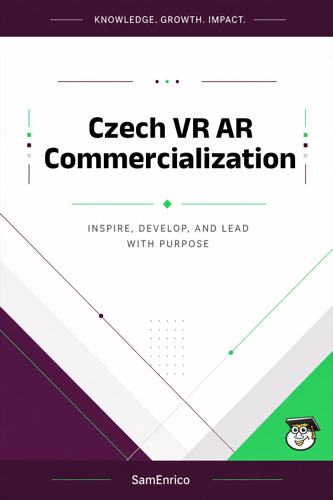
Non-FictionForecast & OutlookExtended Reality
Czech VR AR Commercialization eBook
Projects enterprise applications in training, desi
by Spain Mallie
Projects enterprise applications in training, design, and tourism.
Formats
Free sample
Chapter 1: The Goldilocks Advantage...--–- The conference room at Czech Invest’s Prague headquarters smelled of fresh coffee and ambition. Thirty-two people—founders, engineers, and a few brave investors—had gathered for the agency’s quarterly XR demo day. On the screen, a young entrepreneur from Brno was showing a VR simulation of a nuclear reactor control room. “We’ve reduced training time for ČEZ technicians by forty percent,” she said, clicking through her slides. “And our error rate during simulated emergencies is down to nearly zero.”The audience nodded.
They had seen similar pitches before. But then she added something that made everyone sit up: “We did this without a single hardware prototype. The nuclear regulator accepted our VR validation data as part of the certification process.”That was the moment when the room understood that Czech VR and AR had stopped being a curiosity and started being a business.This book is about how that happened—and how you can do it too. But before we dive into the tactics, the case studies, and the spreadsheets, we need to understand one fundamental question: Why the Czech Republic? Why not Germany, with its deeper pockets?
Why not Poland, with its larger market? Why not the United States, with its venture capital firehose?The answer lies in what I call the Goldilocks Advantage—a rare convergence of conditions that makes this small Central European nation one of the most fertile testing grounds for enterprise XR commercialization on the continent. Not too big, not too small. Not too early, not too late. Just right.The Three Forces Shaping Czech XREvery successful technology ecosystem rests on three pillars: demand, supply, and infrastructure.
The Czech Republic has all three, but not in the way you might expect. The demand isn’t coming from tech startups or consumer gadget enthusiasts. It’s coming from old-economy industries—manufacturing, energy, healthcare, and construction—that are desperate to solve real, painful, expensive problems. The supply comes from a deep bench of engineers, game developers, and technical artists who cut their teeth on PC gaming and industrial simulation. And the infrastructure—from private 5G networks to government grant programs—is being built specifically to enable enterprise adoption, not consumer entertainment.Let me walk you through each of these forces in detail, because understanding them is the difference between launching a product that finds product-market fit and building a demo that never leaves your hard drive.Force One: The Industry 4.0 Imperative Walk onto any factory floor in the Czech Republic—say, Škoda Auto’s plant in Mladá Boleslav or the Siemens facility in Prague—and you’ll see a generation of machinery that was state-of-the-art when it was installed twenty years ago.
The problem isn’t the machines themselves; they still run fine. The problem is the people who know how to operate, maintain, and repair them are retiring. Fast.The Czech Republic has one of the fastest-aging workforces in Europe. According to Czech Statistical Office data, nearly thirty percent of industrial workers are over fifty-five years old. Over the next decade, hundreds of thousands of skilled technicians, engineers, and operators will walk out the factory gates for the last time.
And the young workers replacing them? They grew up with smartphones, You Tube tutorials, and video games. They don’t learn from three-ring binders and faded wall charts. They learn from screens, from interaction, from doing.This is where VR and AR enter the picture. A young technician at ČEZ Temelín—Europe’s largest nuclear power plant—doesn’t need to memorize a six-hundred-page maintenance manual.
She needs to put on a pair of AR glasses, look at a valve, and see step-by-step instructions overlaid on the real equipment. She needs to practice emergency procedures in a VR simulation where mistakes cost nothing but teach everything. She needs to learn by doing, not by reading.The numbers bear this out. A 2023 study by the Czech Manufacturing Association found that companies using VR for technical training reduced onboarding time by an average of fifty-three percent. More importantly, error rates in high-consequence tasks—the kind that can shut down a production line or, worse, cause an accident—dropped by seventy-eight percent.
When you’re operating a nuclear reactor or an automotive assembly line, that’s not just efficiency. That’s survival.But training is just the beginning. The same AR glasses that guide a technician through a repair can also stream live video to a senior engineer working from home, enabling remote collaboration. The same digital twin that helps a trainee practice a procedure can also be used to simulate production line changes before a single conveyor belt is moved. The same VR environment that onboards a new hire can become a collaborative design review space where engineers from Prague, Brno, and Ostrava meet without leaving their desks.The Czech manufacturing and energy sectors are not experimenting with XR because it’s cool.
They are adopting it because they have no choice. The skills gap is a crisis. The cost of error is astronomical. And traditional training methods—classrooms, manuals, videos—are failing to prepare the next generation of workers.This creates an extraordinary opportunity for XR entrepreneurs. Unlike consumer markets, where you have to convince people they want something they’ve never heard of, enterprise customers in these sectors are already searching for solutions.
They have budgets. They have problems. They have timelines. And they are desperate for vendors who can deliver.Force Two: The Demographic Driver in Healthcare If manufacturing is the burning platform for industrial XR, healthcare is the quiet earthquake. The Czech Republic’s population, like most of Europe, is aging rapidly.
The number of people over sixty-five is projected to grow by forty percent over the next fifteen years. At the same time, the healthcare workforce is shrinking. Nurses are burning out. Geriatric specialists are retiring. And the country’s famed spa towns—Karlovy Vary, Mariánské Lázně, Františkovy Lázně—are struggling to attract younger clients.Enter VR and AR, not as gimmicks but as genuine therapeutic and assistive tools.Consider the case of elderly isolation.
When seniors enter long-term care facilities, they often lose connection to the world outside. Family visits become less frequent. Mobility declines. The world shrinks to the size of a bedroom and a dining hall. Depression and cognitive decline follow.
Traditional interventions—group activities, television, even pets—help, but they don’t solve the underlying problem: the loss of agency, autonomy, and meaningful experience.VR offers something different. A senior in a care facility can put on a headset and, for thirty minutes, walk through the streets of the town where she grew up. She can sit by a virtual lake and hear the sounds of water and birds. She can visit a museum she’s never been able to afford to travel to. These are not distractions.
They are genuine experiences that activate memory, emotion, and engagement.The Czech company Kaleido (which we’ll explore in depth later) proved this model at scale. Working with dozens of care facilities across the country, they demonstrated that regular VR sessions reduced symptoms of depression by thirty-two percent and…
This is the end of the free sample. Get the eBook to keep going. Buy now
About this book
Details
- Author
- Spain Mallie
- Publisher
- SamEnrico
- Language
- English
- Genre
- Non-Fiction, Forecast & Outlook, Extended Reality
- Released
- 2026-06-08
- Pages (approx.)
- 155
- Available as
- eBook, Audiobook

Read better in the ZLOADR app
Your eBooks on your phone or tablet. Sign in with your SamEnrico account and start reading.
More by Spain Mallie
 The Beginner's Art of StoppingSpain Mallie$11.99
 Recall Legal Precedent DigestSpain Mallie$11.99
 British Retribution after MutinySpain Mallie$11.99
 Body Function Focus GuideSpain Mallie$11.99
 Ukrainian Border CrossingSpain Mallie$11.99
 Fat Adaptation Insulin GuideSpain Mallie$11.99
 Eric GarcettiSpain Mallie$11.99
 Baba Yaga's Forbidden Forest: The Witch Who Walks on BonesSpain Mallie$11.99
 The Queen’s Last Stand: How Princess Margaret’s Divorce Shook the MonarchySpain Mallie$11.99
 The Great Milkshake Strike: How a 1974 Boycott Reshaped Fast FoodSpain Mallie$11.99
 Understanding Acute Intermittent PorphyriaSpain Mallie$17.99
 The Complete Guide to the Cultural Diversity DietSpain Mallie$11.99
You may also like
 Hong Kong Handover 1997Dunn Johnnie$11.99
 Zumba For Postnatal Recovery CourseNeal Christian$11.99
 Zumba for BeginnersLadner Nikia$11.99
 YouTube Comment Mining GuideHumes Pandora$12.99
 Worry Box MeditationCarlin Rudy$11.99
 Workplace Stress MeditationNguyen Lynn$11.99
 Workplace Stress and Sleep RepairHawley Ivory$11.99
 Workplace Perfectionism CureDelaney Jeffry$11.99
 Workplace Injustice Anger GuideWallen Isabelle$11.99
 Work Addiction and Burnout LinkGreenwood Ester$11.99
 Women in Yoga and WellnessBeattie Galina$11.99
 Women in Stand Up ComedyChun Evangeline$11.99