
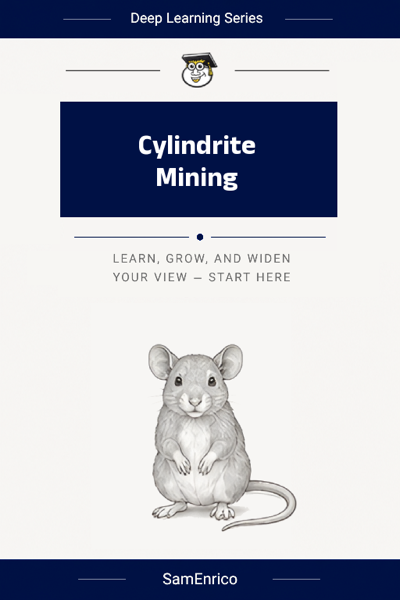
Non-FictionInformativeEducational
Cylindrite Mining
A Coursebook on Cylindrite Mining
A Coursebook on Cylindrite Mining
Formats
About this book
Free sample
Chapter 1: The Rolling Stone--It begins, as so many geological mysteries do, with a man who did not know what he had found.The year is 1893. The place is the Santa Cruz Mine, a modest silver-tin operation clawed into the eastern flank of the Bolivian Andes at an elevation of 4,200 meters—thin air, bitter nights, and rock so hard it dulls drill bits in minutes. The miner's name is recorded in no history book, but we know he was local, likely Quechua, likely illiterate, and certainly bewildered by what tumbled out of a narrow vein that afternoon.It looked like a handful of lead-grey tubes, no larger than cigarette butts, each one strangely curled into itself like a miniature scroll of metal. Some were complete rings, delicate as washers from a machine shop that had never existed in 19th-century Bolivia. Others were partial spirals, as if the rock had tried to roll itself up and then frozen mid-curl.
The miner turned them over in his calloused palm. They were heavy—far heavier than the cassiterite (tin oxide) he usually extracted. They gleamed with a dull metallic luster that caught the feeble light of his tallow candle. He had never seen anything like them.Neither had anyone else.The specimens made their way up the colonial chain of extraction: from the miner to the mine captain, from the captain to the Spanish-born owner, from the owner to a traveling French mineral dealer named Auguste Guyard. Guyard had a keen eye for the strange and the salable.
He recognized immediately that these were not ordinary sulfides. He packed the best specimens in cotton wool, shipped them across the Atlantic to Paris, and delivered them to the mineralogical laboratory of the Sorbonne.There, the tubes sat on a wooden desk, under the gaze of Professor François Ernest Mallard, one of the most accomplished crystallographers of his generation. Mallard picked up his goniometer—an instrument for measuring crystal angles—and began to work. He expected to find angles. All crystals have angles.
That is what "crystal" means: a solid whose atoms are arranged in a repeating, ordered, three-dimensional lattice. That lattice expresses…
This is the end of the free sample. Get the eBook to keep going. Buy now
Contents
- Chapter 1
- Chapter 2
- Chapter 3
- Chapter 4
- Chapter 5
- Chapter 6
- Chapter 7
- Chapter 8
- Chapter 9
- Chapter 10
- Chapter 11
- Chapter 12
Details
- Author
- Rawlins Celine
- Publisher
- SamEnrico
- Language
- English
- Genre
- Non-Fiction, Informative, Educational
- Released
- 2026-05-23
- Pages (approx.)
- 159
- Available as
- eBook, Audiobook

Read better in the ZLOADR app
Your eBooks on your phone or tablet. Sign in with your SamEnrico account and start reading.
More by Rawlins Celine
 Listening For Hearing ImpairedRawlins Celine$11.99
 Peer Support For MATRawlins Celine$11.99
 No Spend Month JournalRawlins Celine$11.99
 Meth Tooth RemineralizationRawlins Celine$11.99
 The Last Breath of AtlantisRawlins Celine$11.99
 AI Customer Service Agent ManagementRawlins Celine$12.99
 Learn to Play the RecorderRawlins Celine$11.99
 How to Start a Fish and Marine Mammal Oil Extraction Business (Beginners Guide)Rawlins Celine$11.99
You may also like
 Hong Kong Handover 1997Dunn Johnnie$11.99
 Zumba For Postnatal Recovery CourseNeal Christian$11.99
 Zumba for BeginnersLadner Nikia$11.99
 YouTube Comment Mining GuideHumes Pandora$12.99
 Worry Box MeditationCarlin Rudy$11.99
 Workplace Stress MeditationNguyen Lynn$11.99
 Workplace Stress and Sleep RepairHawley Ivory$11.99
 Workplace Perfectionism CureDelaney Jeffry$11.99
 Workplace Injustice Anger GuideWallen Isabelle$11.99
 Work Addiction and Burnout LinkGreenwood Ester$11.99
 Women in Yoga and WellnessBeattie Galina$11.99
 Women in Stand Up ComedyChun Evangeline$11.99