
Non-FictionSelf-HelpCycling Psychology
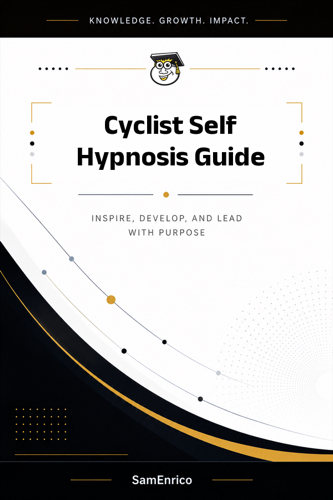
Cyclist Self Hypnosis Guide eBook
Use trance to manage pain and maintain power on lo
by Knox Sheena
Use trance to manage pain and maintain power on long climbs with this workbook.
Formats
Free sample
Chapter 1: The Crack Before The Climb--Every cyclist remembers the exact moment they first cracked on a climb. Not the physical fatigue that comes after hours in the saddle—that’s expected, almost welcomed as proof of effort. No, the crack is something else entirely. It’s the moment your mind eases off the pedals three full seconds before your legs had any intention of stopping. It’s the sudden, inexplicable shift to an easier gear when you know—you know—you could have held the bigger one for another minute, maybe two.
It’s the voice that whispers, not shouted, “This is too much,” and somehow that whisper overrides every muscle fiber screaming, “We can do this.”You’ve felt it. Every climber has. It happens on the steep ramp of a local favorite, on the false flat that somehow feels steeper than the pitch before it, on the lower slopes of a mountain you’ve conquered dozens of times. One moment you’re in the rhythm—breath, stroke, breath, stroke—and the next, something shifts. The gradient hasn’t changed.
Your power meter reads the same number it did thirty seconds ago. Your heart rate hasn’t spiked. But something inside you has decided, without your permission, that continuing at this intensity is no longer possible.That decision wasn’t made by your legs. It wasn’t made by your lungs or your heart or the accumulation of lactate in your quadriceps. It was made by a part of your mind you didn’t even know was voting.This book exists because that moment—the crack before the climb truly gets hard—is the single greatest performance limiter in endurance cycling.
It is not fitness. It is not nutrition. It is not hydration, bike fit, or the weight of your frame. It is the unconscious decision to stop trying before your body has any legitimate reason to stop. And the most frustrating part?
You don’t even realize it’s happening until after it’s over, when you’re spinning an easier gear, wondering why you gave up so early, promising yourself you won’t do it again on the next climb.Then you do it again. Because willpower is not the solution. Grit is not the solution. “Digging deeper” is not the solution. The solution lies in understanding that your mind is already producing the states you need—focus, endurance, pain tolerance, flow—but your conscious awareness has been locked out of the control room.
This chapter begins the process of unlocking that door.The Anatomy of a Crack: What Actually Happens Let’s slow down time for a moment and examine what happens in the sixty seconds before a cyclist cracks on a climb. You’re ten minutes into a fifteen-minute effort. The gradient is steady at seven percent. Your cadence is holding at ninety revolutions per minute. Your breathing is deep but not panicked.
By every objective measure, you are sustaining the effort successfully.Then you notice something. A sensation in your thighs that wasn’t there a minute ago. It’s not pain, exactly—more like a deepening pressure, a sense that your muscles are working harder than they were. Your brain, ever the pattern-matching machine, scans its memory banks for similar sensations. It finds them: every previous time you felt this specific sensation, you were approaching the limit of your sustainable effort.
Your brain flags this as a warning.Now here’s the crucial part. That warning is not a command. It is a suggestion. But because you have never learned to distinguish between data and directive, you treat the warning as if it were already a fait accompli. You believe that because you feel like you’re approaching your limit, you must be approaching your limit.
And so you ease off. You shift down. You sit up slightly. You stop pushing.The crack is not the moment your body fails. The crack is the moment your mind interprets a neutral sensation as a signal to stop.This is not weakness.
This is not a character flaw. This is how the human nervous system evolved to operate. Your brain’s primary job is not to help you set personal records on Alpe d’Huez. Its primary job is to keep you alive, and it does so by erring on the side of caution. A sensation that might indicate danger is treated as if it does indicate danger.
This survival mechanism has kept our species alive for hundreds of thousands of years. Unfortunately, it is disastrously mis-calibrated for the demands of a long climb where the “danger” is simply the discomfort of sustained effort.The good news—and the entire premise of this book—is that this interpretation is not fixed. It is learned. And what is learned can be unlearned. The neural pathways that currently link “sensation of effort” to “command to stop” can be weakened.
New pathways can be built. And the tool for building them is not positive thinking or motivational speeches or “mind over matter” slogans. The tool is self-hypnosis.Why This Book Is Different From Every Other Cycling Psychology Book You may have read books about the mental side of cycling before. Many of them are excellent. They teach visualization, goal-setting, pre-ride routines, and the importance of positive self-talk.
These are valuable skills. But they share a common limitation: they operate at the level of conscious thought, and the crack happens below that level.By the time you consciously think, “I’m feeling some fatigue here,” the unconscious decision to ease off has already been made—or is in the process of being made. Conscious self-talk is too slow. It arrives after the vote has already been cast.Self-hypnosis works differently. It operates directly on the unconscious processes that govern perception, attention, and automatic behavior.
It does not require you to argue with yourself or convince yourself of anything. It bypasses the debating society in your head and speaks directly to the parts of your nervous system that decide, in real time, whether a sensation is interpreted as “productive discomfort” or “unacceptable suffering.”This is not magic. It is neurology. The same mechanisms that allow a hypnotized person to experience a cold cloth as a burning heat or to lift an arm that feels impossibly heavy are the mechanisms you will learn to apply to climbing. You will learn to change the meaning of the sensations that arise during a long climb.
You will learn to gate pain signals before they reach conscious awareness. You will learn to dissociate from the suffering body or associate into it, depending on what the gradient demands. You will learn to distort time so that a thirty-minute climb feels like ten. And you will learn to do all of this while keeping your eyes open, your hands on the bars, and your attention exactly where it needs to be.This book is a workbook because these are not concepts to be understood intellectually. They are skills to be practiced.
Each chapter contains exercises designed to be completed on the bike, in the moments when the crack threatens to open beneath you. You will not…
This is the end of the free sample. Get the eBook to keep going. Buy now
About this book
Details
- Author
- Knox Sheena
- Publisher
- SamEnrico
- Language
- English
- Genre
- Non-Fiction, Self-Help, Cycling Psychology
- Released
- 2026-06-11
- Pages (approx.)
- 141
- Available as
- eBook, Audiobook

Read better in the ZLOADR app
Your eBooks on your phone or tablet. Sign in with your SamEnrico account and start reading.
More by Knox Sheena
 Caffeine Anger ManagementKnox Sheena$11.99
 Women Of French Revolution GuideKnox Sheena$11.99
 Diplomat International Crisis GuideKnox Sheena$11.99
 Creative Problem Solving LogKnox Sheena$11.99
 Russian Caviar SmugglingKnox Sheena$11.99
 Pet Loss For PrisonersKnox Sheena$11.99
 Senior Travel EsteemKnox Sheena$11.99
 Ignatius of Antioch BishopKnox Sheena$11.99
 The Preschooler Sleep SolutionsKnox Sheena$11.99
 The Assertive Email GuideKnox Sheena$11.99
 Set Point Theory ExplainedKnox Sheena$11.99
 CPR for Elderly PatientsKnox Sheena$11.99
You may also like
 Hong Kong Handover 1997Dunn Johnnie$11.99
 Zumba For Postnatal Recovery CourseNeal Christian$11.99
 Zumba for BeginnersLadner Nikia$11.99
 YouTube Comment Mining GuideHumes Pandora$12.99
 Worry Box MeditationCarlin Rudy$11.99
 Workplace Stress MeditationNguyen Lynn$11.99
 Workplace Stress and Sleep RepairHawley Ivory$11.99
 Workplace Perfectionism CureDelaney Jeffry$11.99
 Workplace Injustice Anger GuideWallen Isabelle$11.99
 Work Addiction and Burnout LinkGreenwood Ester$11.99
 Women in Yoga and WellnessBeattie Galina$11.99
 Women in Stand Up ComedyChun Evangeline$11.99