
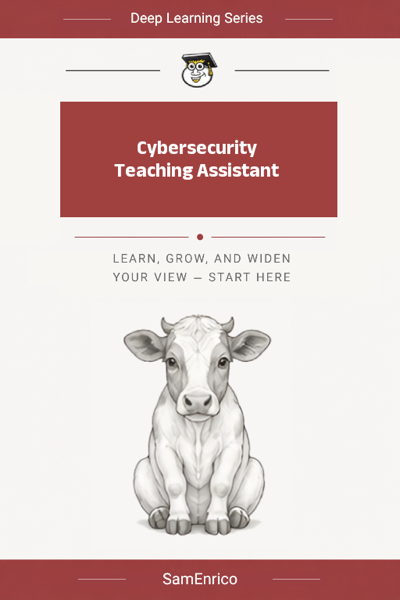
Non-FictionInformativeEducational
Cybersecurity Teaching Assistant eBook
A Coursebook on Cybersecurity Teaching Assistant
A Coursebook on Cybersecurity Teaching Assistant
Formats
Free sample
Chapter 1: The Bridge People…--You know how to execute a perfect ARP spoofing attack. You have John the Ripper cracking weak NTLM hashes in your sleep. You can recite the OSI model backwards, from Physical to Application, without missing a beat. You passed your Security+ exam with a score that made your professor nod approvingly. And now, standing in front of a classroom of thirty undergraduate students, you have achieved what feels like a new state of matter: completely, utterly, and visibly frozen.A student’s hand is raised.
Her name is Sarah, according to the seating chart you were given fifteen minutes ago. She looks genuinely confused, not bored, not defiant – confused. The kind of confusion that precedes either a breakthrough or a complete mental shutdown. Her laptop screen shows Virtual Box, and on that screen is an error message you have seen a hundred times before. You know what it means.
You know how to fix it in under thirty seconds. But Sarah is not the professor. She is not your lab partner from the graduate program. She is a sophomore who took this class because she heard cybersecurity pays well, and she is three weeks into the semester and already questioning every life choice that led her to this moment.She asks: “Why does my VM say ‘VT-x is disabled in BIOS’?”And you freeze.Welcome to the first day of the rest of your teaching life. Welcome to the role no certification exam prepares you for.
Welcome to being a cybersecurity teaching assistant.The Invisible Chasm Let us name the thing that just happened to you. It has a formal name in cognitive science, and once you know it, you will see it everywhere – in your own learning, in your students’ faces, in the way your professor sometimes assumes too much. It is called the Curse of Knowledge.The Curse of Knowledge is a cognitive bias that makes it nearly impossible for an expert to imagine what it is like to be a novice. Once you know something – really know it, at the level where it becomes invisible and automatic – you cannot unknow it. You cannot remember how hard it was to learn.
You cannot reconstruct the confusion, the false starts, the hours of feeling stupid while the pieces slowly clicked into place.For cybersecurity professionals, the Curse of Knowledge is practically an occupational hazard. You learned to type sudo without thinking about why you needed administrative privileges. You learned to read a Wireshark capture the way a musician reads sheet music – as a flow of meaning, not a jumble of symbols. But Sarah does not know any of this. She does not know that VT-x is Intel’s hardware virtualization technology.
She does not know that her laptop’s BIOS (Basic Input/Output System) is the low-level firmware that boots the computer before the operating system loads. She does not know that virtualization requires hardware support that some laptops ship with disabled by default. All she knows is that she followed the lab instructions exactly, and instead of a working Kali Linux desktop, she got an error message in a language she does not speak.And here is the truth that every cybersecurity TA must internalize on day one: that error message is not the problem. The problem is the chasm between what you know and what she knows. The error message is just the visible edge of that chasm.Your job is not to tell her how to fix VT-x.
Your job is to build a bridge.The Three Pillars of the Cybersecurity TAThe traditional teaching assistant model, inherited from humanities and social sciences, assumes that the TA’s primary role is administrative. You grade papers, you hold office hours, you take attendance, you run discussion sections. That model works reasonably well for subjects where the gap between expert and novice is narrow – where the material is primarily textual and the “lab” is a room full of people talking about books.Cybersecurity is not that kind of subject.Cybersecurity is a technical craft built on a foundation of systems thinking, network protocols, operating system internals, and a hundred other concepts that are invisible until you know how to see them. A cybersecurity TA must therefore play three distinct roles, often switching between them in the same conversation. I call these the Three Pillars.Pillar One: Technical Verification Technical Verification is the least glamorous and most essential pillar.
It answers one question: is the student’s environment working correctly? Before you can teach a student anything about cybersecurity, you must ensure that their tools are functioning.This sounds trivial until you have spent fifteen minutes trying to debug why a student’s ping command returns “Destination Host Unreachable” when every other student in the room has working connectivity. The problem is rarely the student’s understanding of ICMP. The problem is almost always the lab environment: the wrong network adapter in Virtual Box, a firewall rule left over from a previous exercise, a typo in an IP address, a virtual machine that was suspended instead of shut down cleanly.Technical Verification requires a specific kind of knowledge. You do not need to know everything about networking.
You need to know the five most common things that break in your specific lab environment, and you need to know how to check each one in under thirty seconds. You need a mental checklist that you can run through while standing over a student’s shoulder. And you need the discipline to run that checklist before you start explaining concepts.Because here is the trap that catches every new TA: when a student asks a question, your brain immediately jumps to the conceptual answer. Sarah asks about VT-x, and your brain starts explaining hardware virtualization. But she does not need an explanation.
She needs someone to tell her to reboot her laptop, press F2 or F10 or whatever key her manufacturer uses to enter the BIOS setup, find the virtualization settings, and enable them. That is Technical Verification. That is the bridge.Pillar Two: Pedagogical Translation Pedagogical Translation is the art of converting expert language into novice language without losing meaning. It is harder than it sounds. Experts speak in abstractions and shortcuts because those abstractions and shortcuts are efficient for communication between peers.
To a novice, they sound like gibberish.Consider the phrase “authentication bypass vulnerability.” To an expert, that is a clear category of security flaw with well-defined characteristics. To a novice, it is four words that sort of make sense individually but combine into nothing. The TA’s job is to translate: “Imagine a locked door that requires a key. An authentication bypass is like discovering that the lock works fine, but the hinges are on the outside. You never need the key.
You just lift the door off its hinges.” That is translation.Translation requires empathy. It requires remembering what it felt like to not know. And it requires a willingness to abandon your favorite technical metaphors when they fail. The Lockbox Analogy for encryption? Some students will get it immediately.
Others will need the Mailbox Analogy. Others will need the Clubhouse Handshake Analogy. The TA who only has one analogy…
This is the end of the free sample. Get the eBook to keep going. Buy now
About this book
Details
- Author
- Weller Kathrin
- Publisher
- SamEnrico
- Language
- English
- Genre
- Non-Fiction, Informative, Educational
- Released
- 2026-05-09
- Pages (approx.)
- 142
- Available as
- eBook, Audiobook

Read better in the ZLOADR app
Your eBooks on your phone or tablet. Sign in with your SamEnrico account and start reading.
More by Weller Kathrin
 Parent Suicide Loss GuideWeller Kathrin$11.99
 Global Talent Migration Data SourcesWeller Kathrin$11.99
 Legacy Family Stories GuideWeller Kathrin$11.99
 The Raffaele Sollecito Separate PathWeller Kathrin$11.99
 Somatic Experiencing Worth ProtocolWeller Kathrin$11.99
 The Poisoned Chalice: How Counterfeit Wine Toppled a DynastyWeller Kathrin$11.99
 Real Estate Insurance OutlookWeller Kathrin$12.99
 One Page Marketing Dashboard WorkbookWeller Kathrin$12.99
 Understanding Leukodystrophy, MetachromaticWeller Kathrin$17.99
 How to Become a Coke-crusher OperatorWeller Kathrin$11.99
You may also like
 Hong Kong Handover 1997Dunn Johnnie$11.99
 Zumba For Postnatal Recovery CourseNeal Christian$11.99
 Zumba for BeginnersLadner Nikia$11.99
 YouTube Comment Mining GuideHumes Pandora$12.99
 Worry Box MeditationCarlin Rudy$11.99
 Workplace Stress MeditationNguyen Lynn$11.99
 Workplace Stress and Sleep RepairHawley Ivory$11.99
 Workplace Perfectionism CureDelaney Jeffry$11.99
 Workplace Injustice Anger GuideWallen Isabelle$11.99
 Work Addiction and Burnout LinkGreenwood Ester$11.99
 Women in Yoga and WellnessBeattie Galina$11.99
 Women in Stand Up ComedyChun Evangeline$11.99