
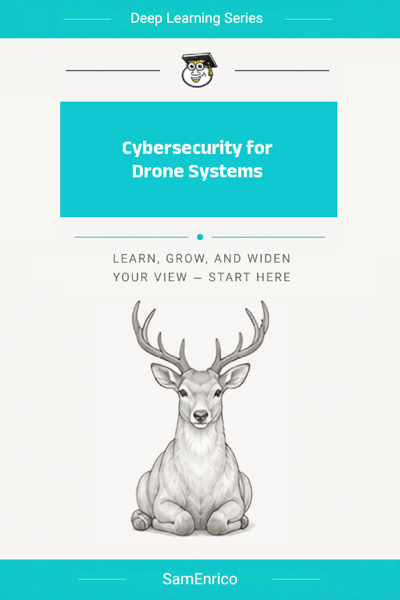
Non-FictionInformativeEducational
Cybersecurity for Drone Systems eBook
A Coursebook on Cybersecurity for Drone Systems
by Utley Isaias
A Coursebook on Cybersecurity for Drone Systems
Formats
Free sample
Chapter 1: The Stolen Sentinel...-- The year is 2011. A sleek, bat-winged drone the size of a small jet glides silently over the mountains of eastern Iran. It is an RQ-170 Sentinel, the crown jewel of the United States Air Force's stealth unmanned fleet—a $6 billion secret designed to penetrate the most sophisticated air defenses on the planet. From its perch 50,000 feet above the earth, it scans, listens, and records, transmitting terabytes of intelligence back to operators in Nevada. Those operators sit in dark rooms, sipping coffee, watching screens that stream live video and telemetry.
They believe they are untouchable.They are wrong.Some 500 miles away, inside a nondescript building, an Iranian cyber team does something that is supposed to be impossible. They do not fire a missile. They do not scramble fighter jets. Instead, they deploy a piece of software defined radio hardware that costs less than $1,000. They begin transmitting a fake GPS signal—a ghost constellation of satellites that does not exist.
The Sentinel's onboard navigation system, trusting the strongest signal it receives, slowly, imperceptibly, begins to believe it is somewhere else. It thinks it is flying over Afghanistan. It is actually descending into Iranian territory.The operators in Nevada watch in horror as their aircraft, their $6 billion crown jewel, begins to turn east. They send override commands. Nothing.
They cycle the power. Nothing. They watch the telemetry spiral downward, then go dark. Thirty minutes later, Iranian state television broadcasts footage of the nearly intact drone, its stealth coating gleaming under the floodlights of a hangar. The Americans call it a malfunction.
The Iranians call it a gift.The era of the unassailable drone ended that day.The Quiet Proliferation: How Drones Became Ubiquitous and Ungoverned That story is not an outlier. It is a warning shot that almost nobody heeded. In the years since 2011, drones have exploded from a niche military tool into a global phenomenon touching nearly every sector of human activity. Walk into any consumer electronics store, and for a few hundred dollars, you can buy a quadcopter that streams high-definition video to your smartphone. Visit a farm in Iowa, and you will see drones mapping crop health, spraying fertilizer, and counting livestock.
Drive past a construction site, and a drone is likely orbiting overhead, tracking progress with millimeter precision. Order a package from Amazon in select test markets, and a drone may deliver it to your backyard. In Ukraine, commercial drones retrofitted with grenades have changed the nature of modern warfare. In Myanmar, drones have been used for surveillance against ethnic minorities. In your own neighborhood, a teenager may be flying one just for the joy of it.This proliferation has happened with breathtaking speed.
According to the Federal Aviation Administration, there were fewer than 500,000 registered drones in the United States in 2015. By 2025, that number exceeds 1.7 million, and that accounts only for registered aircraft—the actual number, including sub-250-gram drones that require no registration, is likely over 5 million globally. The industry is projected to grow to over $40 billion annually by the end of the decade. Drones inspect power lines, survey disaster zones, deliver medicine to remote clinics, fight fires, and film Hollywood blockbusters.But there is a dark underbelly to this explosion. For every legitimate use, there is a potential for exploitation.
And at the heart of that exploitation lies a single, uncomfortable truth: the vast majority of drones flying today have the cybersecurity posture of a smart toaster from 2015. They are designed to be cheap, lightweight, and easy to use. Security is an afterthought—if it is thought of at all.The Security Gap: Why Drones Are Different from Your Laptop You might reasonably ask: why is drone security any different from securing a laptop, a server, or a smartphone? After all, cybersecurity is a mature field. We have firewalls, intrusion detection systems, encryption standards, and incident response plans.
Surely, these same tools apply to flying robots?They do not. Or rather, they do, but with critical, life-and-death differences that make drone security a fundamentally distinct discipline.First difference: physical consequences. When your laptop gets hacked, you lose data. Maybe your credit card numbers are stolen. Maybe embarrassing emails are leaked.
It is stressful, invasive, and costly. But nobody dies. When a drone gets hacked, the consequences are physical. A compromised drone can crash into a crowd, drop its payload on a school, or be weaponized by an adversary. The 2011 Sentinel did not just leak secrets—it physically landed in enemy hands, giving Iran a blueprint for American stealth technology.
A delivery drone hacked mid-flight could be redirected into a hospital. A police surveillance drone could be turned into a flying listening device against the very citizens it is meant to protect. This is not information security. This is cyber-physical security, where digital bits control physical atoms, and the atoms can kill.Second difference: the patch problem. When a vulnerability is discovered in your operating system, you download an update, restart your computer, and move on.
When a vulnerability is discovered in a drone's firmware, the drone is likely airborne, inaccessible, or spread across a continent. How do you patch a thousand drones in flight? How do you update a drone that is delivering medicine over the Amazon rainforest with no internet connection? The answer: often, you cannot. Many drones have no mechanism for secure over-the-air updates at all.
If a vulnerability is found, the drone must be physically recalled—an expensive, impractical solution that means most drones simply remain vulnerable forever.Third difference: the insecure-by-design reality. Traditional IT security has benefited from decades of standards, audits, and best practices. Drones, by contrast, are a Wild West. Many manufacturers prioritize time-to-market and cost over security. The result is drones that transmit unencrypted telemetry, accept unsigned firmware updates, and use default passwords.
A 2020 study by the University of Texas at Austin tested 16 popular commercial drones and found that every single one was vulnerable to GPS spoofing. Every single one. Some of these drones cost thousands of dollars and were marketed to law enforcement and critical infrastructure operators. They could all be hijacked with a $300 device purchased on e Bay.Fourth difference: the air gap is a myth. In traditional IT, there is a concept called the "air gap"—a computer that is physically disconnected from any network, making it theoretically unhackable.
Drones have no such luxury. To function, a drone must communicate. It receives commands from its ground control station. It transmits telemetry and video. It listens for GPS satellites.
It may communicate with other drones in a swarm or with cellular towers. Every single one of these communication channels is a potential attack surface. The drone is, by its very nature, exposed. There is no way to air-gap a flying object that must receive real-time instructions from a human operator on the ground.The Kill Chain in the Sky: A New Model for a New Threat To understand how to defend drones, you must first understand how attackers think. In traditional cybersecurity, the Lockheed Martin Cyber Kill Chain is a classic framework: reconnaissance, weaponization, delivery, exploitation, installation, command and control, actions on objectives.
It describes the steps an attacker takes to breach a network.Drone security requires a modified version of this chain—one that…
This is the end of the free sample. Get the eBook to keep going. Buy now
About this book
Details
- Author
- Utley Isaias
- Publisher
- SamEnrico
- Language
- English
- Genre
- Non-Fiction, Informative, Educational
- Released
- 2026-06-02
- Pages (approx.)
- 120
- Available as
- eBook, Audiobook

Read better in the ZLOADR app
Your eBooks on your phone or tablet. Sign in with your SamEnrico account and start reading.
More by Utley Isaias
 Sarcoma Survivor MemoirUtley Isaias$11.99
 Migraine and Bright Light SensitivityUtley Isaias$11.99
 Refocus Speed TrainingUtley Isaias$11.99
 The Stress and Fibromyalgia GuideUtley Isaias$11.99
 Vitamin C Immune Boosting GuideUtley Isaias$11.99
 NVC for Graduate StudentsUtley Isaias$11.99
 Justin Timberlake FutureUtley Isaias$11.99
 Food Addiction and PregnancyUtley Isaias$11.99
 Blue Zone Manual ToolsUtley Isaias$11.99
 Paper Son: The Forgotten Children of Angel IslandUtley Isaias$11.99
 The Poet Who Defied Kings: The Life and Legacy of Al-MutanabbiUtley Isaias$11.99
 Tangaroa's Wrath: The Great Wave That Swallowed IslandsUtley Isaias$11.99
You may also like
 Hong Kong Handover 1997Dunn Johnnie$11.99
 Zumba For Postnatal Recovery CourseNeal Christian$11.99
 Zumba for BeginnersLadner Nikia$11.99
 YouTube Comment Mining GuideHumes Pandora$12.99
 Worry Box MeditationCarlin Rudy$11.99
 Workplace Stress MeditationNguyen Lynn$11.99
 Workplace Stress and Sleep RepairHawley Ivory$11.99
 Workplace Perfectionism CureDelaney Jeffry$11.99
 Workplace Injustice Anger GuideWallen Isabelle$11.99
 Work Addiction and Burnout LinkGreenwood Ester$11.99
 Women in Yoga and WellnessBeattie Galina$11.99
 Women in Stand Up ComedyChun Evangeline$11.99