
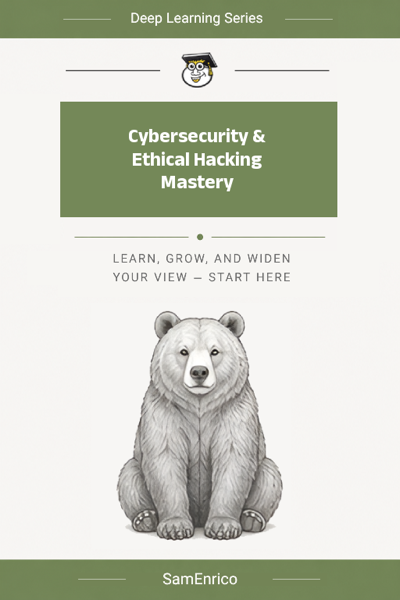
Non-FictionInformativeEducational
Cybersecurity & Ethical Hacking Mastery eBook
A Coursebook on Cybersecurity & Ethical Hacking Ma
by Robins Loise
A Coursebook on Cybersecurity & Ethical Hacking Mastery
Formats
Free sample
Chapter 1: The Mind’s Horizon--–- The first time I watched someone surrender their digital identity without a single password being stolen, I realized cybersecurity had almost nothing to do with computers. It was a Tuesday afternoon in a crowded coffee shop. A young woman in a company jacket answered her phone, listened for ten seconds, then typed her corporate credentials into a website she had just been told to visit. The voice on the phone claimed to be from IT support. It was not.
The website was a clone. And in that moment, twelve years of security training, three firewalls, and an expensive intrusion detection system became irrelevant. The breach did not happen because of a zero-day vulnerability or a sophisticated exploit. It happened because a human being trusted the wrong voice.This is the uncomfortable truth that most cybersecurity books bury under chapters about encryption algorithms and network architectures: the weakest link in any system is not the software. It is the person using it.
And the strongest link is not the firewall. It is the person who hesitates before clicking. Chapter 1 is not about technology. It is about the human operating the technology. Before you learn to scan ports, crack hashes, or write exploits, you must understand why attackers target psychology over code, how to recognize your own cognitive blind spots, and what separates a security professional from a cybercriminal.
This chapter is your foundation. Without it, every technical skill you acquire is a tool without a compass.Most people imagine hacking as a purely technical pursuit. They picture lines of green code scrolling down a black screen, a hooded figure typing furiously, a zero-day exploit chain of breathtaking complexity. That image is not entirely false—those things exist. But they are rare.
The vast majority of successful breaches do not require technical sophistication. They require understanding how people think, how organizations operate, and how trust can be weaponized. The Colonial Pipeline attack succeeded because a VPN account lacked multi-factor authentication and a password had been reused. The Twitter Bitcoin scam succeeded because an employee answered a phone call. The Uber breach succeeded because an attacker sent repeated push notifications until someone accepted.
These are not failures of technology. They are failures of psychology.Let me be direct with you. By the end of this book, you will possess knowledge that could cause real harm. You will know how to discover passwords, intercept communications, and gain unauthorized access to systems. That knowledge comes with a burden of responsibility.
This first chapter draws a line in the sand: ethical hackers use their skills to protect; criminals use them to exploit. The difference is not technical ability. It is the content of your character and the clarity of your consent. Every lab in this book is designed for isolated virtual environments that you control. Pointing these tools at a real system without written permission is a crime.
Treat this knowledge with the seriousness it deserves.The Architecture of Human Trust Trust is the currency of civilization. Without it, commerce stops, relationships fracture, and societies collapse. But trust is also the single most exploitable feature of human psychology. Attackers do not need to break your encryption if they can convince you to decrypt the data yourself. They do not need to bypass your firewall if they can convince you to open a door.Let us examine six psychological principles that attackers weaponize daily.
These are not abstract theories. They are levers that have been used in real breaches, and understanding them is your first line of defense.Authority bias is the tendency to comply with requests from perceived authority figures. When someone calls claiming to be from IT support, the IRS, a bank's fraud department, or the CEO's office, most people's brains shift into automatic compliance mode. The attacker does not need to sound convincing. They need to sound confident.
The MGM Resorts attack in 2023 succeeded because a caller claimed to be an employee who had lost access to their account. The help desk agent, trained to be helpful, reset the credentials without verifying identity. Authority bias turned a security control into a vulnerability.Urgency short-circuits rational decision-making. When a message says "Your account will be suspended in 24 hours," or "Unauthorized login detected—verify immediately," the brain's threat response overrides careful analysis. Attackers create artificial urgency because they know that a calm, skeptical person is their worst enemy.
Phishing emails that create panic have click rates three to five times higher than neutral messages.Liking is the principle that people say yes to people they like. Attackers spend days building rapport on Linked In, engaging with social media posts, and finding common interests. By the time they make a request, the target sees them as a friendly colleague rather than a potential threat. The Twitter Bitcoin scam of 2020 began with an attacker who called Twitter employees multiple times, building familiarity until one employee finally complied.Reciprocity creates indebtedness. If someone does you a favor, you feel obligated to return it.
Attackers send small gifts—free USB drives, coffee gift cards, helpful PDFs—before making a request. The target unconsciously thinks, "They were nice to me. I should help them." This is why spear-phishing campaigns often send benign emails before weaponized attachments.Social proof leverages the human tendency to follow the crowd. "Eighty-four employees have already updated their credentials," or "Your colleagues in accounting have already completed this survey." When people believe others have taken an action, they are far more likely to take it themselves without independent verification.Scarcity creates fear of missing out. "Only ten licenses remain," "Your link expires in one hour." Scarcity bypasses rational analysis by triggering loss aversion—people fear losing an opportunity more than they desire gaining something.Now combine these principles into a single phishing email.
"From: IT Security [authority]. We are migrating to a new authentication system [urgency]. 1,420 employees have already completed the migration [social proof]. Please use the link below before 5 PM today to avoid service interruption [scarcity, urgency]. Thank you for your cooperation [reciprocity implied]." That email will get clicks from otherwise intelligent, trained employees.
The psychology is not subtle. It is effective.The Threat Actor Taxonomy: Know Your Enemy Before you can defend against attackers, you must understand who they are and what they want. Threat actors are not a monolith. They have different resources, different motivations, and different behaviors. Treating them as identical leads to defensive strategies that fail against everyone.Nation-state actors are government-funded groups.
Russian GRU units (Sandworm, Fancy Bear), Chinese groups (APT41, APT10), North Korea's Lazarus Group, Iran's APT35. They have nearly unlimited budgets, time measured in years, and objectives that include espionage, strategic positioning for future conflict, and occasionally disruption of critical infrastructure. They use zero-day vulnerabilities because they can afford to buy or develop them. They are patient. A nation-state might spend six months in reconnaissance before ever touching a target system.
Their attacks are silent, persistent, and devastating.Cybercriminal gangs operate as businesses. Groups like Conti, REvil, Dark Side, and Lock Bit have HR departments, affiliate programs, and even customer support for victims who need help paying ransoms. Their sole motivation is financial profit.…
This is the end of the free sample. Get the eBook to keep going. Buy now
About this book
Details
- Author
- Robins Loise
- Publisher
- SamEnrico
- Language
- English
- Genre
- Non-Fiction, Informative, Educational
- Released
- 2026-05-04
- Pages (approx.)
- 125
- Available as
- eBook, Audiobook

Read better in the ZLOADR app
Your eBooks on your phone or tablet. Sign in with your SamEnrico account and start reading.
More by Robins Loise
 Drug Dependency Support Group DirectoryRobins Loise$11.99
 Anapanasati for DepressionRobins Loise$11.99
 The Sponsorship RelationshipRobins Loise$11.99
 Self Hypnosis For Bowling PerformanceRobins Loise$11.99
 Freudian Dream JournalRobins Loise$11.99
 Caregiving for Parents HandbookRobins Loise$11.99
 Tunnel Driving MeditationRobins Loise$11.99
 The Foreclosure Survival GuideRobins Loise$11.99
 Kurdish Family ReunificationRobins Loise$11.99
 The TikTok Files: How the Algorithm Knows You Better Than You Know YourselfRobins Loise$11.99
 The Last Stand of Dara: Justinian's Bloodstained Gambit (540 AD)Robins Loise$11.99
 The Great Golf Ball Conspiracy: How a Rogue Engineer Rigged the GameRobins Loise$11.99
You may also like
 Hong Kong Handover 1997Dunn Johnnie$11.99
 Zumba For Postnatal Recovery CourseNeal Christian$11.99
 Zumba for BeginnersLadner Nikia$11.99
 YouTube Comment Mining GuideHumes Pandora$12.99
 Worry Box MeditationCarlin Rudy$11.99
 Workplace Stress MeditationNguyen Lynn$11.99
 Workplace Stress and Sleep RepairHawley Ivory$11.99
 Workplace Perfectionism CureDelaney Jeffry$11.99
 Workplace Injustice Anger GuideWallen Isabelle$11.99
 Work Addiction and Burnout LinkGreenwood Ester$11.99
 Women in Yoga and WellnessBeattie Galina$11.99
 Women in Stand Up ComedyChun Evangeline$11.99