
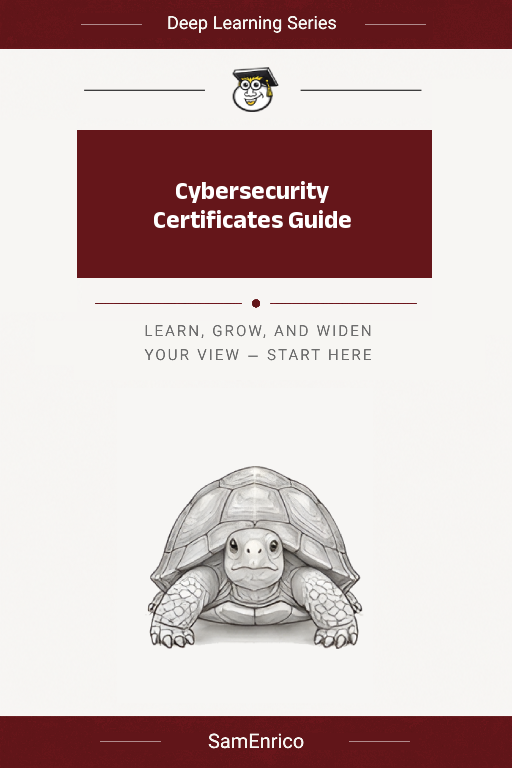
Cybersecurity Certificates Guide eBook
Complete Google, IBM, or University of Maryland Cy
Complete Google, IBM, or University of Maryland Cybersecurity certificates for SOC roles.
Formats
Free sample
Chapter 1: The Certificate Trap...--You have been lied to. Not maliciously, not with ill intent, but lied to nonetheless. The cheerful progress bars on Coursera, the congratulatory emails from Google and IBM, the digital badges you post on Linked In—they have all silently conspired to sell you a promise that no certificate alone can keep. The promise is this: complete our program, pass our assessments, and you will be ready for a career in cybersecurity.It is a beautiful lie. And it has created a generation of certificate-holders who can define the CIA Triad perfectly but cannot tell you which Windows Event ID indicates a successful logon.
They can explain the NIST framework academically but freeze when a real SIEM alert flashes red at 2 AM during a simulated incident response drill. They have invested hundreds of hours and thousands of dollars into credentials that hiring managers have learned to filter out of their applicant tracking systems with a single keyword exclusion rule.This book exists because the lie has a cure. And the cure is not another certificate.The Three Expensive Mistakes Before we map your path through the Google, IBM, and University of Maryland cybersecurity certificates, you must understand the three mistakes that keep certificate-holders unemployed or underemployed. These mistakes are not your fault. They are structural flaws in how online education markets itself to career-changers.
But they are yours to fix.Mistake One: The Confusion Between Knowledge and Skill Knowledge is knowing that a brute-force attack involves multiple failed login attempts followed by a success. Skill is opening a SIEM, writing the query that surfaces that exact pattern across ten thousand log entries in under sixty seconds, and documenting the finding in a ticket that a senior analyst can act upon.Every certificate you will encounter excels at delivering knowledge. The video lectures, the multiple-choice quizzes, the peer-reviewed assignments—they are optimized for the transmission of information. What they cannot do, by their very design, is simulate the stress, the ambiguity, and the tool-specific syntax of a live Security Operations Center. A multiple-choice question does not punish you for forgetting a semicolon.
A discussion forum post does not escalate into a breach if you click the wrong containment button.The result is a market flooded with knowledgeable candidates who cannot perform. Hiring managers report that less than 15 percent of applicants with entry-level certificates can pass a basic practical assessment involving a SIEM query or a packet capture analysis. The certificates taught you what to do. They did not teach you how.Mistake Two: The Vendor Lock-In Trap Google teaches Chronicle. IBM teaches QRadar.
The University of Maryland teaches theory that could apply to any platform but specifics that apply to none. None of them teach Splunk, which remains the market leader in SIEM deployments with over 47 percent market share according to the 2024 SANS SIEM Survey. None of them teach the universal query logic that would allow you to transfer your skills from one platform to another.This is not an accident. Vendor-specific certificates are designed to create loyalty to the vendor's ecosystem. Google wants you to believe that Chronicle is the future of SIEM.
IBM wants you to believe that QRadar is the gold standard. They are not lying—both products are excellent. But the average SOC analyst changes jobs every eighteen months, and the average SOC uses at least two different SIEM platforms in that time. If you have learned only one vendor's syntax, you are not portable. You are captive.The most successful SOC analysts are not the ones who know a single platform deeply.
They are the ones who understand the underlying logic that every SIEM shares—the search bar, the time picker, the index filter, the field extraction—and can translate that logic into any vendor's syntax within a day. This book teaches that universal logic. Your certificates will not.Mistake Three: The Missing Half of Incident Response Every certificate covers the incident response lifecycle. You will learn Preparation, Detection, Containment, Eradication, Recovery, and Post-Mortem. You will memorize the NIST 800-61 phases.
You will pass the quiz.What you will not learn is what to actually type.What command kills a malicious process on a Windows endpoint that is actively encrypting files? What firewall rule isolates a compromised workstation without taking down the entire department? How do you extract a suspicious file from a Linux server without executing it? How do you capture volatile memory before pulling the plug? These are not theoretical questions.
They are the difference between a breach contained in thirty minutes and a breach that becomes a front-page news story.The certificates treat incident response as a management framework. This book treats it as a series of typed commands. Both perspectives are necessary. Only one will get you hired.The Certificate Overlap Matrix Now that you understand the gaps, let us map what each certificate actually provides. The table below shows the core competencies of the three major programs you will be integrating throughout this book.
Keep this matrix close—you will return to it repeatedly as we identify exactly where each certificate ends and where this book begins.The Google Cybersecurity Certificate (Coursera)Google's program is the most accessible entry point for absolute beginners. Its strengths lie in foundational concepts and its simulated SIEM environment, which Google calls Chronicle (though it is a pedagogical simulation, not the full enterprise product). You will learn:The CIA Triad and basic security principles SIEM fundamentals using Google's simulated Chronicle interface Basic Python scripting for automation Entry-level alert triage and prioritization Professional communication and incident documentation What Google does not teach: packet-level network analysis, Windows Event ID forensics, Linux command-line triage beyond the most basic commands, multi-vendor SIEM query logic, or any hands-on containment procedures beyond the theoretical.The IBM Cybersecurity Analyst Certificate IBM's program assumes slightly more technical comfort and pushes deeper into threat intelligence and endpoint detection response concepts. Its crown jewel is integration with IBM X-Force Exchange, a commercial threat intelligence platform you can access in a limited free tier. You will learn:Threat intelligence frameworks and indicators of compromise Endpoint detection and response (EDR) concepts Deeper SIEM exposure via QRadar Community Edition (free, installable)Incident response lifecycle (NIST 800-61, theoretical)Basic command-line skills on Linux and Windows What IBM does not teach: MITRE ATT&CK operationalization (they teach the framework, not the hunt), Python beyond basic syntax, how to build a home lab from scratch, or any Windows Registry forensics.The University of Maryland Cybersecurity Specialization (Coursera)UMD's program is the most academic of the three.
It is excellent for governance, risk, and compliance (GRC) roles but leaves the largest gap for hands-on SOC skills. You will learn:NIST and ISO framework deep dives Risk assessment methodologies Security architecture and control selection Legal and regulatory considerations (HIPAA, PCI, GDPR)Business continuity and disaster recovery planning What UMD does not teach: virtually any hands-on technical skill. No SIEM, no packet analysis, no forensics, no scripting, no incident response commands. This program is designed for analysts who will write policies, not triage alerts.The Dangerous Gaps Common to All Three When you overlay these three certificates, a clear pattern emerges. The skills that…
This is the end of the free sample. Get the eBook to keep going. Buy now
About this book
Details
- Author
- Covert Coreen
- Publisher
- SamEnrico
- Language
- English
- Genre
- Non-Fiction, Student's Shortcut, Cyber
- Released
- 2026-06-01
- Pages (approx.)
- 140
- Available as
- eBook, Audiobook

Read better in the ZLOADR app
Your eBooks on your phone or tablet. Sign in with your SamEnrico account and start reading.
More by Covert Coreen
 Gaming Addiction Recovery StoriesCovert Coreen$11.99
 Journaling Through WithdrawalCovert Coreen$11.99
 Escalator Phobia Step OnCovert Coreen$11.99
 The Anger Anxiety LinkCovert Coreen$11.99
 Bankruptcy And Security InterestCovert Coreen$11.99
 911 Dispatcher Stress ResilienceCovert Coreen$11.99
 Relationship Stress and GradesCovert Coreen$11.99
 The Nursing Home HostageCovert Coreen$11.99
 Jan Pieterszoon Sweelinck: The Maestro of Amsterdam’s Golden AgeCovert Coreen$11.99
 The Oxford Dons: Architects of the Western MindCovert Coreen$11.99
 How to Start a Public Health Laboratory Business (Beginners Guide)Covert Coreen$11.99
 Growing DelospermaCovert Coreen$11.99