
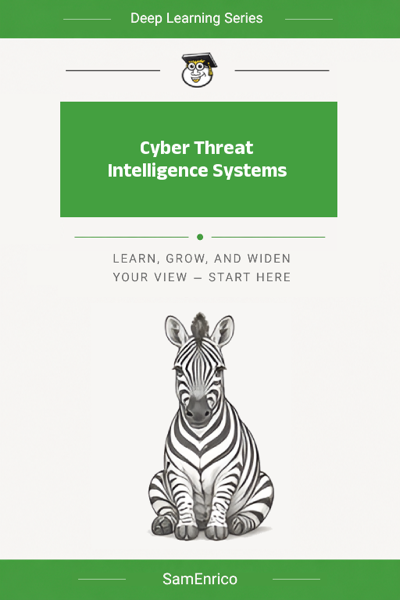
Non-FictionInformativeEducational
Cyber Threat Intelligence Systems eBook
A Coursebook on Cyber Threat Intelligence Systems
by Sisk Rosalva
A Coursebook on Cyber Threat Intelligence Systems
Formats
Free sample
Chapter 1: The $5 Million Screenshot--It was 2:37 PM on a Tuesday when Sarah, a senior security analyst at a Fortune 500 manufacturing firm, saw something strange.Her SIEM dashboard—a sprawling canvas of green, yellow, and red alerts that she had learned to read like a second language—lit up with an anomaly. A outbound connection from a finance department workstation to an IP address in Eastern Europe. The domain resolved to something innocuous: update-adobe[.]com. But Sarah knew that Adobe didn't have infrastructure in that region. She clicked through.
The connection had been active for forty-seven minutes. Exfiltration volume? Low. But persistence? The beacon repeated every sixty-two seconds.She took a screenshot.She pasted it into an email to her manager, subject line: "Possible C2 beacon—needs review."Then she closed the ticket and went back to triaging the other four hundred alerts that had accumulated since lunch.Six weeks later, that same workstation initiated an encrypted session that deployed ransomware across twelve hundred servers.
The demand: $5 million in Bitcoin. The company paid. The attackers released a portion of the stolen data anyway. The CEO resigned. The CISO was fired.
And Sarah—the analyst who had the clue in her hands and let it slip—sat in an exit interview wondering how everything had gone so wrong.The answer was not that Sarah was incompetent. She was, by every technical measure, excellent. She could read packet captures like poetry. She had memorized the entire MITRE ATT&CK matrix. She could recite the difference between AES-128 and AES-256 in her sleep.The problem was that Sarah had data.
She did not have intelligence.The Data-Intelligence Paradox This is the foundational paradox of modern cybersecurity: organizations spend millions of dollars on detection tools, hire dozens of analysts, and collect terabytes of logs—yet remain breathtakingly vulnerable. The 2023 IBM Cost of a Data Breach report found that organizations with mature security operations centers (SOCs) took an average of 204 days to identify a breach. Not contain. Not remediate. Just notice.Two hundred and four days.That is nearly seven months of an adversary living inside your network, stealing credentials, mapping your infrastructure, exfiltrating your intellectual property, and positioning for the final blow.
During those seven months, your SIEM generated alerts. Your EDR logged execution events. Your firewall recorded connections. Your analysts worked shifts. And yet, nobody connected the dots.Why?Because data is not intelligence.
They are related, but they are not the same thing. And mistaking one for the other is the single most expensive error a security organization can make.Let me define these terms with surgical precision.Data is raw, unprocessed, contextless. A hash value—e3b0c44298fc1c149afbf4c8996fb92427ae41e4649b934ca495991b7852b855—is data. A log line showing a Power Shell process spawning cmd.exe is data. An IP address—185.130.5.253—is data.
Data answers the question "What happened?" but provides no insight into why it matters or what to do about it.Information is data with context. That hash corresponds to a known malware family. That Power Shell process is unusual for that specific workstation. That IP address appears on three threat intelligence feeds. Information answers the question "What does this data mean?" but still falls short of telling you what action to take.Intelligence is information that has been processed, analyzed, and contextualized to support a specific decision.
Intelligence answers the question "What do we do now?" It incorporates not just what happened, but who is likely responsible, what they want, how they might act next, and which of your assets are most at risk. Intelligence is actionable. Intelligence is decision-forcing. Intelligence is the difference between a screenshot emailed to a manager and a defender blocking a kill chain before encryption begins.Sarah had data—the IP address, the beacon timing, the domain. She even had information—she recognized the beacon pattern as consistent with Cobalt Strike, a legitimate penetration testing tool that attackers have co-opted for command and control.
But she did not produce intelligence. She never asked the one question that separates analysts from intelligence professionals:"So what?"The One Question That Changes Everything"So what?" sounds dismissive. In the world of threat intelligence, it is the most productive question you can ask.Every alert, every log, every suspicious connection should be run through the "So what?" filter before it is escalated, closed, or ignored. The question forces you to articulate the decision that the intelligence should drive.Apply it to Sarah's C2 beacon:Data: Outbound connection to update-adobe[.]com from finance workstation.So what? That domain is not legitimate Adobe infrastructure.So what?
The beacon timing suggests automated persistence.So what? That indicates a likely compromised machine that has been under adversary control for an unknown period.So what? We need to isolate the workstation, initiate incident response procedures, and hunt for lateral movement from that foothold.Notice what happened in that chain. Each "So what?" moved from observation to implication to action. By the fourth iteration, Sarah would have had a clear directive: isolate, escalate, hunt.Instead, she stopped at the first "So what?"—maybe not even that.
She saw an anomaly, acknowledged it, and moved on. The screenshot was a record of observation, not a trigger for action.This is not a failure of individual analysts. It is a failure of process, training, and culture. Most security professionals are trained to detect, not to think. They are evaluated on how many alerts they close, how many tickets they resolve, how many hours they spend in front of a dashboard.
They are rarely rewarded for asking "So what?" because doing so slows down the metrics that management tracks.This book exists to change that.The Architecture of Intelligence Before we go any further, you need to understand how intelligence gets made. Not as a theoretical diagram, but as a disciplined workflow that you can implement starting tomorrow morning.The intelligence lifecycle has six phases. Every phase is necessary. Most organizations skip at least two of them, which is why their "intelligence" fails.Phase 1: Requirements What do you need to know, and why do you need to know it?This is the most skipped phase, and skipping it is catastrophic. Without clear requirements, you will collect indiscriminately, analyze aimlessly, and disseminate irrelevance.A good requirement is specific, answerable, and decision-driving.
"Tell me about nation-state hacking" is not a requirement. It is a topic. A real requirement sounds like this: "Identify which tactics, techniques, and procedures (TTPs) used by ransomware groups in the last ninety days are likely to evade our existing endpoint detection rules." That requirement tells you what to collect (ransomware TTPs), what to analyze (evasion techniques), and what decision to inform (whether to update detection rules).Phase 2: Collection Gathering the raw data that might answer your requirements.Collection is where most organizations drown. They subscribe to thirty threat feeds, ingest millions of indicators per day, and confuse volume with value. Effective collection is disciplined, targeted, and constantly refined based on feedback from later phases.Sources fall into several categories: open source (OSINT—forums, social media, code repositories, public reports), technical feeds (commercial and open-source indicator lists), internal telemetry (your own logs, which most…
This is the end of the free sample. Get the eBook to keep going. Buy now
About this book
Details
- Author
- Sisk Rosalva
- Publisher
- SamEnrico
- Language
- English
- Genre
- Non-Fiction, Informative, Educational
- Released
- 2026-05-04
- Pages (approx.)
- 154
- Available as
- eBook, Audiobook

Read better in the ZLOADR app
Your eBooks on your phone or tablet. Sign in with your SamEnrico account and start reading.
More by Sisk Rosalva
 Sudden Spouse Death RecoverySisk Rosalva$11.99
 Cameroon Anglophone EscapeSisk Rosalva$11.99
 Breath As Anesthetic TechniqueSisk Rosalva$11.99
 Workaholism Recovery After RetirementSisk Rosalva$11.99
 The Software Engineer Creative CodeSisk Rosalva$11.99
 Self Hypnosis For Self Esteem GuideSisk Rosalva$11.99
 Mountain Path WalkingSisk Rosalva$11.99
 Stress And Weight Gain ScienceSisk Rosalva$11.99
 Dreams About Parent DyingSisk Rosalva$11.99
 Pets.com: The $300 Million Puppet That Barked Too LoudSisk Rosalva$11.99
 Nefertiti's Forgotten Oath: The Pharaoh's ShadowSisk Rosalva$11.99
 The Silk Road of the Sea: The Venetian Merchant-AdmiralsSisk Rosalva$11.99
You may also like
 Hong Kong Handover 1997Dunn Johnnie$11.99
 Zumba For Postnatal Recovery CourseNeal Christian$11.99
 Zumba for BeginnersLadner Nikia$11.99
 YouTube Comment Mining GuideHumes Pandora$12.99
 Worry Box MeditationCarlin Rudy$11.99
 Workplace Stress MeditationNguyen Lynn$11.99
 Workplace Stress and Sleep RepairHawley Ivory$11.99
 Workplace Perfectionism CureDelaney Jeffry$11.99
 Workplace Injustice Anger GuideWallen Isabelle$11.99
 Work Addiction and Burnout LinkGreenwood Ester$11.99
 Women in Yoga and WellnessBeattie Galina$11.99
 Women in Stand Up ComedyChun Evangeline$11.99