
Non-FictionSelf-HelpCybersecurity
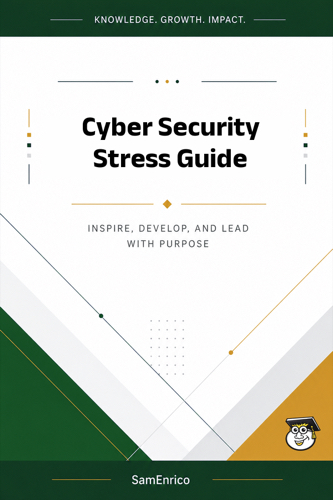
Cyber Security Stress Guide eBook
Defend against live hacks while preventing burnout
by Burnett Bong
Defend against live hacks while preventing burnout from constant vigilance.
Formats
Free sample
Chapter 1: The Frazzled Watchman--–- The first time Raj cried at his desk, it was 3:17 AM on a Tuesday. He wasn’t watching a breach unfold. No exploit was actively ruining his company’s reputation. The network was, by all metrics, quiet. That was the problem.
The silence wasn’t peace; it was the prelude. His brain, trained over eight years in Security Operations, had forgotten how to interpret a quiet dashboard as anything other than a ticking bomb. He had just finished triaging his 147th false positive of the shift—a routine log of an employee logging in from a coffee shop IP address that the system had flagged as “Anonymous Threat Actor.” He knew it was a coffee shop. He knew the employee traveled weekly. But he also knew that if he ignored it and this one time it wasn’t a coffee shop, he would be the one signing an incident report at 9 AM.
So he clicked. He verified. He closed. He moved to number 148. And then he realized his hands were shaking.
Not from caffeine. From the math of it: 148 decisions an hour, 12 hours a day, 5 days a week, with the stakes of a heart surgeon and the mundane repetition of a data entry clerk. He wasn’t exhausted. He was frazzled—a specific, clinical-sounding word for the quiet collapse of the modern cyber defender. This book is for Raj.
It is for the 66% of you who report chronic stress. It is for the 47% who have used the word “frazzled” to describe a state that feels permanent. And it begins with a paradox: the more defenses we build, the more stressed the defenders become.The Paradox of Infinite Defenses For the last twenty years, the cybersecurity industry has operated on a simple, seductive logic: more is better. More firewalls, more endpoint detection, more threat feeds, more compliance checkboxes. The Security Operations Center (SOC) evolved from a small room with a few screens into a sprawling digital fortress of overlapping tools, each promising to close the gap that the last tool left open.
And in terms of technical security, this logic has delivered. The cost of breaching a well-defended network has risen. The dwell time of attackers has decreased. By every metric of machine performance, we are winning.But the human operating the machines is losing.Consider the data. A 2023 industry-wide study of security professionals revealed that 66% report chronic stress levels that meet the clinical threshold for “high risk of burnout.” Among SOC analysts specifically, that number jumps to 72%.
Forty-seven percent—nearly half—described their daily emotional state as “frazzled,” a term psychologists use to denote a state of depleted cognitive reserves where impulse control and decision-making accuracy begin to plummet. Another 35% reported that they had sought mental health treatment specifically related to work stress, but only 12% felt comfortable disclosing that to their employer.The paradox is this: every new security tool is designed to reduce risk, but every new tool also adds a new dashboard, a new queue, a new set of false positives that a human must evaluate. We have optimized for machine security while ignoring human sustainability. The result is a workforce that is technically surrounded by safety but psychologically drowning in vigilance.Acute vs. Chronic: The Stress That Kills Careers To understand why the security field is breaking its defenders, we must first distinguish between two very different types of stress.Acute stress is the biological response to a genuine, short-term threat.
A live incident. A confirmed breach. A penetration test that finds a critical vulnerability on a Friday afternoon. In acute stress, the body releases cortisol and adrenaline, heart rate increases, pupils dilate, and non-essential systems (digestion, reproduction, long-term planning) temporarily shut down. This state is designed for survival.
It is intense, focused, and—crucially—temporary. After the incident resolves, the body returns to baseline. In fact, acute stress can be strengthening. It builds tolerance, sharpens reflexes, and creates a sense of mastery.Chronic stress is different. Chronic stress is the low-grade, sustained activation of the same biological systems, but without the resolution.
It is not the 3 AM breach. It is the 3 AM false positive. It is the endless queue. It is the knowledge that even if you close every alert, a new one will appear within seconds. In chronic stress, cortisol remains elevated not for hours but for weeks, months, or years.
And the human body is not designed for that.The analogy that runs through this book is the Night Watchman Who Never Sees a Sunrise. Imagine a guard hired to watch a castle wall. His job is to scan the horizon for threats. In a healthy system, he works a shift, sees the sunrise, hands off to a colleague, and sleeps. His vigilance is bounded.
Now imagine that the sun never rises. The guard is told that the threat is constant, that any moment could be the attack, and that there is no relief coming. At first, he is hyper-alert. But after hours, his attention fragments. After days, he starts missing obvious signals.
After weeks, he stops believing that vigilance matters. This is not a failure of character. It is a failure of biology. And it is the daily reality of thousands of security professionals.Perpetual Hyper-Vigilance: The New Baseline The concept that defines this chapter—and, in many ways, this entire book—is Perpetual Hyper-Vigilance. It is a state where the brain’s threat-detection system never fully disengages.
The amygdala, the part of the brain responsible for scanning for danger, remains activated even during off-hours, even on vacation, even in sleep.Perpetual Hyper-Vigilance has three distinct components:First, attentional narrowing. When the brain perceives constant threat, it narrows its focus to the immediate environment. Long-term planning suffers. Strategic thinking suffers. The analyst becomes exceptionally good at triaging the next alert and entirely unable to step back and ask, “Why are we getting these alerts in the first place?”Second, decision fatigue.
Every decision, no matter how small, consumes a finite resource of cognitive energy. The 148th false positive requires the same biological expenditure as the first, but the brain has less fuel left. By the end of a shift, analysts make worse decisions not because they are careless but because they are depleted.Third, emotional blunting. Hyper-vigilance is exhausting. To survive, the brain begins to suppress emotional responses.
Curiosity fades. Satisfaction from solving a problem fades. Even the healthy fear that should accompany a real threat fades. The defender becomes numb—not to the work, but to the meaning of the work.This is not burnout. Not yet.
Burnout is the end state. Perpetual Hyper-Vigilance is the long middle—the years of functioning at 60% capacity while telling yourself and your manager that everything is fine.The Biology of Breaking: Cortisol, Sleep, and the Prefrontal Cortex To truly understand why “just toughen up” is not a solution, we must look at the biology. The human stress response is governed by the hypothalamic-pituitary-adrenal (HPA) axis. When the brain perceives a threat, the HPA axis releases cortisol. Cortisol mobilizes energy (glucose), increases blood pressure, and temporarily suppresses non-essential functions like immunity and digestion.
In a healthy system, cortisol levels peak in the morning (helping us wake up) and decline throughout the day, reaching…
This is the end of the free sample. Get the eBook to keep going. Buy now
About this book
Details
- Author
- Burnett Bong
- Publisher
- SamEnrico
- Language
- English
- Genre
- Non-Fiction, Self-Help, Cybersecurity
- Released
- 2026-06-05
- Pages (approx.)
- 131
- Available as
- eBook, Audiobook

Read better in the ZLOADR app
Your eBooks on your phone or tablet. Sign in with your SamEnrico account and start reading.
More by Burnett Bong
 The Vaccination Pain ManagementBurnett Bong$11.99
 The Early Employment ChildhoodBurnett Bong$11.99
 The Affirmation Walk MethodBurnett Bong$11.99
 Art Account Like ComparisonBurnett Bong$11.99
 Financial Stress And Utility Bills GuideBurnett Bong$11.99
 Gaming Financial Ruin RecoveryBurnett Bong$11.99
 John D Rockefeller LifeBurnett Bong$11.99
 Imposter Syndrome For Highly Sensitive PeopleBurnett Bong$11.99
 The Last Words of Hypatia: A Legacy of Light in the Dark AgesBurnett Bong$11.99
 The Collapse of Enron: A Symphony of DeceptionBurnett Bong$11.99
 Baba Yaga’s Bone Cottage: The Witch Who Ate the MoonBurnett Bong$11.99
 Entrepreneurship for Social ImpactBurnett Bong$11.99
You may also like
 Hong Kong Handover 1997Dunn Johnnie$11.99
 Zumba For Postnatal Recovery CourseNeal Christian$11.99
 Zumba for BeginnersLadner Nikia$11.99
 YouTube Comment Mining GuideHumes Pandora$12.99
 Worry Box MeditationCarlin Rudy$11.99
 Workplace Stress MeditationNguyen Lynn$11.99
 Workplace Stress and Sleep RepairHawley Ivory$11.99
 Workplace Perfectionism CureDelaney Jeffry$11.99
 Workplace Injustice Anger GuideWallen Isabelle$11.99
 Work Addiction and Burnout LinkGreenwood Ester$11.99
 Women in Yoga and WellnessBeattie Galina$11.99
 Women in Stand Up ComedyChun Evangeline$11.99