
Non-FictionInformativeEducational
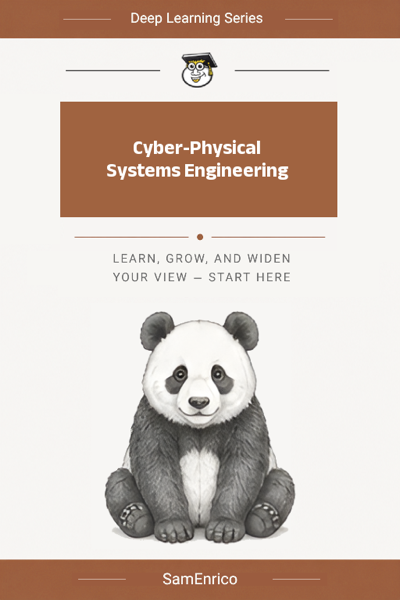
Cyber-Physical Systems Engineering eBook
A Coursebook on Cyber-Physical Systems Engineering
A Coursebook on Cyber-Physical Systems Engineering
Formats
Free sample
Chapter 1: The Robot That Killed a Plant--–- It was a Tuesday morning when the most expensive software bug in the history of that German auto parts factory didn't crash a computer. It crashed a physical machine. The robotic arm, a massive six-axis Kuka unit that had performed the same welding operation 847,000 times without incident, received a routine software update the night before. The update had passed all standard tests: unit tests, integration tests, even a full regression suite. On a developer's laptop, the new control algorithm ran flawlessly.
But at 9:47 AM, when the arm reached for a chassis frame, it didn't stop at the programmed endpoint. It kept moving. Sensors screamed. The emergency stop triggered—but 300 milliseconds too late. The arm tore through the chassis, punched into the adjacent conveyor system, and ripped a hydraulic line.
By the time maintenance killed the main breaker, the damage was done: $200 million in destroyed equipment, six months of production delay, and one very confused software engineering team staring at logs that showed everything had worked perfectly—on the computer.The mistake was not in the algorithm's logic. The mistake was in the engineers' mental model. They had treated the robotic arm as if it were a pure software system: deterministic, isolated, and infinitely forgiving of timing errors. But the arm lived in the physical world, where forces accumulate, inertia does not negotiate, and a 300-millisecond delay in braking translates directly into smashed steel. The software worked.
The physics did not.This is the central challenge of Cyber-Physical Systems engineering. For fifty years, software engineers were taught that their code lived in a box. The box might be a server, a laptop, or a phone, but the fundamental assumption was the same: computation is separate from physics. If your program crashed, the only consequence was lost data or a frustrated user. If your program ran slowly, the user waited.
But when software touches the physical world—when it controls a brake, a valve, a scalpel, a throttle, a generator—then late is wrong, wrong is dangerous, and dangerous can be fatal.Welcome to the world of Cyber-Physical Systems. This book is about what happens when code leaves the box and meets steel, flesh, and concrete. It is about the engineering discipline that fuses control theory, real-time systems, networking, formal methods, and security into a coherent practice for building systems that think and move. By the time you finish this chapter, you will understand what makes a CPS different from any other computing system you have encountered. More importantly, you will understand why the old ways of thinking—the ones that worked for web servers and mobile apps—will fail you here, and what you must put in their place.The Definition That Matters Let us begin with a precise definition, because the term "Cyber-Physical System" has been stretched to cover everything from a smart lightbulb to a Mars rover.
A Cyber-Physical System is an engineered system in which computational elements (software, algorithms, digital logic) are tightly integrated with physical processes through a closed-loop feedback mechanism involving sensors and actuators. The key phrase is "tightly integrated." A system where a human reads a sensor reading and manually adjusts an actuator is not a CPS. A system where a computer records temperature data but does not control the heater is not a CPS. For a system to qualify as a CPS, the computational and physical elements must be in continuous, closed-loop interaction, with the frequency and latency of computation directly affecting the behavior of the physical process.This definition draws clear boundaries. An embedded system—say, the microcontroller in a microwave oven—might qualify as a CPS if its timing affects the physical outcome.
But many embedded systems are simple state machines that react to button presses; the timing of the computation rarely matters as long as it finishes before the user presses the next button. The Internet of Things (Io T) emphasizes connectivity and data collection, not necessarily tight feedback. A smart thermostat that sends temperature readings to the cloud for analysis is Io T. A smart thermostat that adjusts the furnace every five seconds based on those readings is CPS. Traditional control systems, like the PID controllers found in industrial plants, focus entirely on the physical dynamics and treat computation as an ideal, instantaneous actor.
CPS recognizes that computation has its own constraints—scheduling, latency, jitter, failure modes—that must be modeled alongside the physics.The implication is profound. In a CPS, you cannot design the control algorithm without understanding the scheduler. You cannot write the networking code without understanding the dynamics of the physical plant. You cannot test the software without simulating the physics, and you cannot verify the physics without modeling the software's timing. The two domains are not separate concerns to be integrated at the end.
They are a single, unified design problem from the first equation and the first line of code.Why This Matters Now If CPS is so fundamental, why has it emerged as a distinct discipline only in the last fifteen years? The answer is convergence. Three technological trends have accelerated to the point where their intersection has become its own field of study.First, computing has become cheap and small. Microcontrollers that cost fifty cents and consume microwatts of power can be embedded anywhere—inside tires, medical implants, agricultural sensors, structural monitors. Moore's Law gave us the ability to compute at the edge, not just in data centers.Second, networking has become ubiquitous and fast.
Wireless protocols (5G, Wi Fi 6, Bluetooth LE, Lo Ra WAN) allow distributed components to communicate with latencies measured in milliseconds or microseconds. The cloud is no longer a distant abstraction; it can close a control loop from sensor to actuator in real time.Third, the physical systems themselves have become more demanding. Autonomous vehicles require real-time image processing and control at 100 Hz. Smart grids must balance thousands of distributed generators and loads with sub-second frequency regulation. Medical devices must deliver precise doses while adapting to patient physiology.
Industrial robots must collaborate safely with human workers. These applications were impossible a decade ago. They are barely possible now. And they all require CPS engineering.Consider the numbers. The global market for CPS technologies—including autonomous vehicles, industrial robotics, smart grid infrastructure, medical devices, and defense systems—is projected to exceed $250 billion by 2030.
More importantly, the cost of failure is rising. A software bug in a web server might cost a company reputation and revenue. A CPS bug in a self-driving car can cost lives. In 2016, a Tesla Model S operating on Autopilot struck a tractor-trailer, killing the driver. The investigation revealed that the system had detected the truck but failed to brake because the radar and camera had conflicting interpretations.
This was not a sensor failure; it was a failure of sensor fusion, of timing, of the tight coupling between perception and actuation. It was a CPS failure.The Two Abstractions That Will Shape Everything Before we dive into modeling, control, scheduling, and security, we must establish the two fundamental models of computation that underlie every CPS you will ever build. These are not mere theoretical distinctions. They determine how you reason…
This is the end of the free sample. Get the eBook to keep going. Buy now
About this book
Details
- Author
- Bowles Michiko
- Publisher
- SamEnrico
- Language
- English
- Genre
- Non-Fiction, Informative, Educational
- Released
- 2026-06-02
- Pages (approx.)
- 145
- Available as
- eBook, Audiobook

Read better in the ZLOADR app
Your eBooks on your phone or tablet. Sign in with your SamEnrico account and start reading.
More by Bowles Michiko
 Finance Blogger Wealth ComparisonBowles Michiko$11.99
 Financial Anxiety In Young Adults GuideBowles Michiko$11.99Financial Anxiety In Young Adults GuideBowles Michiko$11.99
 Thunberg and Extinction RebellionBowles Michiko$11.99
 The COVID Vaccine UpdateBowles Michiko$11.99
 Healing From Narcissistic ParentsBowles Michiko$11.99
 Somatic Experiencing DreamsBowles Michiko$11.99
 Mental Toughness GuideBowles Michiko$11.99
 Cult Escapee Master GuideBowles Michiko$11.99
 Comparison Cure For Self DoubtBowles Michiko$11.99
 The Last Whistle: How a Single Train Ride United a City in ChaosBowles Michiko$11.99
 The Whispering Lanterns of KyotoBowles Michiko$11.99
You may also like
 Hong Kong Handover 1997Dunn Johnnie$11.99
 Zumba For Postnatal Recovery CourseNeal Christian$11.99
 Zumba for BeginnersLadner Nikia$11.99
 YouTube Comment Mining GuideHumes Pandora$12.99
 Worry Box MeditationCarlin Rudy$11.99
 Workplace Stress MeditationNguyen Lynn$11.99
 Workplace Stress and Sleep RepairHawley Ivory$11.99
 Workplace Perfectionism CureDelaney Jeffry$11.99
 Workplace Injustice Anger GuideWallen Isabelle$11.99
 Work Addiction and Burnout LinkGreenwood Ester$11.99
 Women in Yoga and WellnessBeattie Galina$11.99
 Women in Stand Up ComedyChun Evangeline$11.99