
Non-FictionSelf-Help / Reaction
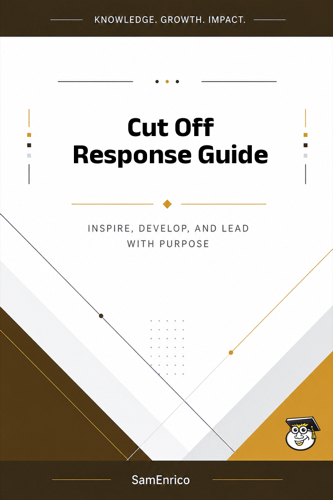
Cut Off Response Guide eBook
Handles being cut off without escalating to road r
Handles being cut off without escalating to road rage.
Formats
Free sample
Chapter 1: Your Brain on Brake Lights--The first time it happened, I was late for a job interview. The second time, I was driving my daughter to school. The third time, I didn’t even remember what I was rushing to—only that someone had stolen my space, and I wanted them to know it.His name was Mike, the man in the silver Honda Civic. I don’t know his real name, of course. I never will.
But at 5:47 PM on a Tuesday, merging onto I-405 in Los Angeles, Mike did something that thousands of drivers do every day without thinking: he changed lanes. Not aggressively. Not maliciously. He simply saw a gap, signaled (barely), and slid into the three-car-length space in front of my bumper.Three seconds later, I was tailgating him at 75 miles per hour, screaming at his taillights. My nine-year-old daughter was in the back seat.
She was crying. I don’t remember passing the next three exits. I remember her tears for a year.I am not a bad person. I donate to the food bank. I coach Little League.
I return my shopping cart to the corral. And yet, in that moment, I became someone I didn’t recognize—someone who would risk his daughter’s safety, his own life, and a stranger’s well-being over three car lengths of asphalt.This book is for Mike. Not the Mike in the silver Honda—he has no idea I exist. This book is for the Mike inside me. The one who forgets, in the three seconds after being cut off, that I am a good person.
The one who believes, for just a moment, that teaching someone a lesson is worth more than arriving alive.If you are reading this, you have a Mike inside you too. Maybe you’ve never acted on it. Maybe you’ve honked, gestured, or tailgated and felt ashamed afterward. Maybe you’ve only fumed silently, your blood pressure spiking while your family pretends not to notice. Wherever you are on that spectrum, you are not broken.
You are not a bad person. You are simply a human being whose brain is doing exactly what evolution designed it to do—and that is the problem.This chapter is about why that happens. Why does a random car merging into your lane feel like a personal attack? Why does your body react with the same intensity as if you were being chased by a predator? And most importantly, what is the first step to breaking the cycle before it breaks you?Let’s start with the story of a nurse named Sarah.The Nurse Who Never Honked (Until She Did)Sarah had been a registered nurse for twelve years.
She had held the hands of dying patients. She had remained calm while doctors yelled and families wept. Her colleagues called her “the icicle” because nothing seemed to rattle her.Then one evening, after a double shift, a silver sedan cut her off on the freeway. She didn’t honk—she had never honked in her life. But something else happened.
Her hands tightened on the wheel. Her face flushed. Her heart pounded so hard she could hear it in her ears. For the next fifteen minutes, she replayed the moment over and over, inventing increasingly elaborate fantasies about what she would say to the driver if she caught up to them.When she arrived home, she was furious at her husband for leaving a dish in the sink. She snapped at her teenager for no reason.
She lay awake at 2 AM, still thinking about the silver sedan.“I don’t understand,” she told me later. “It wasn’t even a close call. There was no danger. I just felt… violated.”That word—violated—is the key to everything.The Psychology of the Stolen Space Why does being cut off feel so personal? The answer lies in two psychological principles that operate beneath the level of conscious thought.
They are ancient, automatic, and incredibly powerful.Territoriality: Your Bumper Is Your Bedroom Imagine you are sitting in your living room. A stranger walks through your front door without knocking, sits on your couch, and begins watching your television. How do you feel? Violated. Angry.
Threatened. Now imagine that same stranger walks past your house on the sidewalk. You feel nothing.The difference is territory. Every animal with a central nervous system defends territory. Birds defend nests.
Wolves defend packs. Humans defend property lines, personal space, and—crucially—the space immediately in front of our moving vehicles.Research from the University of California’s Traffic Safety Center found that drivers perceive the space directly ahead of their vehicle as an extension of their personal territory. The average driver feels ownership over the 2-3 car lengths of asphalt in front of their bumper. This is not a rational belief—you don’t own the road, you don’t own the space, and the law explicitly says you do not have a right to that specific patch of pavement. But rationality has nothing to do with it.
Your ancient lizard brain does not care about traffic laws. It cares about territory.When another car slides into that space, your brain processes it as an invasion. Not a traffic maneuver—an invasion. The same neural circuits that fire when someone steps too close to you in an elevator, or when a stranger sits at your reserved table, light up behind your steering wheel.The Endowment Effect: Why You Overvalue Your Gap The second principle is called the Endowment Effect. It is one of the most robust findings in behavioral economics, and it works like this: people demand much more to give up something they already have than they would be willing to pay to acquire that same thing if they didn’t have it.In a famous experiment, researchers gave half of their participants a coffee mug.
Then they asked the mug-owners how much money they would accept to sell the mug. They asked the non-owners how much they would pay to buy the mug. The mug-owners demanded roughly twice as much money to give up the mug as the non-owners were willing to pay to get it. The mug had not changed. Only the fact of ownership had changed.Now apply this to driving.
The three-car-length gap in front of your car is your “mug.” You didn’t pay for it. You have no legal claim to it. But you have been occupying it for the last several seconds, and in that brief time, your brain has endowed it with value. When another driver takes it, you feel a loss. And because of the Endowment Effect, you feel that loss more intensely than the other driver feels the gain.This is why being cut off feels worse than arriving at a merge point and finding no gap at all.
In the first case, you lost something you felt you owned. In the second case, you never had it to begin with. The objective situation may be identical—you are now following one car at a safe distance—but the emotional experience is completely different.Physical Threat vs. Social Threat: The…
This is the end of the free sample. Get the eBook to keep going. Buy now
About this book
Details
- Author
- Prentice Dotty
- Publisher
- SamEnrico
- Language
- English
- Genre
- Non-Fiction, Self-Help / Reaction
- Released
- 2026-06-06
- Pages (approx.)
- 131
- Available as
- eBook, Audiobook

Read better in the ZLOADR app
Your eBooks on your phone or tablet. Sign in with your SamEnrico account and start reading.
More by Prentice Dotty
 IBS And Mold Exposure GuidePrentice Dotty$11.99
 Weekly Review Mastery GuidePrentice Dotty$11.99
 Habit Tracking JournalPrentice Dotty$11.99
 Career Disappointment RecoveryPrentice Dotty$11.99
 DEXA Scan Body CompositionPrentice Dotty$11.99
 The Twelve Step Home Group GuidePrentice Dotty$11.99
 David Unaipon Australian VoicePrentice Dotty$11.99
 The Bronze Masters of Ife: Sculpting the Divine in Yoruba ArtPrentice Dotty$11.99
 The Pen and the Pitch: How Latin America's Sports Writers Shaped a ContinentPrentice Dotty$11.99
 How to Produce Train PartsPrentice Dotty$11.99
 A Collector's Handbook to the Hupmobile Aerodynamic 6Prentice Dotty$11.99
 German Raise for ImmigrantsPrentice Dotty$12.99
You may also like
 Hong Kong Handover 1997Dunn Johnnie$11.99
 Zumba For Postnatal Recovery CourseNeal Christian$11.99
 Zumba for BeginnersLadner Nikia$11.99
 YouTube Comment Mining GuideHumes Pandora$12.99
 Worry Box MeditationCarlin Rudy$11.99
 Workplace Stress MeditationNguyen Lynn$11.99
 Workplace Stress and Sleep RepairHawley Ivory$11.99
 Workplace Perfectionism CureDelaney Jeffry$11.99
 Workplace Injustice Anger GuideWallen Isabelle$11.99
 Work Addiction and Burnout LinkGreenwood Ester$11.99
 Women in Yoga and WellnessBeattie Galina$11.99
 Women in Stand Up ComedyChun Evangeline$11.99