
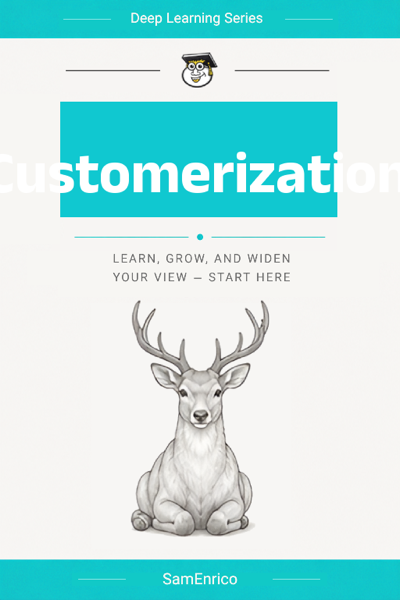
Customerization eBook
A Coursebook on Customerization
by Weddle Audie
A Coursebook on Customerization
Formats
Free sample
Chapter 1: The Average Lie--The average customer has never bought anything from you.Not once. Not ever.This is not a metaphor or a rhetorical flourish. It is a mathematical fact. The "average customer" is a statistical fiction—a composite that exists only in spreadsheets and boardroom presentations. Yet for nearly a century, the entire machinery of modern marketing has been built around serving this imaginary person.
We have optimized supply chains for the average order. We have designed products for the average user. We have written marketing copy for the average reader. We have spent trillions of dollars pursuing a ghost.And we are finally paying the price.The signs of collapse are everywhere. Email open rates have plummeted from forty percent to barely fifteen percent over the past decade.
Click-through rates on display ads now hover below one percent. The average consumer is exposed to an estimated ten thousand marketing messages per day, and they ignore nearly all of them. Not because they are distracted, though they are. Not because they are cynical, though they are. They ignore your marketing because it is irrelevant to them.
It was not written for them. It was written for the average customer, and the average customer does not exist.This chapter dismantles the most dangerous assumption in modern business: the belief that efficiency comes from standardization and that profitability comes from scale. It introduces the foundational principle of customerization—treating each individual as a unique market segment—while offering an important clarification. Segmentation is not the enemy. Worshiping the average is.
Segments are temporary scaffolds on the path to true individualization, useful tools for getting started but not the final destination.By the end of this chapter, you will understand why the "average customer" is a lie, how that lie has cost your company billions, and what it means to adopt the n=1 Principle as your strategic north star.The Invention of a Fiction The average customer was born in the early twentieth century, and like many inventions of that era, it was designed for industrial efficiency, not human truth.Before the Industrial Revolution, most goods were made to order. A tailor measured an individual's body before cutting cloth. A baker knew which customers preferred rye and which wanted sourdough. A blacksmith shaped horseshoes to the specific gait of a specific horse. Production was personalized because production was local, slow, and small-batch.The assembly line changed everything.
Henry Ford's Model T could be produced in staggering quantities only because every car was identical. "Any customer can have a car painted any color that he wants," Ford famously said, "so long as it is black." This was not arrogance. It was physics. Changing paint colors required stopping the production line for hours, destroying the efficiency that made the Model T affordable to the masses.The logic of the assembly line—standardization drives efficiency, efficiency drives scale, scale drives profit—became the logic of marketing. If you could only make one product, you had to sell that product to as many people as possible.
To do that, you needed to understand what "most people" wanted. You needed the average.Market research emerged as the science of the average. Pollsters would survey a representative sample and calculate the mean response. The average consumer wanted a car with four doors, a refrigerator with an ice maker, a television with a twenty-inch screen. Companies built those products.
They wrote advertising campaigns targeting that average consumer. They bought media reaching the broadest possible audience.And it worked remarkably well—for about seventy years.From the 1920s through the 1990s, the average customer was a useful approximation because variation was suppressed. Most households had one television, one telephone, one car. Most consumers shopped at the same local department stores, watched the same three broadcast networks, read the same daily newspapers. The range of choices was narrow.
The differences between individuals, while real, were smaller than the differences between available products.That world no longer exists.The Great Fragmentation Four forces have shattered the average customer into a billion unique individuals.The first force is choice. In 1970, the typical grocery store stocked about seven thousand unique products. Today, that same store stocks over forty thousand. Amazon offers more than six hundred million products. The average consumer now has more choices in a single afternoon than their grandparents had in a lifetime.
With choice comes differentiation. When you have forty thousand options, you can find the product that fits you precisely—and you will reject any product that does not.The second force is data. In 1990, a company's knowledge of its customers was limited to what customers chose to reveal on warranty cards and survey forms. Today, every click, scroll, hover, and hesitation generates data. Companies know not just what customers bought, but what they almost bought, what they looked at before buying, what they bought afterward, and what they searched for but could not find.
This data reveals that no two customers behave identically. The average is not just a simplification; it is a distortion.The third force is technology. Production systems that once required runs of one hundred thousand units can now economically produce runs of one hundred units or even one unit. Nike can manufacture sneakers customized to an individual's foot shape and gait analysis. Netflix can generate a unique homepage for each of its two hundred million subscribers.
The economic case for standardization—that personalization was too expensive—has collapsed.The fourth force is expectation. A generation raised on personalized playlists, tailored news feeds, and curated shopping recommendations has no patience for generic marketing. They do not see personalization as a luxury. They see it as a baseline. When Spotify serves them a Discover Weekly playlist of songs they already own, they complain.
When Netflix recommends a movie they watched last month, they mock the algorithm. When you send them an email addressing them as "Dear Valued Customer," they delete it—or worse, mark it as spam.Taken together, these four forces have made the average customer not just inaccurate but actively harmful. A marketing campaign designed for the average customer appeals to no one specifically and therefore resonates with no one deeply. A product designed for the average user satisfies no one's unique needs. A service designed for the average case fails every edge case, and in a fragmented world, every customer is an edge case.The Two Trillion Dollar Prize The economic incentive for abandoning the average is staggering.Mc Kinsey analyzed personalization efforts across fifteen industries and found that companies implementing advanced personalization generate forty percent more revenue from those efforts than companies at basic levels of personalization.
Google and Facebook built their trillion-dollar valuations on the ability to deliver individualized advertising. Amazon attributes thirty-five percent of its revenue to its personalized recommendation engine.But these are not just tech company stories. Starbucks' personalized loyalty program drives nearly half of all U.S. sales. Nike's customization platform, Nike By You, commands premium pricing while building deeper customer relationships.
Sephora's Beauty Insider program uses purchase history to provide tailored product recommendations, driving a ninety percent retention rate among active members.Aggregate these effects across the economy…
This is the end of the free sample. Get the eBook to keep going. Buy now
About this book
Details
- Author
- Weddle Audie
- Publisher
- SamEnrico
- Language
- English
- Genre
- Non-Fiction, Informative, Educational
- Released
- 2026-06-02
- Pages (approx.)
- 139
- Available as
- eBook, Audiobook

Read better in the ZLOADR app
Your eBooks on your phone or tablet. Sign in with your SamEnrico account and start reading.
More by Weddle Audie
 Twelve Step for Internet and Gaming AddictionWeddle Audie$11.99
 Family Secret Keeping ChildhoodWeddle Audie$11.99
 The Cowboy StanceWeddle Audie$11.99
 Binge Eating Mindfulness Approach GuideWeddle Audie$11.99
 Remote Consulting CommunicationWeddle Audie$11.99
 Anticipatory Grief and HospiceWeddle Audie$11.99
 The Marine Corps OverdoseWeddle Audie$11.99
 Wrist and Forearm Stretching for GamersWeddle Audie$11.99
 Hearst San FranciscoWeddle Audie$11.99
 The Quantum Pioneers of Almaty: Unveiling the Mysteries of the Invisible WorldWeddle Audie$11.99
 The Troll King's Exile: A Saga of Ice and StoneWeddle Audie$11.99
 The Complete Guide to This Is Why You're FatWeddle Audie$11.99