
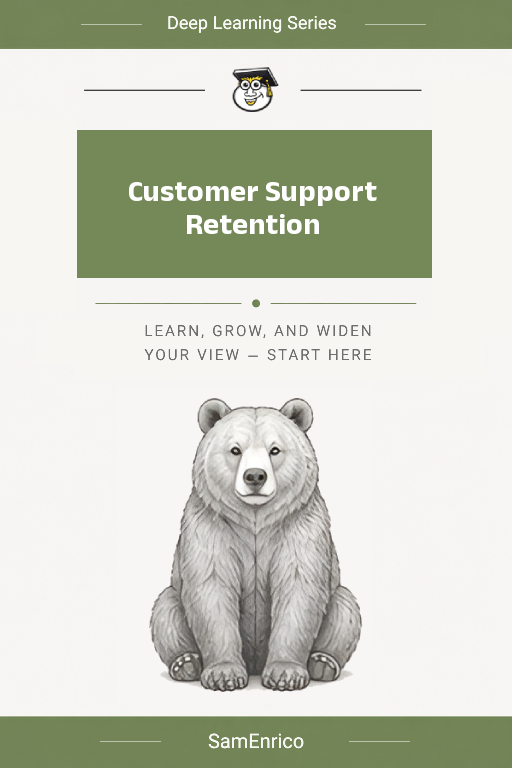
Non-FictionStrategic AtlasSupport
Customer Support Retention eBook
Reveals how top companies use customer support as
Reveals how top companies use customer support as retention lever through fast response, first-call resolution, and proactive outreach.
Formats
Free sample
Chapter 1: The $1.6 Trillion Blind Spot--–- In the year 2019, a mid-sized software company in Austin, Texas, did something that most boardrooms would consider insane. They doubled the size of their customer support team while freezing all marketing spend. Their stock price should have tanked. Their growth should have stalled. Their investors should have revolted.
None of that happened. Instead, their net revenue retention climbed from 82% to 94% in eleven months. Their customer lifetime value increased by 40%. And their marketing team later discovered that every dollar they had been spending on paid acquisition was three times less effective than the word-of-mouth generated by customers who had received outstanding support. This company did not discover a new product.
They did not lower their prices. They simply realized that they had been looking at the wrong numbers.The blind spot that cost this company—and thousands like it—years of wasted money is deceptively simple. Most executives believe that customer support is a cost center. It appears on the profit and loss statement as an expense. It is measured by how quickly calls are answered and how cheaply tickets are closed.
The prevailing logic is elegant in its brutality: support exists to fix problems that should not have happened in the first place. Therefore, the best support is the one that costs the least.This logic is wrong. And it is wrong by a margin that should embarrass every MBA who has ever nodded along to a presentation about "optimizing service delivery costs."The actual data tells a very different story. Across industries, companies that deliberately invest in customer support as a retention lever outperform their peers by nearly every meaningful metric. They grow faster.
They are more profitable. They spend less on marketing. And their employees stay longer. The reason is not mysterious—it is simply ignored because it does not fit neatly into quarterly earnings reports. Customer retention, driven by exceptional support, is the most underleveraged growth engine in modern business.The Economics That Nobody Wants to See Let us begin with a number that should be printed on the wall of every CEO's office: $1.6 trillion.
That is the approximate amount of annual revenue that American businesses lose to customer churn. Not to competitors. Not to market shifts. To churn—the quiet, undramatic decision of a customer to simply stop buying. Most of these customers do not leave because the product failed.
They leave because they felt unheard, unhelped, or unseen. According to a Harvard Business Review study, 40% of customers who churn do so because of poor service, not product deficiency. Another 20% leave because they felt the company did not care about them as individuals. Only 15% leave for a better product.Here is the math that changes everything. A 5% increase in customer retention—not acquisition, not upselling, just keeping the customers you already have—increases profits by 25% to 95%.
Those numbers come from Frederick Reichheld of Bain & Company, who spent two decades studying the economics of loyalty. The range depends on the industry, but the direction is unambiguous. Retention is profit. And support is the primary lever of retention.Yet most companies allocate less than 3% of their operating budget to customer support while spending 20% or more on marketing. This is not a rational allocation of capital.
It is a habit inherited from an era when products were physical, switching costs were high, and customers had no voice. That era is over. A single frustrated customer can now broadcast their experience to ten thousand people in an hour. The same customer can switch to a competitor in thirty seconds. In this environment, the team that answers the phone is more important than the team that buys the ad.The Lifetime Value Calculation You Are Getting Wrong Every executive claims to understand Customer Lifetime Value (LTV).
But most LTV models contain a fatal flaw: they treat support as a cost deducted from revenue rather than a driver of the retention period itself. The standard formula is deceptively simple: LTV = (Average Revenue Per Customer × Gross Margin) / Churn Rate. Notice what is missing. There is no term for support quality. The formula assumes churn is an external force, like weather.
In reality, churn is a direct consequence of how customers feel about their interactions with your company—and those interactions are dominated by support experiences.Let me introduce a more accurate concept: Service-Driven Lifetime Value (SD-LTV). This is the total revenue saved or earned through positive service interactions over the life of a customer. The formula is subtle but powerful. SD-LTV = (Retention Uplift from Support × Average Revenue Per Customer × Customer Lifespan) – (Cost of Support Investment). When you calculate this for your own business, you will likely discover that every dollar spent on effective support returns between three and seven dollars in retained revenue.
No marketing channel delivers that kind of ROI.Consider a concrete example. A Saa S company with 10,000 customers, each paying 100permonth,loses5100 per month, loses 5% of those customers annually to churn. That is 100permonth,loses5600,000 in lost monthly recurring revenue every year just from churn. If that company invests 100,000inimprovingsupport—fasterresponsetimes,betterfirst−callresolution,proactiveoutreach—andreduceschurnbyjust1percentagepoint(from5100,000 in improving support—faster response times, better first-call resolution, proactive outreach—and reduces churn by just 1 percentage point (from 5% to 4%), they save 100,000inimprovingsupport—fasterresponsetimes,betterfirst−callresolution,proactiveoutreach—andreduceschurnbyjust1percentagepoint(from5120,000 in the first year. But here is the kicker: that reduction compounds.
Because retained customers stay longer, buy more, and refer others. Over five years, that $100,000 investment returns well over a million dollars. Show me a Facebook ad campaign with that return.The Transaction Mindset vs. The Hospitality Mindset If support economics are so compelling, why do most companies get it wrong? The answer lies in two competing mindsets that produce radically different behaviors, metrics, and outcomes.The first is the Transaction Mindset.
This is the default setting for most organizations. It views every support interaction as a discrete event with a beginning and an end. The goal is to close the ticket as quickly as possible. The metrics are Average Handle Time (AHT), Cost Per Ticket, and First Response Time. Agents are rewarded for speed.
Customers are treated as problems to be solved. The unspoken philosophy is that support is a necessary evil—a tax on the business of selling products. This mindset is not evil. It is just wrong. It optimizes for the wrong variable.
It asks "How cheaply can we solve this?" rather than "How much trust can we build in this moment?"The second is the Hospitality Mindset. This mindset, borrowed from high-end hotels but applicable to any business, treats customers as guests rather than tickets. The goal is not to close the interaction but to strengthen the relationship. The metrics shift from speed to outcomes: First Contact Resolution, Customer Effort Score, and post-interaction retention. Agents are rewarded for solving the underlying problem, not for hanging up quickly.
The philosophy is that every interaction is an opportunity to earn the right to future business. This is not softer. It is harder. It requires training, authority, and systems that most companies have not built.The difference between these mindsets shows up in the smallest details. A Transaction Mindset agent says: "I understand your issue.
Let me transfer you to billing." A Hospitality Mindset agent says: "I understand your issue. I am going to stay…
This is the end of the free sample. Get the eBook to keep going. Buy now
About this book
Details
- Author
- Escobedo Deirdre
- Publisher
- SamEnrico
- Language
- English
- Genre
- Non-Fiction, Strategic Atlas, Support
- Released
- 2026-05-30
- Pages (approx.)
- 132
- Available as
- eBook, Audiobook

Read better in the ZLOADR app
Your eBooks on your phone or tablet. Sign in with your SamEnrico account and start reading.
More by Escobedo Deirdre
 Workplace Empathy GuideEscobedo Deirdre$11.99
 HIIT Group Class GuideEscobedo Deirdre$11.99
 Twelve Step Serenity Prayer GuideEscobedo Deirdre$11.99
 The OCD Mental Ritual GuideEscobedo Deirdre$11.99
 Oboist Reed Making ArtistryEscobedo Deirdre$11.99
 The Silk and Science Dynasty: How Black Geniuses Wove the Future of FashionEscobedo Deirdre$11.99
 The Breeder's Guide to Jacob SheepEscobedo Deirdre$11.99
 Design Tool Free to PaidEscobedo Deirdre$12.99
 HGV DriverEscobedo Deirdre$11.99
 How to Start a Blood Processing Business (Beginners Guide)Escobedo Deirdre$11.99
You may also like
 Hong Kong Handover 1997Dunn Johnnie$11.99
 Zumba For Postnatal Recovery CourseNeal Christian$11.99
 Zumba for BeginnersLadner Nikia$11.99
 YouTube Comment Mining GuideHumes Pandora$12.99
 Worry Box MeditationCarlin Rudy$11.99
 Workplace Stress MeditationNguyen Lynn$11.99
 Workplace Stress and Sleep RepairHawley Ivory$11.99
 Workplace Perfectionism CureDelaney Jeffry$11.99
 Workplace Injustice Anger GuideWallen Isabelle$11.99
 Work Addiction and Burnout LinkGreenwood Ester$11.99
 Women in Yoga and WellnessBeattie Galina$11.99
 Women in Stand Up ComedyChun Evangeline$11.99