
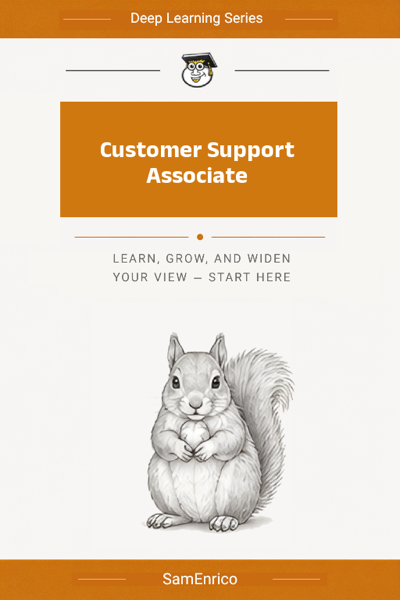
Non-FictionInformativeEducational
Customer Support Associate eBook
A Coursebook on Customer Support Associate
by Buck Gerry
A Coursebook on Customer Support Associate
Formats
Free sample
Chapter 1: The Million-Dollar Headset--The phone rings. Your screen lights up with a customer name, a ticket number, and a timer that will soon turn red if you don't answer. You take a breath. You press accept. And in that moment—before you say a single word—you are already either building or burning the future revenue of your company.This is not an exaggeration.
This is not motivational speaking. This is mathematics.Most people who enter customer support believe they have taken a job answering questions, resetting passwords, and processing refunds. They believe they are a cost center—a necessary expense that companies tolerate because angry customers are expensive to replace. They believe their work is measured in minutes per call, tickets closed per hour, and whether the customer clicked a smiley face at the end of the interaction.Everything you just read is wrong. Dangerously wrong.You are not a cost center.
You are a revenue retention engine. You are not answering questions; you are protecting recurring subscription dollars, preventing chargebacks, and extending customer lifetime value with every single interaction. The headset on your desk is not a tool for listening to complaints. It is a million-dollar instrument—if you learn to play it correctly.This chapter will dismantle the outdated, exhausting, and economically false view of customer support as a "necessary evil." It will show you, with data and stories, why the modern support associate is the most critical actor in customer retention and revenue growth. It will introduce you to the core metrics that actually matter—not the vanity numbers that managers use to justify their budgets, but the real economics of keeping a customer versus losing one.
And it will end with a fundamental reframing of your role: from ticket-closer to loyalty-builder, from order-taker to brand ambassador, from replaceable worker to irreplaceable asset.By the time you finish this chapter, you will never look at a ringing phone the same way again.The Great Misunderstanding: Why Support Got Dismissed For decades, customer support sat in the basement. Literally and figuratively. If you visited a corporate office in the 1990s, the sales team had windows. The marketing team had natural light. Customer support?
They were in the windowless basement, fluorescent lights buzzing, cubicle walls stained with coffee, answering calls from people who had just received the wrong shade of beige curtains.That physical location reflected an economic reality. Support was overhead. Support was a cost. Support was where you put people who couldn't sell, couldn't code, and couldn't manage. The logic was simple: every dollar spent on support was a dollar not spent on acquiring new customers.
So you spent as little as possible. You outsourced. You automated. You measured "efficiency" by how quickly you could hang up and take the next call.This logic made sense in a transaction-based economy. In the 1990s, if a customer had a bad experience with your cable company or your department store, what were they going to do?
Switch to another cable company? In most cities, there wasn't one. Complain on social media? It didn't exist. Write a blog post?
Only if you were technically sophisticated. The power imbalance between company and customer was massive, and companies knew it. They could afford to treat support as a cost center because customers had nowhere else to go.That world is gone. It died sometime between the launch of Twitter in 2006 and the rise of subscription software in the early 2010s. In its place, we have something entirely different: a world where customers have infinite choices, infinite voice, and infinite memory.Consider the economics of a typical software-as-a-service company.
Acquiring a new customer might cost 500inmarketingandsales.Thatcustomersignsupfora500 in marketing and sales. That customer signs up for a 500inmarketingandsales.Thatcustomersignsupfora50 per month subscription. It will take ten months just to break even on the acquisition cost. But if that customer churns—cancels their subscription—after six months? The company loses money on them.
They were a net negative.Now consider what happens when that customer has a problem. They call support. A skilled associate solves their issue in fifteen minutes. The customer stays for two more years. That fifteen-minute interaction just generated $1,200 in gross profit.
That is the economic reality of modern support. The associate on the phone is not a cost. They are a profit center wearing a headset.This shift has been accelerated by three major forces. First, the subscription economy means that revenue is recurring. You do not win a customer once; you win them every single month.
And the primary driver of renewal is not the initial sale—it is the ongoing experience, especially when things go wrong. Second, social media has given every customer a megaphone. One bad support interaction can become a viral thread, a Tik Tok rant, or a Trustpilot review that outranks your own website. Third, and most importantly, switching costs have collapsed. Your customer can leave you and join a competitor in approximately ninety seconds.
The only thing keeping them is the quality of your service—and the memory of how you treated them when they needed help.You are not a cost center. You are the only thing standing between your company and a revenue catastrophe.The Loyalty Effect: Why Retention Creates Riches In 1996, a Bain & Company consultant named Frederick Reichheld published a book that should be required reading for every support associate on earth. The book was called The Loyalty Effect, and its central finding was so simple, so obvious in retrospect, and so consistently ignored that it bordered on tragic.Reichheld studied dozens of companies across industries—credit cards, insurance, software, auto repair, retail banking—and asked a simple question: what happens to profits when customer retention increases by just five percent?The answer stunned everyone. Across almost every industry, a five percent increase in customer retention produced profit increases between twenty-five percent and ninety-five percent. Not five percent.
Not ten percent. Twenty-five to ninety-five percent.Let that sink in. If a company keeps just five out of every one hundred additional customers who would have left, their profits can nearly double.Why does retention have such an outsized effect? Reichheld identified four economic drivers that are worth understanding in depth, because they explain exactly why your work as a support associate is so valuable.First, retained customers buy more over time. This is not loyalty as a warm feeling; it is loyalty as a statistical reality.
A customer in their second year with a company typically spends more than a customer in their first year. They trust the brand. They understand the product. They add additional services, upgrade to premium tiers, or purchase complementary products. This phenomenon is called "share of wallet expansion," and it is almost entirely driven by the customer's experience with support.
If every interaction is painful, they will never expand. If every interaction is effortless, they will give you more of their money without even thinking about it.Second, retained customers cost less to serve. A new customer calls support more often. They ask basic questions. They make mistakes that require fixes.
They are expensive. A retained customer knows how the product works. They have already made their rookie mistakes. They call…
This is the end of the free sample. Get the eBook to keep going. Buy now
About this book
Details
- Author
- Buck Gerry
- Publisher
- SamEnrico
- Language
- English
- Genre
- Non-Fiction, Informative, Educational
- Released
- 2026-05-11
- Pages (approx.)
- 146
- Available as
- eBook, Audiobook

Read better in the ZLOADR app
Your eBooks on your phone or tablet. Sign in with your SamEnrico account and start reading.
More by Buck Gerry
 Estate Planning for Vacation HomesBuck Gerry$11.99
 Kenya Consumer OutlookBuck Gerry$11.99
 Affirmations For Job Interview CourseBuck Gerry$11.99
 Ornithophobia Bird FearBuck Gerry$11.99
 DBT Emotion Regulation for DepressionBuck Gerry$11.99
 The Poisoner of La Rochelle: France's First DNA-Linked Female Serial Killer (1930s)Buck Gerry$11.99
 Understanding Pancreatic Lipomatosis Duodenal StenosisBuck Gerry$17.99
 ROAS First Campaign GuideBuck Gerry$12.99
 Carol Tomé GuideBuck Gerry$12.99
 How to Start a Vegetable Canning BusinessBuck Gerry$11.99
You may also like
 Hong Kong Handover 1997Dunn Johnnie$11.99
 Zumba For Postnatal Recovery CourseNeal Christian$11.99
 Zumba for BeginnersLadner Nikia$11.99
 YouTube Comment Mining GuideHumes Pandora$12.99
 Worry Box MeditationCarlin Rudy$11.99
 Workplace Stress MeditationNguyen Lynn$11.99
 Workplace Stress and Sleep RepairHawley Ivory$11.99
 Workplace Perfectionism CureDelaney Jeffry$11.99
 Workplace Injustice Anger GuideWallen Isabelle$11.99
 Work Addiction and Burnout LinkGreenwood Ester$11.99
 Women in Yoga and WellnessBeattie Galina$11.99
 Women in Stand Up ComedyChun Evangeline$11.99