
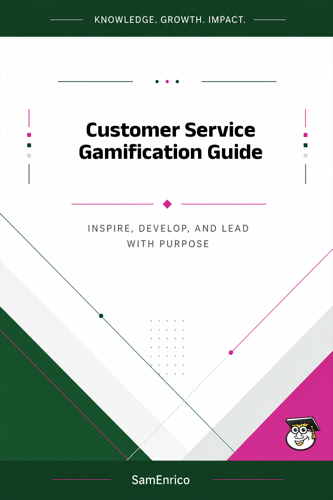
Non-FictionBusiness BriefGamification
Customer Service Gamification Guide eBook
Use points, badges, and leaderboards to motivate a
by Cyr Katy
Use points, badges, and leaderboards to motivate agent performance.
Formats
Free sample
Chapter 1: The Zombie Epidemic--–- Maria had forty-seven badges. A rainbow of digital stickers proclaimed her a "Resolution Warrior," an "Empathy Ninja," and a "Speed Demon." Her avatar wore a virtual crown. Her point total was in the top five percent of her entire contact center. She also hadn't genuinely smiled at a customer in eight months.When I interviewed Maria during my research for this book, she was polite, efficient, and utterly hollow. She could de-escalate an angry caller in under two minutes.
She could navigate three different knowledge bases simultaneously. She knew exactly how many points she needed to qualify for the monthly gift card drawing. But when I asked her, "Do you care about the customers you serve?" she paused for a full seven seconds before saying, "The insurance is good."That pause told me everything.Maria is not an anomaly. She is the product of a well-intentioned but fundamentally broken system. She is a Zombie Agent.The Paradox That Should Keep You Awake Tonight Let me give you a number that will ruin your morning coffee: one hundred percent.According to data aggregated from the Contact Center Association and multiple workforce management studies, the average annual turnover rate in contact centers ranges from 30 to 45 percent under normal conditions.
But among centers that have implemented aggressive gamification programs—points, badges, leaderboards, the whole apparatus—turnover in the first twelve months of gamification implementation can spike to over 100 percent. That means for every ten agents you hire, ten more leave within a year. Some leave because the game burned them out. Some leave because they stopped caring. Some leave because they realized the game was never about them at all.Here is the paradox that makes this chapter essential reading: seventy percent of Forbes Global 2000 companies now use some form of gamification.
The market for gamification platforms is projected to exceed thirty billion dollars annually within the next three years. And yet, despite this massive investment, the average contact center still loses more than a third of its workforce every year. The tools are supposed to solve retention. They are making it worse.Why?Because most gamification is built on a lie. The lie is this: "If we make work fun, agents will stay."This is the "fun-first fallacy," and it is killing your team.The Fun-First Fallacy: Why Cartoons Won't Save You The fun-first fallacy manifests in predictable ways.
A manager reads an article about gamification. They purchase a software license. Within weeks, the contact center is adorned with digital confetti. Agents earn badges for "showing up on time." Leaderboards display colorful avatars racing toward the finish line. There might be a mascot.
There might be sound effects. There absolutely will be a lot of points.This approach confuses entertainment with engagement. Entertainment is passive. You watch a movie. You eat popcorn.
You feel good for two hours and then forget everything. Engagement is active. It requires effort, challenge, and meaning. Entertainment is a sugar rush. Engagement is a slow-burning fire.The fun-first fallacy treats agents like children who need to be distracted from the unpleasantness of work.
It assumes that the fundamental problem with customer service is that it is boring, and the solution is to make it less boring with digital stickers. This is wrong for three reasons.First, customer service is not boring to people who are good at it. It is challenging, dynamic, and deeply human. The agent who resolves a complex billing dispute after forty-five minutes of patient listening is not looking for a badge. They are looking for the satisfaction of having solved something real.Second, treating adults like children breeds resentment.
When you give a thirty-five-year-old professional a cartoon badge for "Being a Team Player," you are not motivating them. You are condescending to them. And they will eventually respond to that condescension by checking out emotionally.Third, the fun-first fallacy ignores the actual psychology of motivation. As we will explore in detail in Chapter 2, humans are not driven by external rewards in the way most managers assume. We are driven by competence, autonomy, and belonging.
A dancing badger on a screen provides none of these things.Meet the Zombie Agent: Symptoms and Diagnosis The Zombie Agent is the natural endpoint of the fun-first fallacy. You can identify Zombie Agents by four unmistakable symptoms.Symptom One: Mechanical Proficiency Without Emotional Investment.Zombie Agents hit their metrics. Their average handle time is acceptable. Their first contact resolution rate is fine. Their customer satisfaction scores hover around the median.
But there is no warmth. No curiosity. No sense that the agent on the other end of the line sees the customer as a human being. They are following a script, even when no script exists.I watched a Zombie Agent handle a call from a elderly woman whose internet had been down for a week. The agent resolved the issue in six minutes.
He was technically perfect. He also never once said "I understand why you are frustrated" or "I am sorry this happened to you." He treated the call as a transaction. The customer hung up with her internet working and her dignity slightly diminished.Symptom Two: Point-Chasing Behavior That Undermines Actual Service.Zombie Agents optimize for the game, not the customer. If the game rewards speed, they rush. If the game rewards positive surveys, they learn to manipulate customers into giving high scores (a phenomenon known as "survey begging").
If the game rewards resolution without escalation, they will solve problems incompletely rather than transfer to a specialist.I have seen agents intentionally transfer calls to colleagues right before resolution so that the colleague gets the "resolve" points while they move on to the next call. I have seen agents end calls prematurely because a thirty-second hold would hurt their handle time. I have seen agents celebrate a badge for "Most Calls Taken" while the quality of those calls deteriorated to nothing.Symptom Three: Zero Transfer of Learning to Novel Situations.Zombie Agents can handle the ninety percent of calls that follow predictable patterns. But when something unusual happens—a new product defect, an edge case in billing, a customer with an unusual request—they freeze. They have learned to play the game, not to think.
Their cognitive flexibility has atrophied because the game rewarded repetition, not adaptation.Symptom Four: Quiet Quitting Without Actually Quitting.This is the most dangerous symptom. Zombie Agents do not resign. They stop trying. They show up on time, take their calls, earn their points, and go home. They are not rude.
They are not insubordinate. They are simply not present. They have mentally checked out while their body remains in the chair. And because they are technically meeting expectations, their managers have no clear grounds for intervention.If this description makes you uncomfortable because it sounds like half your team, you are not alone. In my consulting work, I have seen Zombie Agents in every industry: telecommunications, banking, healthcare, retail, software-as-a-service.
They are the silent epidemic of modern customer service.Engagement Gamification vs. Performance Gamification To understand how we created the Zombie Agent, we must distinguish between two fundamentally different approaches to gamification.Engagement Gamification is what…
This is the end of the free sample. Get the eBook to keep going. Buy now
About this book
Details
- Author
- Cyr Katy
- Publisher
- SamEnrico
- Language
- English
- Genre
- Non-Fiction, Business Brief, Gamification
- Released
- 2026-06-08
- Pages (approx.)
- 145
- Available as
- eBook, Audiobook

Read better in the ZLOADR app
Your eBooks on your phone or tablet. Sign in with your SamEnrico account and start reading.
More by Cyr Katy
 Startup Founder Burnout GuideCyr Katy$11.99
 The Journal Article Citation GuideCyr Katy$11.99
 Validation for Pregnancy LossCyr Katy$11.99
 Intermittent Fasting Keto ComboCyr Katy$11.99
 The Candace's Gold: The Heist That Built an EmpireCyr Katy$11.99
 Climate Insurance for MarineCyr Katy$12.99
 Retrospectives for StartupsCyr Katy$12.99
 Staff Mechanical EngineerCyr Katy$11.99
 Learn to Play the Uruttu ChendaCyr Katy$11.99
 How to Become a Steeple JackCyr Katy$11.99
You may also like
 Hong Kong Handover 1997Dunn Johnnie$11.99
 Zumba For Postnatal Recovery CourseNeal Christian$11.99
 Zumba for BeginnersLadner Nikia$11.99
 YouTube Comment Mining GuideHumes Pandora$12.99
 Worry Box MeditationCarlin Rudy$11.99
 Workplace Stress MeditationNguyen Lynn$11.99
 Workplace Stress and Sleep RepairHawley Ivory$11.99
 Workplace Perfectionism CureDelaney Jeffry$11.99
 Workplace Injustice Anger GuideWallen Isabelle$11.99
 Work Addiction and Burnout LinkGreenwood Ester$11.99
 Women in Yoga and WellnessBeattie Galina$11.99
 Women in Stand Up ComedyChun Evangeline$11.99