
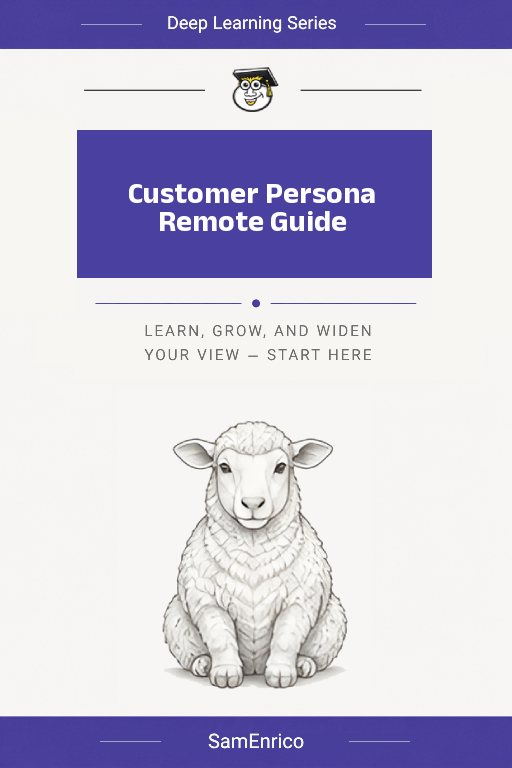
Non-FictionStartup GuideStrategic Planning
Customer Persona Remote Guide eBook
Create customer personas for your business plan us
Create customer personas for your business plan using online surveys and social listening tools.
Formats
Free sample
Chapter 1: The $47,000 Mistake--I once spent $47,000 proving that I knew absolutely nothing about my own customer.It was 2021. I had just raised a small seed round for a B2B Saa S tool designed to help remote teams manage asynchronous communication. We had built a beautiful product. The onboarding flow was silky. Our landing page had testimonials from three friendly founders who had given us permission to use their names.
We were ready.I had also built what I believed was a world-class customer persona. Her name was "Remote Rachel." She was thirty-four years old, lived in a mid-sized city, worked as a mid-level marketing manager at a company with fifty to two hundred employees, earned $85,000 per year, and had two children under the age of six. She liked yoga, meal prep, and complained on Twitter about Zoom fatigue. I had a stock photo of her—a white woman in a blazer laughing while holding a latte—and I had printed her persona card on heavy cardstock and taped it above my monitor.I loved Remote Rachel. I had invented her, and she made me feel smart.We launched our advertising campaign on Linked In, Facebook, and Google.
We targeted women aged thirty to forty, with job titles containing "marketing" or "operations," living in suburban zip codes with median incomes between 75,000and75,000 and 75,000and100,000. We spent $47,000 over eight weeks.We got thirty-seven sign-ups. Zero converted to paid.The post-mortem was brutal. We interviewed the thirty-seven people who had signed up. They were not marketing managers.
They were not women in their thirties. They were men in their twenties working at startups, and they had signed up because they thought our tool would help them manage their engineering teams. They had abandoned the product when they realized it was built for marketing workflows.I had not spent 47,000onadvertising.Ihadspent47,000 on advertising. I had spent 47,000onadvertising.Ihadspent47,000 on a hallucination.The Epidemic of Invented Customers Here is a uncomfortable truth that the software vendors will not tell you: most businesses operate on "zombie personas"—static, demographic-heavy caricatures that were invented in a conference room, not discovered in the wild. These personas are not data.
They are fiction with a template.I see this everywhere I consult. A B2B software company presents me with "Startup Steve," age twenty-eight to thirty-five, founder or early employee, "values efficiency." A DTC e-commerce brand shows me "Mindful Molly," age thirty-two to forty-two, "cares about sustainability." A local service business hands me "Busy Brian," "needs convenience and reliability."These personas have three things in common. First, they are based on demographics—age, income, zip code—that someone guessed. Second, they are so broad as to be meaningless. "Values efficiency" describes every business buyer.
"Cares about sustainability" describes every consumer who has ever recycled a bottle. Third, and most damning, they were created without any direct input from actual customers.The people who build these personas are not stupid. They are busy. They are under pressure to "know their customer" and to produce a deliverable that looks professional. So they do what everyone else does: they make reasonable guesses, they borrow from industry reports, and they invent a name and a stock photo.
Then they call it a day.But in a remote-first economy—where you cannot observe customers in person, where you cannot sit in their waiting rooms or watch them use your product in their offices—these guesses are not just harmless fiction. They are actively dangerous.Why Demographics Are Dead (As Predictors)Let me be precise about what I am claiming, because this is where many readers will object.I am not saying demographics are useless. They remain useful for one specific thing: finding your audience in advertising platforms. When you log into Facebook Ads or Linked In Campaign Manager, you cannot target "people who feel frustrated by their project management software." You can target people by age, job title, and zip code. Demographics are your entry pass to the advertising auction.What I am saying is that demographics no longer predict behavior.This distinction matters enormously.
A demographic descriptor like "age thirty-four, marketing manager, $85,000 income" tells you where a person sits in the economic and organizational structure. It does not tell you what they will buy, what they fear, what they desire, or what will trigger a purchase decision. Two thirty-four-year-old marketing managers with identical incomes can have radically different buying habits based on their values, their fears, and the online tribes they belong to.Consider this. One marketing manager wakes up at 6:00 AM, reads a newsletter about productivity hacks, and believes that the right software will finally fix her team's chaos. She buys tools constantly and churns just as fast.
Another marketing manager wakes up at 6:00 AM, reads a newsletter about burnout and work-life balance, and believes that most software is a distraction from real human connection. She avoids new tools and resists any change to her workflow. Same demographic. Completely different buyer.Demographics told you where to find these two people. They did not tell you which one would buy your product.The remote economy has accelerated this breakdown.
When everyone works from home, when your customer could be in Boise or Bangalore, when the old signals of status (office location, commute time, suit vs. casual) have disappeared, demographics lose even more predictive power. Your customer's zip code tells you almost nothing about their pain points. Their age tells you almost nothing about their values. Their job title tells you almost nothing about their decision-making process.You need a different framework.The Psychographic Pivot: Motivations, Pain Points, Triggers The replacement for demographic guesswork is psychographics—the study of personality, values, attitudes, interests, and lifestyles.
But psychographics, as traditionally practiced, can be just as fuzzy as demographics. "Values sustainability" is not a psychographic. It is a self-reported label that tells you nothing about what someone will actually do.After analyzing hundreds of successful persona projects across B2B Saa S, e-commerce, and professional services, I have distilled psychographic research down to three dimensions that actually predict behavior. These three dimensions will appear throughout this book, and every persona you build will be organized around them.Motivations (What They Desire)Motivations are the positive outcomes your customer is moving toward. They are the hopes, the aspirations, the "if only" statements that live in the quiet moments of the workday.
A motivation is not a feature request. It is not "I need a reporting dashboard." It is the emotional state that the reporting dashboard enables: "I want to feel confident that my team is on track so I can stop checking email at 11:00 PM."Motivations come in two flavors. Intrinsic motivations are internal and psychological: mastery, autonomy, belonging, peace of mind. Extrinsic motivations are external and measurable: a promotion, a bonus, a faster workflow, a lower cost. Both matter, but intrinsic motivations are stickier and more predictive of long-term loyalty.
People will forgive a product that delivers peace of mind. They will abandon a product that delivers only efficiency.Pain Points (What They Flee From)Pain points are the negative outcomes your customer is moving away from. They are the fears, the frustrations, the "I hate it when"…
This is the end of the free sample. Get the eBook to keep going. Buy now
About this book
Details
- Author
- Garrison James
- Publisher
- SamEnrico
- Language
- English
- Genre
- Non-Fiction, Startup Guide, Strategic Planning
- Released
- 2026-06-01
- Pages (approx.)
- 141
- Available as
- eBook, Audiobook

Read better in the ZLOADR app
Your eBooks on your phone or tablet. Sign in with your SamEnrico account and start reading.
More by Garrison James
 The Delegation Skill GuideGarrison James$11.99
 Values And Mission Alignment Startup Foundation CourseGarrison James$11.99
 Team Conflict Anger ManagementGarrison James$11.99
 The Vitamin D SAD GuideGarrison James$11.99
 Unity Persuasion FrameworkGarrison James$11.99
 The Waltz of Vienna: Empress Sisi and the Golden Age of Austro-Hungarian SplendorGarrison James$11.99
 Understanding Tricho Odonto Onycho Dermal SyndromeGarrison James$17.99
 OKR Linked Business PlanGarrison James$12.99
 How to Start a Drag Scraper Business (Beginners Guide)Garrison James$11.99
 ArboricultureGarrison James$11.99
You may also like
 Hong Kong Handover 1997Dunn Johnnie$11.99
 Zumba For Postnatal Recovery CourseNeal Christian$11.99
 Zumba for BeginnersLadner Nikia$11.99
 YouTube Comment Mining GuideHumes Pandora$12.99
 Worry Box MeditationCarlin Rudy$11.99
 Workplace Stress MeditationNguyen Lynn$11.99
 Workplace Stress and Sleep RepairHawley Ivory$11.99
 Workplace Perfectionism CureDelaney Jeffry$11.99
 Workplace Injustice Anger GuideWallen Isabelle$11.99
 Work Addiction and Burnout LinkGreenwood Ester$11.99
 Women in Yoga and WellnessBeattie Galina$11.99
 Women in Stand Up ComedyChun Evangeline$11.99