
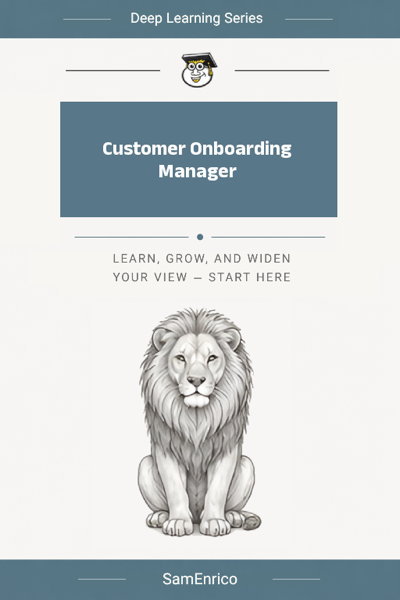
Non-FictionInformativeEducational
Customer Onboarding Manager eBook
A Coursebook on Customer Onboarding Manager
by Beall Celena
A Coursebook on Customer Onboarding Manager
Formats
Free sample
Chapter 1: The $1.6 Trillion Blind Spot--The average company loses 32% of its new customers within the first 90 days. Not because the product failed. Not because the price was wrong. But because no one taught them how to win.This chapter establishes onboarding as the single most leveraged growth lever most companies ignore. You will learn why onboarding is not training, not implementation, and not “customer success lite”—but a distinct strategic function with measurable ROI.
You will understand the four onboarding models, the metrics that separate retention winners from churn disasters, and why the Onboarding Manager role is the fastest-growing job in Saa S for a reason.By the end of this chapter, you will never again treat onboarding as a checkbox. You will see it as the competitive weapon it truly is.The Day the Software Died Let me tell you about Sarah.She was the VP of Sales at a mid-sized logistics company. In December, she signed a $120,000 annual contract with a supply chain visibility platform. The demo was beautiful. The sales rep promised a two-week implementation.
The CEO was thrilled.Day 1 after signing: a welcome email with a link to a help center.Day 3: a calendar invitation for a kickoff call—three weeks out.Day 12: the kickoff call. The onboarding manager spent 45 minutes walking through every feature. Sarah’s team was confused but nodded along.Day 18: login credentials arrived. No one from Sarah’s team logged in.Day 25: a check-in email: “How’s it going?” No reply.Day 45: Sarah’s boss asked, “When are we getting that ROI you promised?”Day 60: Sarah’s team attempted to use the platform for the first time. Nothing worked the way they expected.
They opened four support tickets. Two went unanswered for a week.Day 90: the renewal reminder arrived. Sarah forwarded it to her boss with one word: “Cancel.”The vendor lost $120,000. Sarah lost credibility. And neither side understood what really happened.The software worked perfectly.
The onboarding failed catastrophically.This story repeats tens of thousands of times every single day. According to a 2023 study by Profit Well, companies with structured onboarding programs retain 76% of customers at day 90. Companies with no onboarding retain just 44%. That gap—32 percentage points—represents over $1.6 trillion in annual recurring revenue left on the table across the global Saa S industry.Onboarding is not a step. It is the entire relationship in disguise.The Great Misunderstanding Most executives believe onboarding is “training.” Some call it “implementation.” A few dismiss it as “customer service with a smile.” All of them are wrong.Onboarding is the process of moving a customer from signed contract to first realized value faster than their attention span expires.That definition contains three critical elements.
First, “first realized value” is not the same as “product access.” Giving someone a key to a gym is not the same as them losing weight. Second, “faster than their attention span expires” acknowledges a brutal truth: customers forget why they bought within 48 hours. Third, “process” implies repeatability, not heroics.The Onboarding Manager, therefore, is not a trainer. The role is a hybrid beast requiring four distinct skill sets.Strategist. You align product capabilities to customer business outcomes.
You do not demo features; you map value.Project manager. You track timelines, dependencies, deliverables, and risks across two organizations—yours and the customer’s.Trainer. You educate users not on what the product does, but on how to achieve their goals with it. These are different activities.Therapist. You manage anxiety, resistance, fear of change, and internal politics inside the customer’s organization.
People do not resist software; they resist the change software represents.No single job description ever captures this blend. That is why great Onboarding Managers are rare and why they command salaries that have risen 47% since 2020.The Four Models of Onboarding Not every customer needs the same onboarding experience. A five-person design agency signing up for Figma requires something radically different than a global bank implementing SAP. Understanding the four models is the first step toward designing onboarding that scales.High‑touch onboarding is what most enterprise companies imagine when they hear the term. A dedicated Onboarding Manager works one-on-one with the customer.
Implementation plans are custom. Training is live and personalized. Kickoff meetings involve multiple stakeholders. Timelines range from four to twelve weeks. This model delivers the highest satisfaction and retention rates—when executed well.
But it does not scale. Each Onboarding Manager can handle at most ten to fifteen enterprise onboardings simultaneously. Cost per onboarding can exceed 10,000.Usehigh−touchforannualcontractvaluesabove10,000. Use high-touch for annual contract values above 10,000.Usehigh−touchforannualcontractvaluesabove50,000 or strategic accounts where failure would damage the brand.Low‑touch onboarding is the opposite. No dedicated human.
Automated email sequences. In-app checklists. Pre-recorded training videos. Self-serve knowledge bases. The customer navigates entirely on their own.
This model scales infinitely. A single product manager can design a low-touch flow that serves millions. Cost per onboarding approaches zero. But activation rates are typically lower—often below 40% for complex products. Use low-touch for self-serve products with monthly pricing below $100 or for freemium models where volume matters more than depth.Hybrid onboarding splits the difference.
Automated systems handle the first 80% of the journey: welcome emails, basic training, in-app guides. Then a human steps in for the critical final 20%: complex configuration, executive alignment, or the “Aha!” moment that requires live interaction. This is the fastest-growing model because it balances scale and effectiveness. A single Onboarding Manager can handle fifty to eighty hybrid onboardings simultaneously. Use hybrid for mid-market customers with annual contract values between 10,000and10,000 and 10,000and50,000.Product‑led onboarding is the newest and most misunderstood model.
Here, the product itself drives adoption. No separate onboarding team exists. The user learns by doing, guided by in-app prompts, empty states that show what to do next, and progressive disclosure that reveals features only when needed. Canva, Figma, Slack, and Dropbox all exemplify product-led onboarding. The product is the teacher.
This model works only when the product is intuitive enough that the average user can achieve value within sixty seconds of first login. Use product-led for consumer-grade B2B products with low complexity and high frequency of use.The mistake most companies make is choosing one model and applying it to every customer. The best organizations segment their customer base and match the onboarding model to the customer’s needs, willingness to pay, and complexity of use.The Metrics That Actually Matter Most companies measure onboarding by activity. “We sent the welcome email.” “We completed the kickoff call.” “We delivered training.” These are vanity metrics. They feel like progress but predict nothing.The three metrics that actually predict retention are Time-to-First-Value, activation rate, and retention at day 90 and day 180.Time-to-First-Value (TTFV) measures the days from contract signature to the moment the customer achieves their first meaningful outcome.
Not login. Not training completion. Real value. For Slack, TTFV is the time until a user sends their first message in a channel with at least one other person. For Zoom, it is the first meeting with screen share.
For a payroll platform, it is the first successful payroll run. TTFV is the single most predictive metric in onboarding. Every day of delay increases churn probability by roughly…
This is the end of the free sample. Get the eBook to keep going. Buy now
About this book
Details
- Author
- Beall Celena
- Publisher
- SamEnrico
- Language
- English
- Genre
- Non-Fiction, Informative, Educational
- Released
- 2026-05-07
- Pages (approx.)
- 147
- Available as
- eBook, Audiobook

Read better in the ZLOADR app
Your eBooks on your phone or tablet. Sign in with your SamEnrico account and start reading.
More by Beall Celena
 Workplace Rejection ResilienceBeall Celena$11.99
 Pancho Gonzales Fierce CompetitorBeall Celena$11.99
 Menopause Low Carb GuideBeall Celena$11.99
 Equifax Free Credit MonitoringBeall Celena$11.99
 Green Beret Survival SchoolBeall Celena$11.99
 The Vanishing Act of the Great Pyramid’s Missing StoneBeall Celena$11.99
 The White Queen of Medellín: Griselda Blanco's Rise and FallBeall Celena$11.99
 Freelance Skill Stacking HandbookBeall Celena$12.99
 Business Travel Rebound AnalysisBeall Celena$12.99Business Travel Rebound AnalysisBeall Celena$12.99
 Understanding Gastroenteritis, EosinophilicBeall Celena$17.99
 How to Become a Multi-operation-machine OperatorBeall Celena$11.99
You may also like
 Hong Kong Handover 1997Dunn Johnnie$11.99
 Zumba For Postnatal Recovery CourseNeal Christian$11.99
 Zumba for BeginnersLadner Nikia$11.99
 YouTube Comment Mining GuideHumes Pandora$12.99
 Worry Box MeditationCarlin Rudy$11.99
 Workplace Stress MeditationNguyen Lynn$11.99
 Workplace Stress and Sleep RepairHawley Ivory$11.99
 Workplace Perfectionism CureDelaney Jeffry$11.99
 Workplace Injustice Anger GuideWallen Isabelle$11.99
 Work Addiction and Burnout LinkGreenwood Ester$11.99
 Women in Yoga and WellnessBeattie Galina$11.99
 Women in Stand Up ComedyChun Evangeline$11.99