
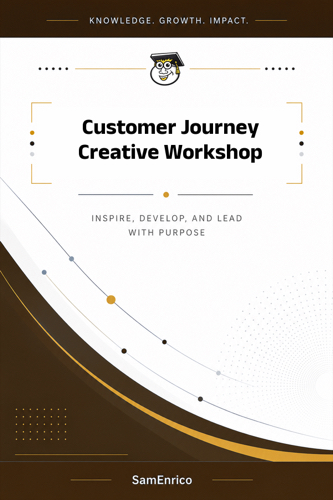
Non-FictionSelf-HelpCustomer Experience
Customer Journey Creative Workshop eBook
Map user experiences collaboratively to spark inno
Map user experiences collaboratively to spark innovation using this team guide.
Formats
Free sample
Chapter 1: The Poster Lie--–- In a gleaming conference room on the thirty-seventh floor of a Fortune 500 headquarters, a team of twelve people stood around a table covered in butcher paper, sticky notes, and markers. They had just completed a six-week journey mapping initiative. The facilitator, a well-meaning UX researcher named Sarah, had interviewed twenty-three customers, synthesized four hundred sticky notes, and created a map so detailed it stretched eighteen feet across the wall. It showed every touchpoint, every emotion, every channel, every backend process. It was, by any academic standard, a masterpiece.The Chief Marketing Officer stood back, hands on hips, and said, "This is beautiful.
Frame it."And they did. They framed the map and hung it in the hallway outside the executive conference room. Six months later, when the customer satisfaction scores had dropped another eleven percent, someone finally noticed the map was still there, untouched, its sticky notes curling at the edges. The team had spent approximately sixty-two thousand dollars in salary time to produce a poster. Not one idea from that map had been implemented.
Not one customer pain point had been fixed. The only thing that had changed was that everyone felt vaguely guilty whenever they walked past the eighteen-foot reminder of their collective inaction.This is not an outlier. This is the norm.According to a 2024 survey of two hundred enterprise companies, seventy-eight percent have created at least one customer journey map in the past twelve months. But only twelve percent could name a single initiative that resulted directly from that mapping work. The other eighty-eight percent produced posters.
Beautiful, expensive, completely useless posters.This book exists because that number is unacceptable. And the problem is not what you think.The Wrong Diagnosis Most people believe journey mapping fails because the method is flawed, or because teams lack skill, or because the data was incomplete. These are all polite fictions that protect us from the real answer. Journey mapping fails because we treat it as a documentation exercise rather than a collaboration ritual. We behave like archaeologists, carefully excavating the past and cataloging our findings, when we should be acting like combat engineers, building bridges to a different future.The poster on the wall is a symptom of a deeper disease.
The disease is called the Alignment Trap.What Is the Alignment Trap?The Alignment Trap is the gap between knowing what customers need and actually aligning the organization to deliver it. It has three distinct mechanisms, each of which sabotages journey mapping efforts before they begin.The first mechanism is the Separation of Seeing from Doing. Most journey mapping projects are run by research or UX teams whose mandate ends at insight delivery. They see the pain points, they document the opportunities, and then they hand a PDF over the wall to product and operations teams who were not in the room when the insights were generated. The people who need to act on the map never participated in creating it.
The map becomes a foreign object, an imposition from another department, rather than a shared artifact that everyone owns.The second mechanism is the Tyranny of the Visual. Beautiful maps feel like accomplishments. When a team spends six weeks interviewing customers and arranging sticky notes into a perfect gradient of colors, they experience a dopamine hit of completion. The brain registers the finished map as a job done. Research in behavioral psychology shows that the act of visualizing a goal can actually reduce the likelihood of pursuing it, because the brain confuses the representation of the work with the work itself.
Pretty maps are dangerous precisely because they feel satisfying.The third mechanism is the Absence of Conflict. Real alignment requires disagreement. It requires a product manager to say, "Our checkout flow is fine," and a support agent to say, "No, it's not, I get twelve calls a day about the same broken field," and a marketing person to say, "But our brand promise is speed, so we need to fix it yesterday." In most journey mapping processes, these conversations never happen because the relevant people are never in the same room. The map is built in a silo, presented in a meeting, and then debated in passive-aggressive email threads that resolve nothing.The Alignment Trap is not a failure of technique. It is a failure of social architecture.
You can have the most rigorous research methodology in the world, the most beautiful visualization, the most comprehensive data set, and it will all amount to a poster if you do not build the map with the people who have the power to change it.The Workshop Difference The solution is not a better template, a smarter software tool, or a more detailed research protocol. The solution is the workshop format itself.A workshop is not a meeting. Meetings are where people share information. Workshops are where people transform information into decisions. A workshop is time-boxed, outcome-obsessed, and structured around collaborative creation rather than passive consumption.
When you build a journey map in a workshop, everyone in the room adds sticky notes, argues about touchpoints, negotiates the emotional curve, and votes on priorities. By the time the map is finished, it is not Sarah's map or the UX team's map. It is our map. And because it is our map, we are committed to acting on it.There are three specific advantages that workshops have over traditional journey mapping processes.First, workshops compress timelines dramatically. A traditional six-week mapping project can be compressed into a one-day workshop.
This is not a trade-off in quality; it is a correction of inefficiency. Most of those six weeks are spent in coordination overhead, waiting for feedback, and polishing visuals that do not matter. In a workshop, you have four hours to get the map onto the wall. That constraint forces honesty. You cannot overthink the shade of blue for a touchpoint when the clock is ticking.
You can only put down what you know to be true.Second, workshops force cross-functional participation. In a traditional process, the UX researcher interviews customers alone, synthesizes alone, and presents to a group that was not involved. In a workshop, the product manager, the support lead, the engineer, and the marketer all sit side by side, adding sticky notes to the same wall. When the support lead says, "Customers scream about the password reset flow every single day," the engineer hears it directly, not through a filtered research report. That direct exposure changes behavior.Third, workshops produce conflict productively.
In a traditional process, disagreements are deferred to email or Slack, where they fester. In a workshop, disagreements happen in real time, with the map as a neutral referee. Two departments cannot argue about whose fault a problem is when the sticky note is right there on the wall, at the precise stage of the journey, with customer quotes attached. The map becomes an external arbiter. You are not arguing with each other; you are arguing with the evidence on the wall.The Two Worlds: Emergency Room vs.
Luxury Hotel To understand why workshops produce different outcomes in different contexts, consider two extreme cases: the Emergency Room and the Luxury…
This is the end of the free sample. Get the eBook to keep going. Buy now
About this book
Details
- Author
- Greenfield Merideth
- Publisher
- SamEnrico
- Language
- English
- Genre
- Non-Fiction, Self-Help, Customer Experience
- Released
- 2026-06-06
- Pages (approx.)
- 144
- Available as
- eBook, Audiobook

Read better in the ZLOADR app
Your eBooks on your phone or tablet. Sign in with your SamEnrico account and start reading.
More by Greenfield Merideth
 Oral Presentation Fear WorkbookGreenfield Merideth$11.99
 Honor and Respect TriggersGreenfield Merideth$11.99
 SEAL Night Vision Close QuartersGreenfield Merideth$11.99
 Food Addiction and BrainGreenfield Merideth$11.99
 The Alchemist’s Secret: Jabir ibn Hayyan and the Birth of Modern ChemistryGreenfield Merideth$11.99
 The Ballot Thief: How a Forgotten Election Changed the WorldGreenfield Merideth$11.99
 IPO Readiness ManualGreenfield Merideth$12.99
 ESL Lesson Plan TemplatesGreenfield Merideth$12.99
 How to Start a Skiing Facilities BusinessGreenfield Merideth$11.99
 Understanding GalactosemiaGreenfield Merideth$17.99
 Co ManagerGreenfield Merideth$11.99
You may also like
 Hong Kong Handover 1997Dunn Johnnie$11.99
 Zumba For Postnatal Recovery CourseNeal Christian$11.99
 Zumba for BeginnersLadner Nikia$11.99
 YouTube Comment Mining GuideHumes Pandora$12.99
 Worry Box MeditationCarlin Rudy$11.99
 Workplace Stress MeditationNguyen Lynn$11.99
 Workplace Stress and Sleep RepairHawley Ivory$11.99
 Workplace Perfectionism CureDelaney Jeffry$11.99
 Workplace Injustice Anger GuideWallen Isabelle$11.99
 Work Addiction and Burnout LinkGreenwood Ester$11.99
 Women in Yoga and WellnessBeattie Galina$11.99
 Women in Stand Up ComedyChun Evangeline$11.99