
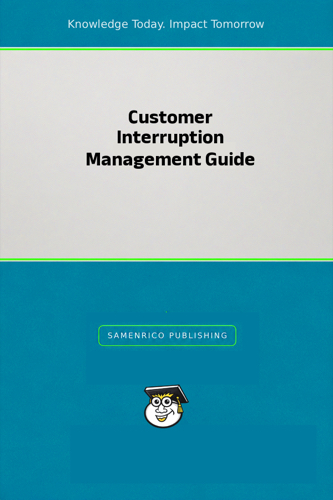
Customer Interruption Management Guide
Blocks customer service time and deflects non-urge
by Knapp Lanny
Blocks customer service time and deflects non-urgent requests.
Formats
About this book
Free sample
Chapter 1: The Hidden Tax--–- It was 2:17 on a Tuesday afternoon when Sarah, a senior customer support agent at a mid-sized software company, received what seemed like an innocent Slack message from a colleague: "Hey, quick question – do you remember the login URL for the old sandbox environment?" She typed back the answer in eleven seconds and returned to the complex ticket she had been resolving. That eleven-second interruption cost her company $347. She never knew it. Neither did her manager. Neither did the CEO who had been complaining about missed revenue targets.
But the math was unforgiving, and the math was invisible.This chapter opens by revealing the single most dangerous illusion in modern customer service: the belief that a short interruption has a short cost. Drawing on cognitive psychology research, workplace productivity studies, and real-world service data, we will dismantle that illusion piece by piece. You will learn the true cost formula that every service leader ignores, the 80/20 rule that turns interruption management into a competitive advantage, and an objective definition of "non-urgent" that gives you permission to protect your focus without guilt. By the end of this chapter, you will never look at a "quick question" the same way again.The $347 Eleven-Second Answer Let us return to Sarah. Her eleven-second response was not the cost.
The cost began after she hit send. According to research published in the journal Human-Computer Interaction, after a brief interruption, knowledge workers require an average of twenty-three minutes and fifteen seconds to return to the same depth of focus. This phenomenon is called the "resumption lag" – the cognitive friction of reloading context, reorienting priorities, and re-establishing flow. During that twenty-three-minute recovery period, Sarah worked at approximately sixty percent of her normal effectiveness. She made two small errors in the ticket she was handling: a mistyped date and a missing attachment.
Those errors generated a follow-up email from the customer the next day, which required another seven minutes of handling.The eleven-second answer, when fully accounted for, consumed twenty-eight minutes of Sarah's time across three days, generated customer friction, and increased her error rate. At…
This is the end of the free sample. Get the eBook to keep going. Buy now
Contents
- Chapter 1
- Chapter 2
- Chapter 3
- Chapter 4
- Chapter 5
- Chapter 6
- Chapter 7
- Chapter 8
- Chapter 9
- Chapter 10
- Chapter 11
- Chapter 12
Details
- Author
- Knapp Lanny
- Publisher
- SamEnrico
- Language
- English
- Genre
- Non-Fiction, Self-Help, Customer Service
- Released
- 2026-06-09
- Pages (approx.)
- 125
- Available as
- eBook, Audiobook

Read better in the ZLOADR app
Your eBooks on your phone or tablet. Sign in with your SamEnrico account and start reading.
More by Knapp Lanny
 Jamaican Customer Sat ImprovementKnapp Lanny$11.99
 The Eliezer Ben Yehuda Hebrew RevivalKnapp Lanny$11.99
 Linguistics Essay PromptsKnapp Lanny$11.99
 Anger Management for Remote WorkersKnapp Lanny$11.99
 The Bloodhound of Beirut: A Victorian-Era Murder Solved by a DogKnapp Lanny$11.99
 BarberKnapp Lanny$11.99
 Reinsurance M&A GuideKnapp Lanny$12.99
 QuickBooks for Retail GuideKnapp Lanny$12.99
 How to Start a Ophthalmic Instruments (wholesale) Business (Beginners Guide)Knapp Lanny$11.99
 Understanding Podder-tolmie SyndromeKnapp Lanny$17.99
You may also like
 Self Esteem for Customer Facing RolesBrock Bradley$11.99
 Hospitality Anger Management GuideBanuelos Madelaine$11.99
 Handling Angry CustomersVillalobos Suzann$11.99
 De escalate Angry Customer GuideGood Tobias$11.99
 Airline Gate Agent Stress GuideEllison Eden$11.99
 Remote Support Communication GuideKingsley Rosalind$11.99
 Customer Service De escalationGarris Barabara$11.99
 Assertiveness In Customer Service GuideStearns Rosaria$11.99
 Pomodoro for Customer SupportBeam John$11.99
 Outsourcing for Customer SupportJenkins Alfred$11.99
 NVC In Customer Support WorkbookCanales Roxann$11.99
 Difficult Conversations With CustomersHope Tomeka$11.99