
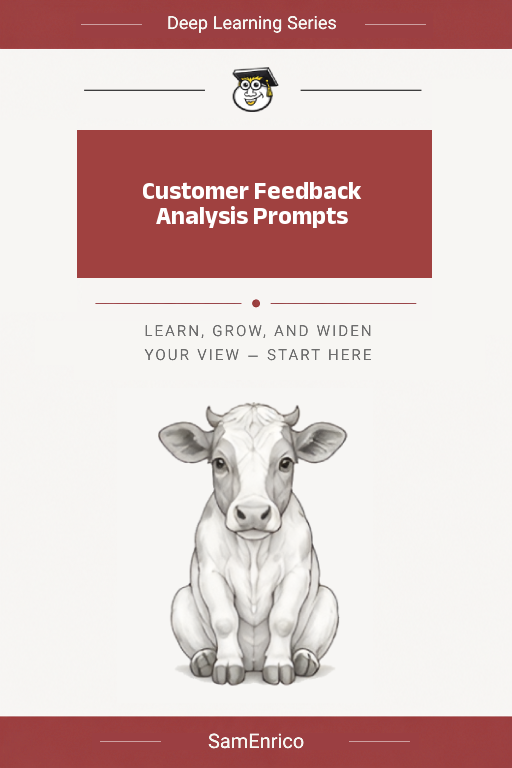
Customer Feedback Analysis Prompts eBook
Extract themes, sentiments, and feature requests f
by Winn Clarita
Extract themes, sentiments, and feature requests from customer feedback using prompts that categorize qualitative data for business analysis.
Formats
Free sample
Chapter 1: The Qualitative Abyss--–- Your company just released its quarterly customer survey. The NPS score is a clean, quantifiable number: 42, down from 47 last quarter. Leadership wants to know why. The product team wants to know what to fix. The marketing team wants to know what to say.
The only data that answers “why” is buried in the open-text comments—two thousand verbatim responses ranging from a single word to several paragraphs. Your team does not have the bandwidth to read them all. The insights stay buried. The score gets debated without context. And another quarter passes without truly understanding what customers actually need.This is the qualitative abyss.
Every organization that collects customer feedback falls into it. Open-ended questions reveal the motivations, frustrations, and unmet needs that structured questions cannot capture. A customer who writes “the checkout process was confusing” is giving you actionable intelligence. A hundred customers who write similar things are giving you a roadmap. But unlike quantitative data—scores, percentages, averages—qualitative responses resist easy aggregation, charting, and analysis at scale.
They sit in spreadsheets, databases, and feedback platforms, unread and untapped, because traditional methods cannot keep up.This chapter explains why qualitative feedback remains so difficult to analyze, examines the limitations of traditional approaches, and introduces the prompt engineering solution that changes everything. By the end, you will understand why your current methods fail and how well-designed prompts with large language models can finally unlock the value buried in customer words.The NPS Paradox: A Number Without a Story The Net Promoter Score is one of the most widely used metrics in business. It is simple, comparable, and easy to track over time. But it is also a trap. A number without context is just a number.
When your NPS drops by five points, you know something happened. You do not know what. You do not know why. You do not know whether to blame product quality, pricing, customer support, or something else entirely.The only data that answers those questions is the open-text follow-up: “What is the primary reason for your score?” Customers who give low scores explain their frustration. Customers who give high scores explain their delight.
But those explanations arrive in unstructured, human language—messy, varied, and impossible to reduce to a single number without losing meaning.Consider the difference. Quantitative data tells you that 23 percent of customers are detractors. Qualitative data tells you that those detractors are frustrated specifically with mobile app crashes after the latest update. Quantitative data tells you that your NPS improved among enterprise customers. Qualitative data tells you that the improvement is driven by a new feature you launched—but also that enterprise customers are still struggling with onboarding.
Quantitative data tells you that sentiment is declining. Qualitative data tells you that the decline is concentrated in the Midwest region and primarily concerns shipping delays.Without qualitative analysis, you have symptoms without causes. You have scores without stories. You have numbers that raise questions but provide no answers. The qualitative abyss is the gap between the questions your leadership team asks and the answers buried in customer words.Three Traditional Approaches and Why They Fail Most organizations attempt to analyze qualitative feedback using one of three traditional approaches.
Each has significant limitations. Understanding these limitations is essential to appreciating why prompt engineering represents such a breakthrough.Manual Tagging: Accurate but Not Scalable Manual tagging is the most straightforward approach. An analyst reads each customer comment and assigns categories, sentiment labels, or tags based on a predefined coding scheme. For small volumes—perhaps fifty comments per survey wave—this works reasonably well. For thousands of comments, it collapses.The first problem is scale.
A skilled analyst can tag perhaps fifty to one hundred comments per hour. A thousand comments require ten to twenty hours of focused work. A typical enterprise survey might generate five thousand to twenty thousand open-text responses. Manual tagging at that volume would require weeks of full-time effort. By the time the analysis is complete, the feedback is months old, and the business has already moved on.The second problem is inconsistency.
Human analysts interpret language differently. One person might tag “the interface is clunky” as a usability issue; another might tag it as a feature request; a third might tag it as negative sentiment without a category. Even the same analyst will be inconsistent over time—fatigue sets in, judgment wavers, and the first hundred comments are coded differently than the last hundred.The third problem is subjectivity. Manual tagging requires judgment calls. What counts as “negative” versus “neutral”?
What is the boundary between “product quality” and “user experience”? Without rigorous, documented rules, manual tagging becomes an exercise in personal opinion. With rigorous rules, the process slows to a crawl.Manual tagging produces accurate results for small samples. For large-scale analysis, it is simply not feasible.Rule-Based Keyword Matching: Fast but Naive Rule-based keyword matching automates categorization using simple rules. If a comment contains the word “shipping,” label it as a delivery issue.
If it contains “bug” or “crash,” label it as a product issue. This approach is fast, consistent, and requires no human reading time.But it is also naive. Language is not that simple.Consider the sentence “Shipping was great, but the product arrived damaged.” Contains the word “shipping”—tagged as delivery. The customer’s real issue is product damage, not shipping speed. The keyword rule missed the nuance entirely.Consider “The mobile app crashes constantly, but customer support was very helpful.” Contains “crash” (product issue) and “support” (service issue).
Which category wins? The rule-based system must choose, but the choice is arbitrary. The customer is telling you about two separate problems, but the system forces them into a single bucket.Consider “This is NOT a billing issue.” Contains the word “billing.” The rule-based system tags it as a billing issue, which is the exact opposite of what the customer said. Negative modifiers destroy simple keyword rules.Synonyms cause another set of problems. “The interface is glitchy,” “the UI is laggy,” “the dashboard is slow,” and “the platform is unresponsive” all describe similar problems using different words.
A rule-based system must be updated continuously with new synonyms, and it will always miss emerging language.Rule-based keyword matching works for narrow, well-defined domains where language is predictable. Customer feedback is not predictable. Customers write creatively, emotionally, and idiosyncratically. Keyword matching cannot keep up.Machine Learning Text Classification: Powerful but Resource-Intensive Traditional machine learning offers a more sophisticated approach. Instead of simple keyword rules, ML models learn patterns from labeled examples.
If you provide thousands of comments already tagged with categories, a model can learn to classify new comments automatically.This approach solves many problems of keyword matching. ML models handle synonyms naturally. They learn to ignore negative modifiers. They can incorporate complex patterns across multiple words. A well-trained model can achieve accuracy comparable to human analysts at near-infinite scale.But the model requires training data.
Thousands of pre-labeled examples. That labeled data must come from somewhere—usually from manual tagging. The cold-start problem is severe: you need the labels to train the model, but you need the model to generate labels at scale. This…
This is the end of the free sample. Get the eBook to keep going. Buy now
About this book
Details
- Author
- Winn Clarita
- Publisher
- SamEnrico
- Language
- English
- Genre
- Non-Fiction, AI Operator
- Released
- 2026-05-30
- Pages (approx.)
- 146
- Available as
- eBook, Audiobook

Read better in the ZLOADR app
Your eBooks on your phone or tablet. Sign in with your SamEnrico account and start reading.
More by Winn Clarita
 Recruiter InMail ResponseWinn Clarita$11.99
 Cannabis Use Disorder and Cardiovascular HealthWinn Clarita$11.99
 Women's Equal Pay Act HistoryWinn Clarita$11.99
 Eyewear Consumption TrendsWinn Clarita$11.99
 Rajneesh Medical ClinicWinn Clarita$11.99
 Non 24 Hour Rhythm DisorderWinn Clarita$11.99
 Caregiver AffirmationsWinn Clarita$11.99
 The Celestial Visionaries: How Black Industrialists Funded the StarsWinn Clarita$11.99
 Neon Labyrinth: The Forgotten Grid of Tokyo's UndergroundWinn Clarita$11.99
 Understanding Multifocal Motor NeuropathyWinn Clarita$11.99
 How to Produce Gardening Sickles and MachetesWinn Clarita$11.99
 A Collector's Handbook to the Chrysler (USA) Chrysler CIWinn Clarita$11.99
You may also like
 Hong Kong Handover 1997Dunn Johnnie$11.99
 Zumba For Postnatal Recovery CourseNeal Christian$11.99
 Zumba for BeginnersLadner Nikia$11.99
 YouTube Comment Mining GuideHumes Pandora$12.99
 Worry Box MeditationCarlin Rudy$11.99
 Workplace Stress MeditationNguyen Lynn$11.99
 Workplace Stress and Sleep RepairHawley Ivory$11.99
 Workplace Perfectionism CureDelaney Jeffry$11.99
 Workplace Injustice Anger GuideWallen Isabelle$11.99
 Work Addiction and Burnout LinkGreenwood Ester$11.99
 Women in Yoga and WellnessBeattie Galina$11.99
 Women in Stand Up ComedyChun Evangeline$11.99