
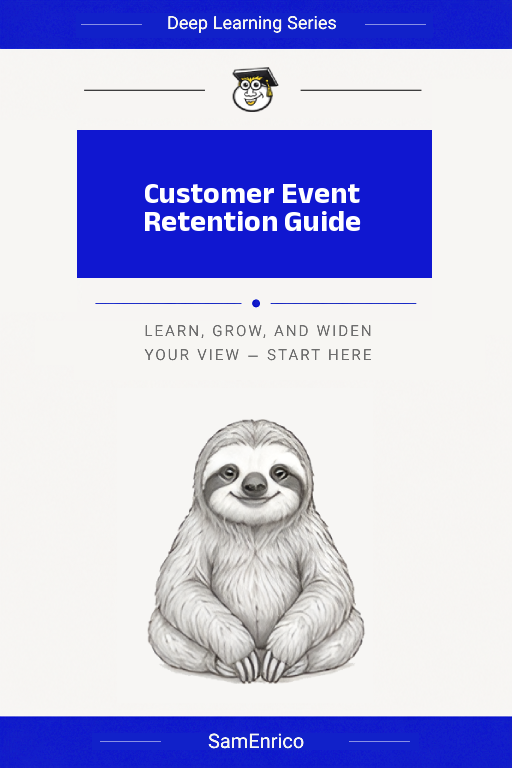
Non-FictionStrategic AtlasEvents
Customer Event Retention Guide eBook
Studies how top performers use customer events, su
by Leblanc Zena
Studies how top performers use customer events, summits, and meetups to drive retention and community building.
Formats
Free sample
Chapter 1: The Silent Exit...--–- The email arrived on a Tuesday. "Dear Team, after careful consideration, we have decided not to renew our annual contract. We've appreciated your support, but our needs have changed." No warning. No negative support tickets. No angry phone calls.
The customer had a 92% product satisfaction score, had attended three webinars, and had never once spoken to a customer success manager about dissatisfaction. They simply left. Quietly. Politely. And took $240,000 in annual recurring revenue with them.This is not an anomaly.
This is the defining crisis of modern subscription businesses.For the past decade, companies have obsessed over customer acquisition. We poured billions into growth marketing, sales development representatives, and "freemium" funnels. We celebrated logos like Olympic medals. We built massive customer success teams armed with playbooks, health scores, and automated email sequences. And yet, despite all of this, the average Saa S company loses between 5% and 15% of its annual recurring revenue to churn every single year.
For every ten customers you sign this quarter, at least one will be gone within twelve months. In some industries, the number is four or five.The problem is not your product. The problem is not your pricing. The problem is not even your support team.The problem is that you have been measuring the wrong thing, optimizing for the wrong outcome, and building relationships on a foundation that was never designed to create loyalty.The Transaction Delusion: Why Satisfaction Doesn't Save You For decades, the gospel of customer success has been built on a deceptively simple equation: Happy customers stay. Unhappy customers leave.
Therefore, if we increase satisfaction, we will decrease churn. This is the "Transaction Delusion"—the belief that customer retention is a rational calculation of value received versus price paid, mediated by the quality of support interactions.The Transaction Delusion manifests in every corner of modern business. It lives in the automated NPS survey that pops into your inbox thirty minutes after a support ticket closes: "How likely are you to recommend us?" It lives in the quarterly business review where the account manager presents a slide deck of product usage metrics and says, "You're getting great value!" It lives in the customer success dashboard that tracks ticket resolution time, feature adoption rates, and login frequency, then assigns a "health score" based on these transactional inputs.Here is the uncomfortable truth that the data reveals: There is almost no correlation between transactional satisfaction and customer loyalty over the long term.A 2019 study of 15,000 B2B customers found that 78% of customers who churned had rated their satisfaction as "good" or "excellent" in the preceding ninety days. They weren't angry. They weren't frustrated.
They were... indifferent. They saw value in the product but felt no emotional attachment to the company. When a competitor offered a slightly better price or a feature that solved an edge case, they switched without guilt or hesitation.This is "silent churn"—the slow erosion of a customer base where no single interaction signals danger, no support ticket escalates, and no health score drops into the red zone. Silent churn is the quiet resignation of customers who renew out of inertia rather than enthusiasm.
They pay their bills. They log in sporadically. They never advocate, never refer, and never expand. And then, one day, they leave.Silent churn is a cancer that metastasizes invisibly. By the time you detect it, the customer is already gone.The Emotional Loyalty Gap To understand why transactional satisfaction fails as a retention strategy, we need to understand how human beings actually make decisions about loyalty.
The answer lies in a branch of psychology called affective neuroscience, which studies the relationship between emotion and behavior.Decades of research have demonstrated that human loyalty—whether to a brand, a community, or a relationship—is driven by a small set of emotional states. These include:Shared identity: "These people are like me. They understand my struggles and my goals."Emotional safety: "I can be honest here without fear of judgment or punishment."Mutual influence: "My voice matters. I can shape what happens next."Need fulfillment: "This group helps me solve problems I cannot solve alone."Shared history: "We have been through things together. That matters."These five factors—which we will explore in depth throughout this book—are the building blocks of what psychologists call "affective commitment." Affective commitment is the emotional bond that makes a customer stay not because they have to (switching costs, contract terms, lack of alternatives) but because they want to.
They stay because leaving would feel like losing something meaningful.Traditional customer success tactics address almost none of these factors.Automated onboarding emails? Transactional. Support ticket systems? Transactional. Quarterly business reviews?
Transactional. NPS surveys? Transactional. Feature release webinars? Transactional.
Renewal reminders? Transactional.Every one of these touchpoints treats the customer as a rational actor making calculated decisions about features, price, and support response times. But human beings are not rational actors. We are emotional creatures who occasionally make rational calculations to justify our emotional decisions.The customers who never churn—the ones who renew year after year, who upgrade without being asked, who refer colleagues and defend you on social media—are not staying because your product has the best feature set. They are staying because they belong.
They have found something in your ecosystem that satisfies the five factors of emotional loyalty. They have found a community.The Event-Led Growth (ELG) Revolution This book introduces a new strategic framework: Event-Led Growth (ELG) . ELG is the practice of using live, interactive, community-driven experiences as the primary engine of customer retention, expansion, and advocacy. It is the deliberate design of belonging.Event-Led Growth is not about webinars. It is not about user conferences as a marketing tactic.
It is not about "lunch and learns" or happy hours. ELG is a fundamental reorientation of how you relate to your customers. It is the recognition that your product is not the center of your customer's world—their problems, their peers, and their professional identity are. Events are the bridge between your product and those deeper drivers.The data behind ELG is compelling. In a 2022 study of 500 B2B Saa S companies, those with mature event programs (defined as three or more event types per customer lifecycle stage) had:3.2x higher net revenue retention (NRR) than companies with no event program47% lower support ticket volume from customers who attended at least one event within their first 90 days58% higher expansion revenue from event attendees compared to non-attendees71% of customers who described themselves as "loyal advocates" had attended a community-hosted event in the prior six months These numbers are not coincidental.
Events create the conditions for emotional loyalty to emerge. They provide shared experiences that build history. They create spaces where customers can see themselves in others, building identity. They establish norms of reciprocity and mutual concern, building safety. They give customers a voice in product direction, building influence.
And they solve problems that documentation and support tickets cannot—the messy, contextual, human problems that require peer insight.Why Traditional Tactics Failed (And What Replaces Them)To understand why ELG works, we must first understand why traditional retention tactics fail. Let us examine three…
This is the end of the free sample. Get the eBook to keep going. Buy now
About this book
Details
- Author
- Leblanc Zena
- Publisher
- SamEnrico
- Language
- English
- Genre
- Non-Fiction, Strategic Atlas, Events
- Released
- 2026-05-29
- Pages (approx.)
- 157
- Available as
- eBook, Audiobook

Read better in the ZLOADR app
Your eBooks on your phone or tablet. Sign in with your SamEnrico account and start reading.
More by Leblanc Zena
 HIIT Immune System BoostLeblanc Zena$11.99
 The Post Scream Repair GuideLeblanc Zena$11.99
 Empathy For Suicidal ThoughtsLeblanc Zena$11.99
 Step Eleven Prayer Meditation GuideLeblanc Zena$11.99
 The Norman Feudalism GuideLeblanc Zena$11.99
 The Last Kingpin: The Rise and Fall of Frank MatthewsLeblanc Zena$11.99
 Shoestring Startup PR GuideLeblanc Zena$12.99
 The Breeder's Guide to Lavender TurkeysLeblanc Zena$11.99
 Interior Design AssistantLeblanc Zena$11.99
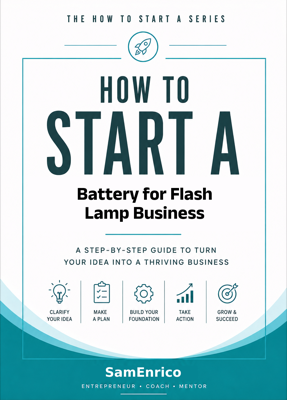 How to Start a Battery for Flash Lamp Business (Beginners Guide)Leblanc Zena$11.99
You may also like
 Hong Kong Handover 1997Dunn Johnnie$11.99
 Zumba For Postnatal Recovery CourseNeal Christian$11.99
 Zumba for BeginnersLadner Nikia$11.99
 YouTube Comment Mining GuideHumes Pandora$12.99
 Worry Box MeditationCarlin Rudy$11.99
 Workplace Stress MeditationNguyen Lynn$11.99
 Workplace Stress and Sleep RepairHawley Ivory$11.99
 Workplace Perfectionism CureDelaney Jeffry$11.99
 Workplace Injustice Anger GuideWallen Isabelle$11.99
 Work Addiction and Burnout LinkGreenwood Ester$11.99
 Women in Yoga and WellnessBeattie Galina$11.99
 Women in Stand Up ComedyChun Evangeline$11.99