
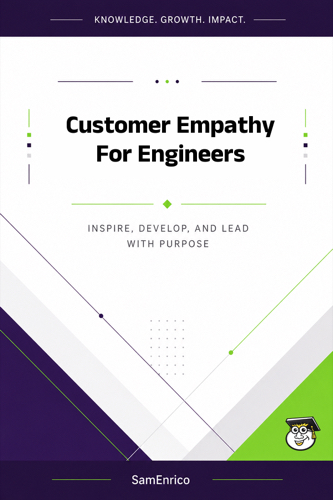
Non-FictionSelf-HelpEmpathyUser Research
Customer Empathy For Engineers eBook
Understand user needs creatively without formal de
Understand user needs creatively without formal design research training.
Formats
Free sample
Chapter 1: The Compile Error...--–- In 2007, a team of forty-seven engineers at a major camera company spent eighteen months building what they called "the most advanced compact camera ever created." It had fifty-three manual controls, a raw image processor, and a menu system with seven nested levels. They were proud. They should have been. By every logical metric—processor speed, megapixel count, dynamic range—they had beaten every competitor. The product launched in September.
By December, it was selling at fifty percent off. By February, it was discontinued.The engineers were baffled. "We gave them everything," the lead architect told a reporter. "We don't understand what more they could want."Across town, a different team had been watching something the first team never thought to look at: actual human beings. Specifically, they had watched a grandmother named Eleanor try to take a picture of her granddaughter's birthday party with a prototype camera.
Eleanor did not care about ISO. She did not know what dynamic range meant. She wanted three things: a big button she could find without reading glasses, a way to turn off the flash so she wouldn't blind the children, and a single step to send the photo to her daughter.The second team removed forty-eight features. They kept a big shutter button, a flash toggle, and a "send to daughter" button that emailed the photo with one click. The camera sold four million units in its first year.The first team had suffered a compile error.
Not in their code—in their assumptions.The Engineer's Blind Spot If you are reading this book, you are likely someone who takes pride in logic. You write clean functions. You optimize for edge cases. You believe that if you just understand the system well enough, you can predict its behavior perfectly. This works brilliantly for machines.It fails catastrophically for humans.Here is the problem: engineers are trained to find correct solutions.
Human behavior is not correct or incorrect—it is messy, contradictory, and context-dependent. When you assume that your own logic applies to all users, you do not build bad products. You build products that perfectly solve a problem no one has. That is worse than bad. That is wasted time, wasted money, and wasted careers.The grandmother test taught us something uncomfortable: the best engineer in the world is a terrible proxy for the average user.
You are not the user. Your tech-savvy friends are not the user. Your CEO is definitely not the user. And yet, every day, product decisions are made based on what "makes sense" to the people building the product, not the people using it.This chapter is about why that happens and what to do about it. We will name the specific cognitive roadblocks that keep engineers stuck in their own perspective.
We will distinguish between what users actually need versus what they can articulate. And you will walk away with a concrete tool—an Assumption Inventory—that you can apply to any project starting tomorrow.But first, we need to talk about why smart people make dumb assumptions.The Four Roadblocks to Empathy Over a decade of studying engineering teams, I have observed four distinct patterns of failure. These are not personality flaws. They are cognitive defaults—mental shortcuts that work beautifully for debugging code but destroy your ability to understand users. I call them the Four Roadblocks.Roadblock 1: Idealism The idealistic engineer builds for how the world should work, not how it does work.You see this in authentication systems that require twelve-character passwords with special symbols, numbers, and capital letters—because "users should have secure passwords." And then you see the sticky note on the monitor with "Password123!" written in Sharpie.
The user is not wrong. They are adapting to a system that ignored their reality.Idealism says: "If users would just read the documentation, they would understand." Reality says: users will not read the documentation. They will click buttons randomly until something works, and then they will keep doing that thing forever, even if it is wrong.The idealistic engineer blames the user. The empathetic engineer blames the design.Here is the test: if you have ever said "they should just..." in a product meeting, you are in Roadblock 1. "They should just update their browser." "They should just read the error message." "They should just know that clicking the logo takes you home." These are not facts.
These are fantasies about a world that does not exist.Roadblock 2: Egocentrism The egocentric engineer assumes that other people think exactly like them.This is the most dangerous roadblock because it feels like empathy. "I would want this feature, so users will want it." "I find this menu intuitive, so it is intuitive." The egocentric engineer is not malicious—they are genuinely trying to put themselves in the user's shoes. The problem is that they are putting themselves in the user's shoes while wearing their own brain.Consider the keyboard shortcut debate. An engineer argues passionately that Ctrl+Shift+Alt+S is the perfect shortcut for saving a draft. It is not used by any other program.
It is mnemonic if you think about it (Save + Shift + Alt + Secondary?). The engineer has memorized it. The engineer uses it every day. The engineer cannot understand why users keep clicking the file menu.The answer is that users have not spent four hundred hours with this software. They have spent four minutes.
They do not think like you because they have not been steeped in your logic for months. They have other things on their mind—their boss, their kids, the fact that they have not eaten lunch. Your feature is not the center of their universe. It is a speed bump.Here is the test: if you have ever been genuinely surprised that a user did not know something "obvious" about your product, you are in Roadblock 2. That thing was not obvious.
You just forgot that you learned it.Roadblock 3: Misguided Realism The misguided realist rejects user feedback because "that edge case is statistically rare."On the surface, this sounds smart. Engineers are taught to prioritize. You cannot solve every problem. Some users will always fall through the cracks. The misguided realist takes this reasonable principle and applies it to the wrong situations.The problem is that "rare" does not mean "unimportant." It often means the opposite.
The user who cannot log in because of a bug that affects 0.1% of sessions is not a statistic. They are a person who is currently locked out of their work, missing a deadline, and telling everyone they know that your product is garbage.The misguided realist also misunderstands how rare problems become common problems. Today's edge case is tomorrow's main use case. When Gmail launched, archiving email was a weird power-user feature. Now it is the default behavior for billions of people.
The user who cannot find the archive button is not an edge case—they are a sign that you designed something poorly.Here is the test: if you have ever said "that only affects 1% of users" as a reason to close a bug without fixing it, you are in Roadblock 3. Ask yourself: if…
This is the end of the free sample. Get the eBook to keep going. Buy now
About this book
Details
- Author
- Carnahan Gerry
- Publisher
- SamEnrico
- Language
- English
- Genre
- Non-Fiction, Self-Help, Empathy, User Research
- Released
- 2026-06-07
- Pages (approx.)
- 147
- Available as
- eBook, Audiobook

Read better in the ZLOADR app
Your eBooks on your phone or tablet. Sign in with your SamEnrico account and start reading.
More by Carnahan Gerry
 Downsize Without MovingCarnahan Gerry$11.99
 Cali Cartel Phones TappedCarnahan Gerry$11.99
 Dialysis Technician StressCarnahan Gerry$11.99
 Social Entrepreneur Succession PlanCarnahan Gerry$11.99
 The Lost Expedition: Mawson's Arctic of the OutbackCarnahan Gerry$11.99
 The Last Voyage of the Marie Celeste: A Ghost Ship’s SecretCarnahan Gerry$11.99
 How to Become a Casket InspectorCarnahan Gerry$11.99
 UAE VAT Return FilingCarnahan Gerry$12.99
 Running Remote Strategy Meetings Across Time ZonesCarnahan Gerry$12.99
 Understanding Familial Ventricular TachycardiaCarnahan Gerry$17.99
 Remote Programming (Car/key Fob)Carnahan Gerry$11.99
You may also like
 Hong Kong Handover 1997Dunn Johnnie$11.99
 Zumba For Postnatal Recovery CourseNeal Christian$11.99
 Zumba for BeginnersLadner Nikia$11.99
 YouTube Comment Mining GuideHumes Pandora$12.99
 Worry Box MeditationCarlin Rudy$11.99
 Workplace Stress MeditationNguyen Lynn$11.99
 Workplace Stress and Sleep RepairHawley Ivory$11.99
 Workplace Perfectionism CureDelaney Jeffry$11.99
 Workplace Injustice Anger GuideWallen Isabelle$11.99
 Work Addiction and Burnout LinkGreenwood Ester$11.99
 Women in Yoga and WellnessBeattie Galina$11.99
 Women in Stand Up ComedyChun Evangeline$11.99