
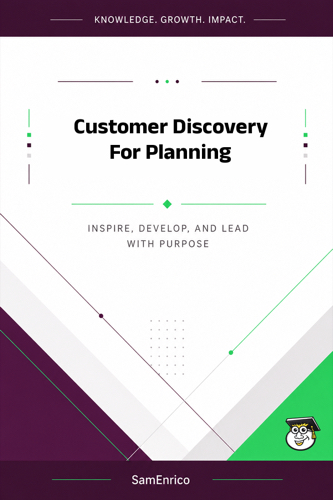
Non-FictionStartup GuideCustomer Development
Customer Discovery For Planning eBook
Interview potential customers before writing plan
by Briggs Clint
Interview potential customers before writing plan to ground assumptions in reality.
Formats
Free sample
Chapter 1: The Fiction Factory--Every business plan is a novel. Some are thrillers. Most are tragedies. Yours is probably both—you just don't know it yet.Let me prove this to you in thirty seconds.Think about the last business plan you wrote, read, or contributed to. It probably had sections labeled "Market Size," "Customer Problem," "Solution Overview," "Revenue Model," and "Competitive Analysis." Those sections contained numbers—specific, confident numbers.
You wrote things like "40% of target customers will convert in year one" or "average deal size of $5,000" or "churn rate under 5%."Now answer this: Where did those numbers come from?If you are like 99% of founders, executives, and MBA graduates, those numbers came from one of three places: a spreadsheet model built on assumptions you Googled, a competitor's public filing that you adjusted slightly downward to appear humble, or your own gut feeling dressed in business casual clothing.None of those are facts. They are guesses. They are fiction. And you are betting your time, money, and reputation on them.This book exists because that fiction is expensive.The $1.2 Million Mistake I once worked with a serial entrepreneur named Marcus. He had raised $1.2 million for a B2B Saa S platform that helped construction companies manage subcontractor compliance.
His plan was immaculate: forty-seven pages, eleven charts, three financial scenarios (optimistic, realistic, conservative), and a go-to-market strategy that named specific trade show booths he would rent.Marcus had done everything right—according to business school.He had identified a problem (compliance paperwork was a mess). He had sized the market (hundreds of thousands of construction firms). He had built a solution (elegant code, beautiful UI, automated workflows). He had even done "customer discovery"—he had interviewed twelve construction company owners at a trade show in Las Vegas.Every single one of those owners told him the same thing: "Yes, we have that problem. Yes, we would use a solution like yours.
Yes, we would pay for it."Marcus built the product in eight months. He launched to silence. He sold exactly three subscriptions in the first quarter. His investors pulled their follow-on funding. The company died.What happened?The twelve construction owners at the trade show had lied to Marcus.
Not maliciously. Not even consciously. They had given him what every founder desperately wants to hear: polite, agreeable, worthless validation.Because here is the truth that Marcus learned too late: people say "yes" to avoid conflict. They say "yes" because they like you. They say "yes" because it costs them nothing to be optimistic about your future product while they walk back to their real problems.
And then they never pay, never switch, never change their behavior.Marcus had not done customer discovery. He had done customer theater. He had written a novel and called it a plan.The House of Cards The metaphor for this book—and for your business plan—is a house of cards.Each assumption you make is a card. On its own, it looks solid. It stands upright.
It seems reasonable. But when you stack assumptions on top of assumptions, the entire structure becomes precarious. One real-world wind—one customer who does not behave as predicted, one competitor who moves differently than expected, one pricing assumption that proves wrong—and the whole thing collapses.The tragedy is not that the house collapses. The tragedy is that you spent months building it before discovering that the foundation was sand.This book will teach you how to test every card before you place the next one on top. By the time you finish these twelve chapters, you will have a single question that destroys the fiction factory: "How do you know that?"If you cannot answer that question with a specific, verifiable, behavioral fact from a real human customer, you do not know it.
You are guessing. And guessing is expensive.The Assumption vs. Knowledge Distinction Let us draw a hard line in the sand.An assumption is any belief you hold about your customer, problem, solution, or business model that you have not yet verified through direct observation of human behavior. Assumptions are not bad. They are necessary.
Every business starts with assumptions. The danger is not having assumptions. The danger is treating them like facts.Knowledge is a belief that you have tested through a structured interaction with a real customer and found to be consistent with observed behavior. Knowledge has a date attached to it. Knowledge has a source: "On March 15th, we interviewed Sarah, a marketing director at a $50M Saa S company.
She told us that she currently spends 8 hours per week manually reconciling ad spend across four platforms. When we asked what she has tried to fix this, she showed us a spreadsheet she built herself."That is knowledge. It is imperfect, incomplete, and may change. But it is not fiction.Your job before writing a plan is to convert as many assumptions as possible into knowledge. You will never convert all of them—that is impossible.
But you will convert the right ones. The ones that, if wrong, would destroy your business.The Failure Bow: A New Ritual Most business cultures punish failure. If you make an assumption and it proves wrong, you look foolish. You wasted time. You get a disappointed look from your investors or your boss.That culture is why businesses build fiction.This book requires you to adopt a new ritual: The Failure Bow.Every time you discover that one of your assumptions is false, you will bow.
Literally or metaphorically, you will acknowledge that you have just saved yourself weeks, months, or years of building the wrong thing. You will celebrate the failure. You will thank the customer who proved you wrong. You will mark it in your notes with a special symbol (I use a small bow emoji 🙇).Why? Because a false assumption discovered in a 30-minute interview costs you nothing except a bit of pride.
A false assumption discovered after six months of development costs you your company.The Failure Bow rewires your brain to see contradiction as a gift. When a customer says something that shatters your hypothesis, your first reaction should not be to defend or rationalize. It should be to bow and say, "Thank you. You just saved me."This is not toxic positivity. This is economic reality.
Every false assumption you discover is money that stays in your bank account and months of your life that you get back.The Kill List: Your Three Most Dangerous Guesses Not all assumptions are created equal.Some assumptions, if wrong, mean you adjust your pricing. Some mean you change a feature. Some mean you rewrite your marketing copy. Annoying, but survivable.Other assumptions, if wrong, mean your business does not exist. There is no pivot.
There is no workaround. You are solving a problem nobody has, selling to a customer who cannot buy, or building a solution that cannot work.These are Kill List assumptions. You will identify exactly three of them. Not two. Not four.
Three.Why three? Because the human brain can hold three priorities simultaneously. More than three, and you are not prioritizing—you are listing. The Kill List is not a grocery…
This is the end of the free sample. Get the eBook to keep going. Buy now
About this book
Details
- Author
- Briggs Clint
- Publisher
- SamEnrico
- Language
- English
- Genre
- Non-Fiction, Startup Guide, Customer Development
- Released
- 2026-06-08
- Pages (approx.)
- 133
- Available as
- eBook, Audiobook

Read better in the ZLOADR app
Your eBooks on your phone or tablet. Sign in with your SamEnrico account and start reading.
More by Briggs Clint
 Cognitive Distortions in Sex AddictionBriggs Clint$11.99
 Anchoring Persuasion EffectBriggs Clint$11.99
 Age Difference Self EsteemBriggs Clint$11.99
 The Baghdad Bank Heist: A Million-Dollar BetrayalBriggs Clint$11.99
 Manager Assistant StoreBriggs Clint$11.99
 Remote Presentation Eye ContactBriggs Clint$12.99
 Learn to Play the IgilBriggs Clint$11.99
 How to Start a Picnic Grounds BusinessBriggs Clint$11.99
You may also like
 Hong Kong Handover 1997Dunn Johnnie$11.99
 Zumba For Postnatal Recovery CourseNeal Christian$11.99
 Zumba for BeginnersLadner Nikia$11.99
 YouTube Comment Mining GuideHumes Pandora$12.99
 Worry Box MeditationCarlin Rudy$11.99
 Workplace Stress MeditationNguyen Lynn$11.99
 Workplace Stress and Sleep RepairHawley Ivory$11.99
 Workplace Perfectionism CureDelaney Jeffry$11.99
 Workplace Injustice Anger GuideWallen Isabelle$11.99
 Work Addiction and Burnout LinkGreenwood Ester$11.99
 Women in Yoga and WellnessBeattie Galina$11.99
 Women in Stand Up ComedyChun Evangeline$11.99