
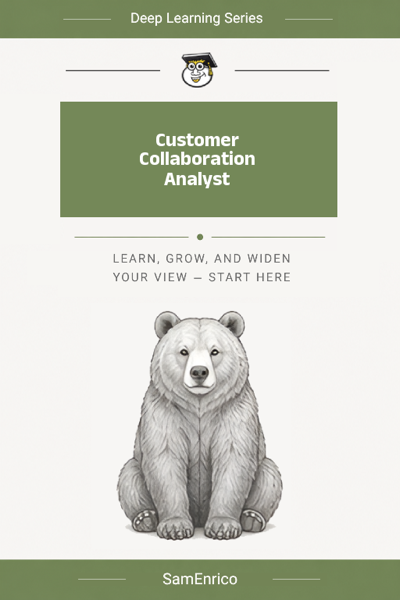
Customer Collaboration Analyst eBook
A Coursebook on Customer Collaboration Analyst
by Hills Branda
A Coursebook on Customer Collaboration Analyst
Formats
Free sample
Chapter 1: The Collaboration Trap...--–- Sarah had just spent three weeks building the perfect churn model. She had cleaned the data, validated the assumptions, run sensitivity analyses, and created a dashboard so elegant that her manager had called it “a work of art.” She presented it to the client with confidence. The VP of Sales nodded politely, thanked her for her time, and promptly ignored every single recommendation. Six months later, the client lost their largest account. Sarah was placed on a performance improvement plan.
She wasn’t wrong. She was irrelevant.This is the single most dangerous condition facing analysts today. You can be technically flawless, statistically rigorous, and analytically brilliant – and still fail. Not because your data is bad. Not because your insights are wrong.
But because no one did anything with them. The gap between insight and action has always been wide, but in the age of self-service BI and automated reporting, that gap has become a chasm. Clients no longer pay for spreadsheets or dashboards. They pay for shared understanding and action. And if you cannot deliver both, you are not an analyst.
You are an expensive report generator waiting to be automated.Welcome to the collaboration trap. It looks like this: you work harder, deliver more, and are valued less. Your reports get longer, your dashboards get more complex, and your inbox fills with “thank you” emails that never translate into actual decisions. The client asks for “just one more slice” of data, and you provide it, thinking you are being helpful. But you are not being helpful.
You are being used as a crutch for their indecision. The collaboration trap is the silent career killer of the modern analytics profession, and most analysts do not even know they are in it until they are being piped out.This book exists to get you out of that trap and into a new role: the Customer Collaboration Analyst. This is not a job title you will find on Linked In – yet. It is a competency, a mindset, and a practice that sits at the intersection of three established fields: data analytics (discovering the “what”), customer experience (understanding the “why”), and business collaboration (driving the “how”). The Customer Collaboration Analyst, or CCA, does not just find answers.
They make those answers matter. They sit beside the client, translate raw data into a shared narrative, and align cross-functional teams to act. They treat collaboration not as a soft skill but as a technical deliverable with its own metrics, frameworks, and disciplines.The Cost of Being Ignored Before we build the solution, we must understand the full cost of the problem. Every day, across every industry, analysts are producing work that never sees the light of action. A study by Gartner found that more than 60 percent of analytics projects fail to drive measurable business outcomes.
Not because the analytics were wrong, but because they were not adopted. Think about that for a moment. More than half of the work being done by professional analysts – the queries, the models, the dashboards, the reports – leads to no change whatsoever. That is not a failure of technique. That is a failure of collaboration.The cost is not merely wasted effort.
It is lost revenue, churned clients, and stalled careers. When a client ignores your insight, they are not just ignoring a chart. They are ignoring an opportunity to retain a customer, reduce friction, or capture market share. And eventually, they will blame you for not being “strategic enough.” The cruel irony is that you were strategic. You found the signal in the noise.
You just did not know how to make them care.Consider the story of Marcus, a senior data scientist at a mid-sized Saa S company. Marcus built a predictive model that identified which clients were at risk of churning with 85 percent accuracy. He presented his findings to the Customer Success team. They nodded, asked for a few more columns of data, and then did nothing. Three months later, churn spiked.
The Customer Success director blamed “poor data quality.” Marcus was asked to “improve his model.” The model was not the problem. The lack of a collaborative process was the problem. No one had agreed on what to do with the predictions. No one owned the next step. No one had been brought into the discovery process.
Marcus was a brilliant detective who had never learned to be a diplomat.The Three Personas of the Customer Collaboration Analyst To escape the collaboration trap, you must embody not one role but three. The Customer Collaboration Analyst is simultaneously a Detective, a Journalist, and a Diplomat. Each persona serves a distinct function, and the best analysts learn to move fluidly between them depending on the situation.The Detective is the persona most analysts are comfortable with. The Detective uncovers hidden patterns, validates data quality, and answers the question “what happened?” The Detective writes the SQL queries, builds the statistical models, and sanity-checks the assumptions. Without the Detective, you have no truth.
But the Detective alone cannot drive action. Data without narrative is just noise.The Journalist takes the Detective’s findings and crafts them into a compelling story. The Journalist selects the right evidence, structures the narrative for a specific audience, and answers the question “why does it matter?” The Journalist knows that a chart with a headline is worth ten charts without one. The Journalist understands that executives do not have time to “explore the data” – they need to be told what to think, clearly and concisely. But even the Journalist cannot close the gap to action.
Storytelling without negotiation is just performance.The Diplomat is the persona that most analysts neglect, to their professional peril. The Diplomat negotiates trade-offs, aligns conflicting priorities, and secures commitment to act. The Diplomat answers the question “what are we going to do about it?” The Diplomat knows that data can be perfect and the story can be beautiful, but if the Economic Buyer is threatened, the technical team is overloaded, or the end user is confused, nothing will happen. The Diplomat navigates the political landscape of the client organization and ensures that insights become decisions.The Collaboration Spectrum: Facilitator to Driver A critical nuance that separates this book from every other analytics text is the recognition that the analyst’s role exists on a spectrum. On one end of the spectrum is the Facilitator.
The Facilitator guides the client to discover their own answers. They ask Socratic questions, run co-creation workshops, and ensure that the client owns the solution. On the other end of the spectrum is the Driver. The Driver steps in when facilitation has failed, when the client is stalling, or when a hard decision needs to be made. The Driver secures commitment, escalates when necessary, and takes ownership of the outcome.Most books tell you to be one or the other.
Be a facilitator. Be a consultant. Or be a driver. Be a leader. The truth is that you need to be both, and you need to know when to shift.
The Collaboration Spectrum is the framework that allows you to do that. Early in a project, when you are discovering…
This is the end of the free sample. Get the eBook to keep going. Buy now
About this book
Details
- Author
- Hills Branda
- Publisher
- SamEnrico
- Language
- English
- Genre
- Non-Fiction, Informative, Educational
- Released
- 2026-05-09
- Pages (approx.)
- 134
- Available as
- eBook, Audiobook

Read better in the ZLOADR app
Your eBooks on your phone or tablet. Sign in with your SamEnrico account and start reading.
More by Hills Branda
 Stolen Goods Fence NetworkHills Branda$11.99
 Purchase Multiple CompendiumHills Branda$11.99
 Parental Addiction and DeathHills Branda$11.99
 Lactose Free Grocery Shopping CourseHills Branda$11.99
 The Unseen Crown: The Rise and Fall of the First Female PharaohHills Branda$11.99
 From Ashes to Apollo: The Unlikely Return of Apollo 13Hills Branda$11.99
 Understanding Cassia–stocco–dos Santos SyndromeHills Branda$17.99
 Proctored Math Exam GuideHills Branda$12.99
 DUNS Number Activation GuideHills Branda$12.99
 How to Start a Potato Growing Business (Beginners Guide)Hills Branda$11.99