
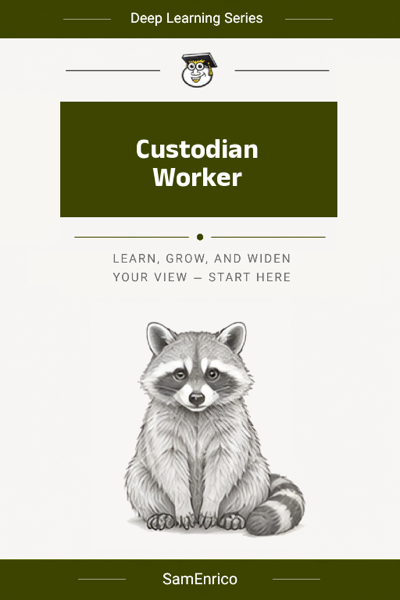
Non-FictionInformativeEducational
Custodian Worker eBook
A Coursebook on Custodian Worker
A Coursebook on Custodian Worker
Formats
Free sample
Chapter 1: Beyond the Mop...--–- The fluorescent lights of the high school flickered to life at 5:17 AM, casting long shadows across the polished terrazzo hallway. Maria adjusted her grip on the mop handle, took a deep breath, and began her daily ritual. In four hours, 1,800 students would flood these corridors. They would never know her name. They would never see the careful way she wiped the corners of every locker bank or the precision with which she applied floor finish to the gymnasium.
But if she did her job poorly, everyone would notice. The smell would linger. The floors would feel sticky. The restrooms would become a topic of whispered complaints. This is the paradox of the professional custodian: success is invisible, but failure is unmistakable.For decades, the custodial profession has suffered from a profound identity crisis.
The public imagines a janitor with a key ring and a push broom, someone whose primary qualification is the ability to lift heavy objects and tolerate unpleasant smells. Popular culture has reinforced this stereotype through characters like Groundskeeper Willie from The Simpsons or the perpetually ignored janitor in countless sitcoms who dispenses wisdom while emptying trash cans. These portrayals, while sometimes affectionate, have done immense damage to the profession. They suggest that custodial work requires no specialized knowledge, no strategic thinking, and no professional judgment. Nothing could be further from the truth.The modern custodian is, in fact, a multi-disciplinary professional whose work touches on chemistry, biology, physics, public health, safety engineering, and facilities management.
A custodian makes decisions every shift that affect the health of hundreds or thousands of people. A custodian identifies potential safety hazards before they cause injuries. A custodian protects millions of dollars in building assets through preventive maintenance. And increasingly, a custodian serves as the frontline defense against infectious diseases that can shut down entire organizations. This chapter dismantles the outdated stereotype and rebuilds the custodian as what they truly are: a facility health and safety specialist whose work has direct, measurable impacts on human well-being and organizational success.The Economic Reality of Preventive Maintenance Every building is a collection of assets that are constantly depreciating.
Floors wear down. Carpets stain and tear. Surfaces accumulate damage from use and abuse. A building that receives no custodial attention will, in most cases, require complete replacement of its interior finishes within five to seven years. A building that receives professional custodial care can extend that timeline to fifteen or even twenty years.
The difference is not marginal—it is transformative.Consider the example of vinyl composition tile, or VCT, which remains the most common commercial flooring material in American schools and offices. A typical VCT floor costs between three and five dollars per square foot to install. For a fifty-thousand-square-foot facility—roughly the size of a medium-sized elementary school or a small office building—the floor represents an investment of $150,000 to $250,000. With minimal custodial care (daily sweeping and occasional damp mopping), that floor will begin showing significant wear within three years. By year five, the tiles may be scratched, discolored, and stained beyond repair.
By year seven, replacement becomes inevitable.Now consider the same floor with professional custodial care. Daily dust mopping removes abrasive soil before it can scratch the surface. Periodic scrubbing and recoating (typically every three to six months) renews the protective finish layer. Annual or semi-annual stripping removes the old, damaged finish entirely and replaces it with a fresh system. With this regimen, the same VCT floor can last fifteen to twenty years.
The custodial supplies required for this maintenance cost approximately $0.15 to $0.25 per square foot per year. Over a fifteen-year period, the facility saves between $100,000 and $175,000 in avoided replacement costs.Carpet tells a similar story. A commercial-grade carpet costs four to eight dollars per square foot installed. With only vacuuming and spot cleaning, that carpet will show significant wear, staining, and compaction within five years. By year seven, it will look shabby and may harbor allergens and bacteria that affect indoor air quality.
With professional maintenance—regular HEPA vacuuming, prompt spot treatment, and annual hot water extraction—the same carpet can last twelve to fifteen years. The annual cost of extraction cleaning is roughly $0.10 to $0.15 per square foot. Over a ten-year period, the savings in avoided replacement easily exceed $50,000 for a modestly sized facility.These numbers are not theoretical. They have been documented by facilities management organizations including the International Sanitary Supply Association (ISSA) and the Building Owners and Managers Association (BOMA). Yet most facility owners and managers do not calculate the return on investment for custodial services.
They treat cleaning as an expense to be minimized rather than an investment to be optimized. This is a costly error. A reduction in custodial staffing of twenty percent might save $40,000 per year in labor costs, but if it reduces the lifespan of the facility's finishes by just two years, the replacement costs will wipe out those savings many times over.The professional custodian understands this economic reality. They do not see themselves as a cost center. They see themselves as asset preservation specialists.
Every time they apply floor finish, every time they extract a carpet, every time they properly maintain a piece of equipment, they are adding years of useful life to the building. This is not cleaning. This is wealth preservation.The Psychology of Cleanliness: How Clean Spaces Shape Human Behavior Cleanliness affects more than just the physical condition of a building. It affects the psychological state of every person who enters that building. Research in environmental psychology has consistently demonstrated that perceived cleanliness influences mood, productivity, trust, and even ethical behavior.A landmark study published in the Journal of Environmental Psychology in 2015 examined the relationship between office cleanliness and worker productivity.
Researchers measured the cleanliness of fifty office environments using standardized assessment tools, then correlated those scores with self-reported productivity and objective performance metrics. The findings were striking: workers in the cleanest offices reported fifteen to twenty percent higher productivity than workers in the dirtiest offices. They also reported lower stress levels, fewer headaches, and greater job satisfaction. The effect persisted even after controlling for factors like salary, job role, and office size.Why does cleanliness affect productivity? Part of the answer lies in cognitive load theory.
When a person works in a visibly dirty environment, their brain must constantly process and filter out distracting stimuli—the stain on the carpet, the dust on the blinds, the smudge on the window. This unconscious processing consumes mental resources that could otherwise be devoted to the task at hand. A clean environment, by contrast, is cognitively invisible. It does not demand attention. It fades into the background, allowing full concentration on work.The effect extends beyond individual productivity to organizational trust and reputation.
Consider the restroom. Most visitors to a facility will use the restroom within the first hour of their visit. If that restroom is dirty—if the floor is sticky, if there is no soap, if the toilet paper is empty, if unpleasant odors linger—the visitor will form a negative impression of the entire organization within seconds. This is not a conscious judgment. It is an automatic, emotional response rooted in evolutionary psychology.…
This is the end of the free sample. Get the eBook to keep going. Buy now
About this book
Details
- Author
- Horner Shakia
- Publisher
- SamEnrico
- Language
- English
- Genre
- Non-Fiction, Informative, Educational
- Released
- 2026-06-02
- Pages (approx.)
- 146
- Available as
- eBook, Audiobook

Read better in the ZLOADR app
Your eBooks on your phone or tablet. Sign in with your SamEnrico account and start reading.
More by Horner Shakia
 Veteran Suicide Attempt StoryHorner Shakia$11.99
 Chronic Illness Child Self WorthHorner Shakia$11.99
 Assertive Communication for SeniorsHorner Shakia$11.99
 The Home Decor Instagram EnvyHorner Shakia$11.99
 Middle Splits Hip AdductorHorner Shakia$11.99
 The Eagle and the Fox: Murat's Daring Ride at EylauHorner Shakia$11.99
 How to Start a Periodical Publishing Business (Beginners Guide)Horner Shakia$11.99
 Understanding N-acetyl-alpha-d-galactosaminidaseHorner Shakia$17.99
 Citation Rules for Nursing StudentsHorner Shakia$12.99
 Role Level Gap Analysis ToolHorner Shakia$12.99
You may also like
 Hong Kong Handover 1997Dunn Johnnie$11.99
 Zumba For Postnatal Recovery CourseNeal Christian$11.99
 Zumba for BeginnersLadner Nikia$11.99
 YouTube Comment Mining GuideHumes Pandora$12.99
 Worry Box MeditationCarlin Rudy$11.99
 Workplace Stress MeditationNguyen Lynn$11.99
 Workplace Stress and Sleep RepairHawley Ivory$11.99
 Workplace Perfectionism CureDelaney Jeffry$11.99
 Workplace Injustice Anger GuideWallen Isabelle$11.99
 Work Addiction and Burnout LinkGreenwood Ester$11.99
 Women in Yoga and WellnessBeattie Galina$11.99
 Women in Stand Up ComedyChun Evangeline$11.99