
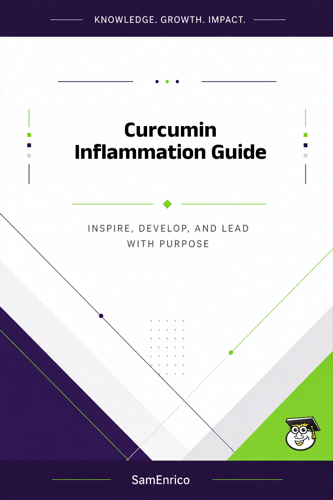
Non-FictionHealth & WellnessRheumatology
Curcumin Inflammation Guide eBook
Reduce joint pain and neuroinflammation with turme
Reduce joint pain and neuroinflammation with turmeric extract.
Formats
Free sample
Chapter 1: The Golden Molecule...--–- On a humid morning in Mumbai, a 68-year-old former accountant named Arvind did something he had not done in eleven years: he sat down on the floor to tie his shoes. For nearly a decade, arthritic knees had forced him to sit on a chair, lift his foot onto his opposite thigh, and struggle with laces while wincing. His morning stiffness lasted two hours. His orthopedist had prescribed diclofenac, then celecoxib, then a tentative conversation about knee replacement. Arvind had tried turmeric tea—his grandmother’s remedy—and felt nothing.
He assumed the spice was a relic of folklore, a comfort food with no real power. Then his daughter, a pharmacist in London, sent him a bottle of curcumin extract. Not the yellow powder from the kitchen. Something darker, more concentrated, almost orange-red in its intensity. Three weeks later, he texted her a photo of his shoes, tied while sitting cross-legged on a yoga mat.
The caption read: “I forgot what this felt like.”Arvind is not a miracle. He is not an outlier published in a medical journal. He is one of thousands of people who have discovered the gap between what we think we know about turmeric and what the science actually says. That gap is the subject of this chapter—and this entire book. Because the molecule that changed Arvind’s knees is the same molecule that may protect your brain from the slow fire of neuroinflammation.
But to understand why, you must first unlearn almost everything you have heard about turmeric.The Spice That Fooled the World Turmeric (Curcuma longa) is a rhizome, an underground stem that resembles ginger’s uglier cousin. It has been used in India for over four thousand years as a dye, a culinary spice, and a medicine. In Ayurveda, the traditional system of Indian medicine, turmeric is classified as a rasayana—a rejuvenative that cleanses the channels of the body (Srotas) and reduces Ama, a sticky, toxic residue of incomplete digestion. Ancient texts prescribed it for jaundice, wounds, respiratory infections, and arthritis. But here is the critical fact that Ayurvedic practitioners did not know: turmeric by weight is only two to five percent curcuminoids.
And of those curcuminoids, the most biologically active—the one that interacts with human inflammation pathways—is a single molecule called curcumin. That molecule makes up barely one to two percent of the raw spice.Let that sink in. One hundred grams of turmeric powder—about half a cup—contains roughly one to two grams of curcumin. The rest is starch, fiber, volatile oils (turmerones, which have their own mild benefits), and water. When you sprinkle turmeric into golden milk or curry, you are consuming a tiny fraction of the molecule that actually does the work.
This is not a failure of tradition. It is a failure of translation. Grandmothers who swore by turmeric tea were not wrong; they were simply working with a tool that was too blunt for the job. Their remedies produced subtle, inconsistent effects because the dose of curcumin in a cup of tea is vanishingly small—often less than fifty milligrams, and poorly absorbed at that.Modern supplement companies capitalized on this confusion. Walk into any health food store, and you will see bottles labeled “Turmeric 500 mg” next to “Curcumin 95%” next to “Curcumin Complex with Black Pepper.” Most consumers assume these are interchangeable.
They are not. The difference between grocery store turmeric and a properly formulated curcumin extract is the difference between splashing a glass of wine on a wound and receiving intravenous antibiotics. Both contain active ingredients. Only one delivers them in a concentration and form that can alter disease.The Extraction Revolution: How We Learned to Concentrate a Molecule Understanding curcumin requires understanding how it is extracted from the rhizome. This is not academic trivia.
The method of extraction determines purity, potency, and—most importantly—whether you are ingesting toxic solvent residues along with your anti-inflammatory.The oldest commercial method is solvent extraction. The turmeric rhizome is dried, ground, and soaked in a solvent such as ethanol (drinking alcohol), acetone (nail polish remover), or ethyl acetate (a sweet-smelling industrial solvent). The solvent dissolves the curcuminoids, which are then separated from the liquid, dried, and powdered. Solvent extraction is cheap and efficient. It yields a concentrated product—typically 95% curcuminoids—with minimal equipment.
But there is a catch. Unless the manufacturer performs additional purification steps (which add cost), trace amounts of solvent remain in the final product. Acetone, in particular, is a neurotoxin at high doses. Regulatory agencies allow small residual amounts, but “allowed” is not the same as “optimal.” For a supplement taken daily for months or years, even trace solvents represent an unnecessary risk.The superior alternative is supercritical carbon dioxide (CO2) extraction. Carbon dioxide is pressurized to a point where it becomes a “supercritical fluid”—neither liquid nor gas, but something in between, with the density of a liquid and the diffusivity of a gas.
Supercritical CO2 is pumped through ground turmeric. It selectively dissolves the curcuminoids and essential oils (the turmerones) while leaving behind cellulose, starch, and any microbial contaminants. Then the pressure is released, the CO2 returns to gas and evaporates, leaving behind a pure, solvent-free oleoresin. No acetone. No ethyl acetate.
No neurotoxic residue.Supercritical CO2 extraction has another advantage: it preserves the full spectrum of turmeric’s bioactive compounds. Standard solvent extraction often strips away the volatile turmerones because they evaporate during drying. But turmerones have their own anti-inflammatory and neuroprotective effects. They inhibit COX-2 (the same enzyme targeted by celecoxib) and activate the Nrf2 pathway, which upregulates the body’s own antioxidant defenses. A supercritical CO2 extract gives you curcumin plus turmerones plus a clean safety profile.
The only downside is cost: supercritical equipment is expensive, and the process is slower than solvent extraction. You will pay more for a CO2-extracted product. But as with most things in life, you get what you pay for.The “95% Curcuminoids” Benchmark: What It Really Means You have seen the label: “Standardized to 95% curcuminoids.” It appears on bottles from cheap drugstore brands to premium practitioners-only lines. Most people read it as a guarantee of quality. It is not.
It is a guarantee of concentration, and concentration is only one variable in a much more complicated equation.Curcuminoids are a family of three related compounds: curcumin (which accounts for about 70-80% of the total), demethoxycurcumin (15-20%), and bisdemethoxycurcumin (3-5%). All three have anti-inflammatory activity, but curcumin is the most potent by a significant margin. A “95% curcuminoids” product could theoretically contain 95% demethoxycurcumin and almost no curcumin. That would meet the label claim but would be far less effective than a product with a natural ratio (approximately 75% curcumin, 20% demethoxycurcumin, 5% bisdemethoxycurcumin). Ethical manufacturers specify the curcumin content.
Unethical ones hide behind the broader term.Furthermore, a 95% curcuminoid concentration does not guarantee bioavailability. As you will learn in Chapter 3, even pure curcumin is so poorly absorbed that most of it passes through the gastrointestinal tract unchanged and exits in the feces. A 95% extract that is not formulated for absorption is like owning a Ferrari with flat tires. It looks impressive on the label. It…
This is the end of the free sample. Get the eBook to keep going. Buy now
About this book
Details
- Author
- Villareal Bernetta
- Publisher
- SamEnrico
- Language
- English
- Genre
- Non-Fiction, Health & Wellness, Rheumatology
- Released
- 2026-06-09
- Pages (approx.)
- 155
- Available as
- eBook, Audiobook

Read better in the ZLOADR app
Your eBooks on your phone or tablet. Sign in with your SamEnrico account and start reading.
More by Villareal Bernetta
 Nursing Home Selection GuideVillareal Bernetta$11.99
 Zanzibar Revolution 1964Villareal Bernetta$11.99
 Persuasive Policy Proposal GuideVillareal Bernetta$11.99
 The Somatic Anger ReleaseVillareal Bernetta$11.99
 Bartender Rapport SkillsVillareal Bernetta$11.99
 The Assertive Communication WorkbookVillareal Bernetta$11.99
 Cancer Survivor MusicianVillareal Bernetta$11.99
 Social Proof In SalesVillareal Bernetta$11.99
 The Unwritten Laws: How the Iroquois Confederacy Shaped Modern DemocracyVillareal Bernetta$11.99
 The Ballad of the Forgotten Forest: How a Lost Tribe Saved the AmazonVillareal Bernetta$11.99
 The Battle of Arausio: Rome's Bloodied Lesson (105 BC)Villareal Bernetta$11.99
 The Mineral Guide to OrpimentVillareal Bernetta$11.99
You may also like
 Hong Kong Handover 1997Dunn Johnnie$11.99
 Zumba For Postnatal Recovery CourseNeal Christian$11.99
 Zumba for BeginnersLadner Nikia$11.99
 YouTube Comment Mining GuideHumes Pandora$12.99
 Worry Box MeditationCarlin Rudy$11.99
 Workplace Stress MeditationNguyen Lynn$11.99
 Workplace Stress and Sleep RepairHawley Ivory$11.99
 Workplace Perfectionism CureDelaney Jeffry$11.99
 Workplace Injustice Anger GuideWallen Isabelle$11.99
 Work Addiction and Burnout LinkGreenwood Ester$11.99
 Women in Yoga and WellnessBeattie Galina$11.99
 Women in Stand Up ComedyChun Evangeline$11.99