
Non-FictionInformativeEducational
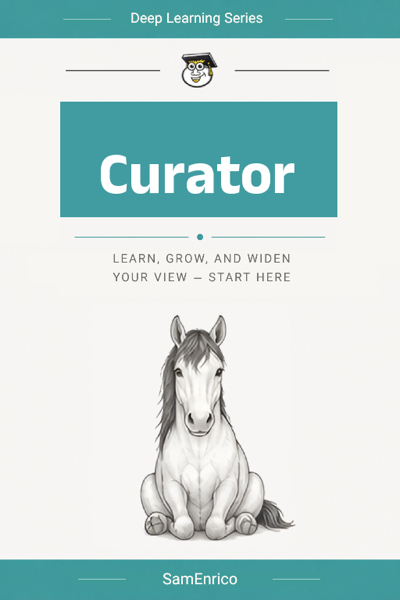
Curator eBook
A Coursebook on Curator
A Coursebook on Curator
Formats
Free sample
Chapter 1: The Keeper’s Rebellion...--–- The word “curator” arrives in English carrying a corpse on its back. That corpse is the Latin verb curare: to care for, to heal, to trouble oneself about. For most of the word’s two-thousand-year journey, the curator was not a visionary or an author or a public intellectual. The curator was a servant. Specifically, a servant of objects.
The Roman curator aquarum oversaw the aqueducts. The medieval curator reliquiarum dusted bone fragments encased in gold. The Renaissance curatore of a Wunderkammer—a cabinet of wonders—unlocked the door for visiting princes, then locked it again behind them. To be a curator was to be invisible, diligent, and obedient to the collection. The curator said “yes” to the board, “no” to the public, and “please” to the dust cloth.That version of the curator still exists.
You will meet her in Chapter 8, where she files condition reports with the devotion of a medieval scribe. You will meet him in Chapter 6, where he reconciles a budget line item for crating shipping with the same anxiety a sailor feels watching a storm approach. But the curator you are about to become—the curator this book is designed to train—is something else entirely. She is a rebel against the very etymology of her job title. She still cares, yes.
But she cares less about the dust on the plinth and more about the power dynamics encoded in the plinth’s height. She still heals, but she heals institutional wounds: colonial legacies, exclusionary hiring practices, the gentle but vicious violence of the white cube’s supposed neutrality.This chapter is called The Keeper’s Rebellion because it tells the story of how a minor, custodial, almost clerical profession became one of the most contested and powerful roles in contemporary culture. It is a story of four transformations. First, from private collector to public custodian. Second, from custodian to scholar.
Third, from scholar to auteur. And fourth—the transformation happening right now, as you read this sentence—from auteur to something we do not yet have a name for: mediator, activist, logistician, and co-author all at once. By the end of this chapter, you will understand not just the history of curation but the intellectual stakes of choosing this profession. You will also understand why, in Chapter 11, we will ask you to decide whether a curator can ever legitimately call herself an author—or whether that claim is the profession’s original sin.The Etymology Trap: Why Curare Is Not Destiny Before we march through history, a warning. It is fashionable in curatorial studies to begin with the Latin curare and then declare that the curator’s true essence is “care.” This is not wrong, but it is dangerously sentimental.
The Romans did not believe that caring for aqueducts was a spiritual vocation. They believed it was a job. The medieval church did not appoint relic-keepers because those men (always men) had a special sensitivity to the sacred. It appointed them because relics were worth more than the villages they sat in, and someone needed to hold the key.Care, in its original administrative sense, meant control. The curator of a Roman grain supply cared for the grain by counting it, guarding it, and distributing it according to imperial priorities.
If the emperor wanted Rome fed and the provinces starved, the curator obliged. There was no rebellion in that care. There was only protocol.This matters because the contemporary curator’s self-image as a benevolent caretaker—a gentle hand wiping dust from a ceramic bowl—obscures the history of museums as instruments of state power. When the Louvre opened in 1793, rebranded from a royal palace to a public museum, the revolutionary government did not throw open its doors out of pure democratic idealism. The Louvre was a pedagogical weapon.
The new French Republic needed citizens who could recognize their national heritage, feel pride in it, and therefore fight for it. The curator of the revolutionary Louvre was not a neutral custodian. He was a propagandist. He arranged paintings to tell a story of French superiority. He wrote labels that turned Flemish landscapes into lessons about republican virtue.
He cared for the collection, yes. But the care was always in service of a political project.So when we say that curation is an act of care, we must immediately ask: care for whom? Care toward what end? The curator who cares only for the object—who obsesses over humidity levels and ignores the fact that the object was stolen—is not a good curator. She is a negligent one.
This book will teach you to care for objects and for the ethical relationships those objects encode with source communities, with contemporary artists, with disabled visitors, with children who cannot read your jargon-filled wall labels. That is the keeper’s rebellion: not abandoning care, but expanding its constituency.The First Transformation: From Private Collector to Public Custodian (1600–1800)The first great shift in curatorial identity occurred over two centuries, from the heyday of the aristocratic Wunderkammer to the birth of the national museum. To understand this shift, you must imagine a room in a German princely palace in 1650. The room is small, maybe fifteen feet square. Every surface—walls, ceiling, tables, even the floor—is covered with objects.
A stuffed crocodile hangs next to a narwhal tusk (presented as a unicorn horn). A mechanical clock in the shape of a galleon sits beside a shard of the True Cross. There are Roman coins, Aztec featherwork, a mermaid hand (actually a dried skate), and a portrait of the prince himself, painted on a slice of agate. This is a cabinet of curiosities, and it has no curator in our sense. It has a custode—a keeper who dusts, locks, and occasionally explains the collection to visitors.
But the custode does not select objects (the prince does), does not interpret them (the prince decides their meaning), and does not publish research (the prince’s chaplain writes the catalogue).The cabinet of curiosities was an encyclopedia in a box. Its organizing principle was wonder, not logic. A crocodile next to a clock suggested that the world was strange, divine, and inexhaustible. There was no hierarchy of value. A fossil was as interesting as a gold coin because both were evidence of God’s playful creation.The Enlightenment killed that room.
In the 1730s, the Swedish naturalist Carl Linnaeus proposed a system for classifying all living things by genus and species. In the 1750s, the French encyclopedist Denis Diderot argued that knowledge should be organized by discipline, not by wonder. By the time the Louvre opened in 1793, the Wunderkammer was dead. In its place stood the taxonomic museum: galleries of Greek sculpture arranged by period, halls of natural history organized by evolutionary order, rooms of paintings hung chronologically by school. The new curator was not a keeper of wonders.
He was a scholar.This transformation had two profound consequences. First, the curator became a selector. Someone had to decide which paintings belonged to the “Florentine school” and which were merely Florentine-adjacent. Someone had to argue that this Roman bust was Augustan, not Flavian, and therefore…
This is the end of the free sample. Get the eBook to keep going. Buy now
About this book
Details
- Author
- Valencia Marnie
- Publisher
- SamEnrico
- Language
- English
- Genre
- Non-Fiction, Informative, Educational
- Released
- 2026-05-06
- Pages (approx.)
- 154
- Available as
- eBook, Audiobook

Read better in the ZLOADR app
Your eBooks on your phone or tablet. Sign in with your SamEnrico account and start reading.
More by Valencia Marnie
 Masturbation Compulsion Recovery GuideValencia Marnie$11.99
 Remote Decision Making ProcessValencia Marnie$11.99
 Exercise Induced Menstrual ChangesValencia Marnie$11.99
 The MBSR for Cancer SupportValencia Marnie$11.99
 The Unseen Brushstrokes: How Yayoi Kusama Defied the Art World with Dots and InfinityValencia Marnie$11.99
 Dream Rehearsal for Insomnia PTSDValencia Marnie$11.99
 Pixel Pioneers: The Untold Battle of the 8-Bit RevolutionValencia Marnie$11.99
 Understanding Hecht–Scott SyndromeValencia Marnie$17.99
 Student Visa Success For Dubai GuideValencia Marnie$12.99
 Africa Renewable Energy OutlookValencia Marnie$12.99
 How to Start a Ceiling Coverings Made of Plastic Business (Beginners Guide)Valencia Marnie$11.99
You may also like
 Hong Kong Handover 1997Dunn Johnnie$11.99
 Zumba For Postnatal Recovery CourseNeal Christian$11.99
 Zumba for BeginnersLadner Nikia$11.99
 YouTube Comment Mining GuideHumes Pandora$12.99
 Worry Box MeditationCarlin Rudy$11.99
 Workplace Stress MeditationNguyen Lynn$11.99
 Workplace Stress and Sleep RepairHawley Ivory$11.99
 Workplace Perfectionism CureDelaney Jeffry$11.99
 Workplace Injustice Anger GuideWallen Isabelle$11.99
 Work Addiction and Burnout LinkGreenwood Ester$11.99
 Women in Yoga and WellnessBeattie Galina$11.99
 Women in Stand Up ComedyChun Evangeline$11.99