
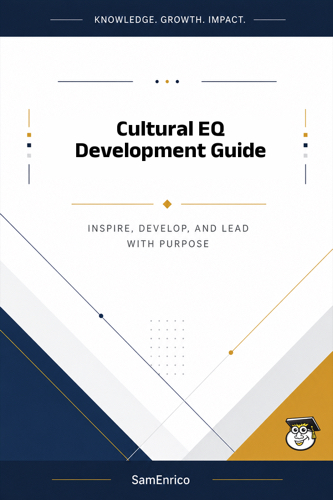
Non-FictionSelf-HelpCross-Cultural
Cultural EQ Development Guide eBook
Builds emotional awareness across different cultur
Builds emotional awareness across different cultural norms and expressions.
Formats
Free sample
Chapter 1: The Empathy Trap--–- Maria had always considered herself a people person. In São Paulo, where she had built her career in marketing over twelve years, this identity was her superpower. She could read a room in thirty seconds, knew exactly when to offer a warm embrace versus a firm handshake, and had never met a client she couldn't eventually charm. Her performance reviews glowed with phrases like "exceptional emotional intelligence" and "natural leader who brings out the best in her teams." When her Brazilian employer offered her a two-year rotation to lead a joint venture in Munich, Maria accepted with confidence. After all, if you understand people, you understand people—everywhere, right?The first three months were baffling.
Her German counterparts were not unfriendly, exactly, but they were... something. In her first team meeting, Maria opened with her usual warm greeting, asked everyone how their weekend had been (with genuine interest), and shared a brief, self-deprecating story about getting lost on the U-Bahn. The room responded with silence—not hostile silence, but the kind of silence that follows a joke no one found funny. She pressed on, assuming she needed to try harder.By month two, Maria noticed that her German colleagues avoided her during lunch.
When she approached their table in the company canteen, conversations stopped. One engineer, Klaus, had stopped making eye contact entirely. Maria concluded that Klaus disliked her personally. She tried everything: bringing Brazilian sweets to the office, offering to help with his projects, even asking him directly, "Is everything okay between us?" Klaus blinked at her as if she had asked about the weather on Mars, said "Everything is fine," and turned back to his screen.The crisis came during a presentation. Maria proposed a bold marketing campaign for a new product—the kind of creative, slightly risky idea that had made her famous in São Paulo.
She expected debate, enthusiasm, maybe some healthy pushback. Instead, a junior German analyst named Stefan raised his hand and said, "This is wrong. Your assumptions about the European market are not supported by the data on slides four, seven, and twelve. You have also misunderstood the regulatory framework in section three." He said all of this in a calm, flat voice, without malice, and then looked at her expectantly as if waiting for a thank you.Maria felt her face burn. In her culture, this kind of public critique was an act of war—a humiliation designed to destroy relationships.
She later learned that Stefan had no idea she was upset. When a colleague asked him about the exchange, Stefan said, "She asked for feedback. I gave her feedback. She is the project lead. It is my job to help her succeed." He was genuinely confused by her reaction.By month four, Maria had developed a stress rash, stopped sleeping well, and was secretly searching for jobs back in Brazil.
She told a friend: "I thought I was good with people. Germany has proven me wrong."What Maria did not yet know—what this book will teach you—is that her emotional intelligence was not broken. It was simply calibrated to a different cultural operating system. Every skill that made her successful in São Paulo—warmth, self-disclosure, indirect critique, physical proximity, emotional expressiveness—became a liability in Munich not because those skills are bad, but because she was using the wrong map.This is the Empathy Trap: the seductive and dangerous belief that your ability to read and respond to emotions in your home culture will automatically translate to all other cultures. It will not.
In fact, high emotional intelligence in one cultural context can make you less effective in another, because your finely tuned radar is picking up signals that don't exist and missing signals that do. Maria's warm approach was not read as friendliness in Munich; it was read as unprofessional boundary-crossing. Her self-deprecating story was not read as humility; it was read as incompetence. Her attempt to ask Klaus directly about their relationship was not read as courageous conflict-resolution; it was read as bizarre and invasive.The tragedy of the Empathy Trap is that its victims are almost always people who genuinely care about others. They are the ones who pride themselves on their people skills.
They are the ones who most want to connect across difference. And they are the ones who suffer the most confusion and pain when their best efforts fail.This chapter will do three things. First, it will expose why the Empathy Trap exists by examining the flawed assumption at the heart of Western emotional intelligence models. Second, it will introduce the concept of cultural emotional scripts—the invisible rules that govern how people in different societies are supposed to feel, express, and respond to emotions. Third, it will provide your first diagnostic tool: the Cultural EQ Blind Spot Assessment, which will help you identify where your own empathy is most likely to fail you.By the end of this chapter, you will understand why Maria's story is not a story of personal failure but a story of mismatched maps.
And you will take the first step toward building a new map—one that works across borders.The Universalist Assumption: Where EQ Models Go Wrong To understand the Empathy Trap, we must first understand the intellectual foundation upon which most emotional intelligence training is built. That foundation rests on a single, largely unexamined assumption: emotions are biologically universal.The most influential figure in the EQ movement is Daniel Goleman, whose 1995 book Emotional Intelligence spent more than a year on the New York Times bestseller list and fundamentally changed how businesses think about leadership. Goleman's model identifies five components of EQ: self-awareness, self-regulation, motivation, empathy, and social skill. These components, he argues, are universal human capacities. A leader in Tokyo who lacks self-awareness is just as ineffective as a leader in Toronto who lacks self-awareness.
Empathy—the ability to understand another person's emotional state—works the same way everywhere.This assumption is not unreasonable. After all, research by Paul Ekman in the 1960s and 1970s seemed to show that six basic emotions (anger, disgust, fear, happiness, sadness, and surprise) are expressed and recognized universally across cultures. Ekman traveled to Papua New Guinea and showed photographs of facial expressions to the Fore people, an isolated tribe with almost no exposure to Western culture. The Fore people recognized the emotions in the photographs at rates far above chance. The conclusion seemed clear: emotions are hardwired into human biology, and emotional intelligence is therefore a universal skill.There is only one problem: Ekman was both right and wrong.He was right that certain facial muscle configurations are associated with certain emotional states across cultures.
A smile that involves the orbicularis oculi muscle (the "Duchenne smile") does indicate genuine positive emotion in almost every human society. A furrowed brow does correlate with anger or confusion in most places.But Ekman was wrong—or at least incomplete—in assuming that this biological foundation means that emotional intelligence is universal. The mistake is analogous to saying that because all human beings have the same vocal apparatus (lungs, larynx, tongue, lips), language is universal. The truth…
This is the end of the free sample. Get the eBook to keep going. Buy now
About this book
Details
- Author
- Ramirez Heidi
- Publisher
- SamEnrico
- Language
- English
- Genre
- Non-Fiction, Self-Help, Cross-Cultural
- Released
- 2026-06-06
- Pages (approx.)
- 147
- Available as
- eBook, Audiobook

Read better in the ZLOADR app
Your eBooks on your phone or tablet. Sign in with your SamEnrico account and start reading.
More by Ramirez Heidi
 Call Center Distraction ManagementRamirez Heidi$11.99
 Caregiver Stress Relationship CareRamirez Heidi$11.99
 Sales Listening Skills GuideRamirez Heidi$11.99
 The Missing Out FearRamirez Heidi$11.99
 The Town That Adopted ThemRamirez Heidi$11.99
 The Quit Smoking Sexual HealthRamirez Heidi$11.99
 Forest Focus ReminderRamirez Heidi$11.99
 Exam AffirmationsRamirez Heidi$11.99
 The Secret Life of the Stanford Prison Experiment: When Science Crossed the LineRamirez Heidi$11.99
 The Divine Harmonies: Bach and the Baroque RevolutionRamirez Heidi$11.99
 The Stone Physicians: Gothic Cathedrals and the Science of SurvivalRamirez Heidi$11.99
 Ultimate Handbook Guide to Kaohsiung : (China) Travel GuideRamirez Heidi$11.99
You may also like
 Hong Kong Handover 1997Dunn Johnnie$11.99
 Zumba For Postnatal Recovery CourseNeal Christian$11.99
 Zumba for BeginnersLadner Nikia$11.99
 YouTube Comment Mining GuideHumes Pandora$12.99
 Worry Box MeditationCarlin Rudy$11.99
 Workplace Stress MeditationNguyen Lynn$11.99
 Workplace Stress and Sleep RepairHawley Ivory$11.99
 Workplace Perfectionism CureDelaney Jeffry$11.99
 Workplace Injustice Anger GuideWallen Isabelle$11.99
 Work Addiction and Burnout LinkGreenwood Ester$11.99
 Women in Yoga and WellnessBeattie Galina$11.99
 Women in Stand Up ComedyChun Evangeline$11.99