
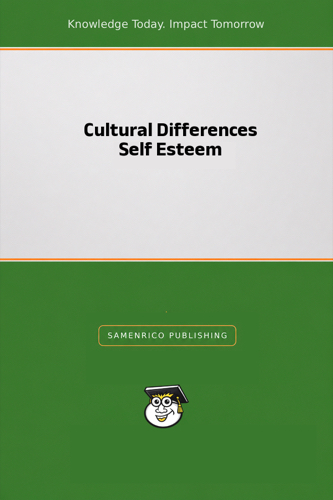
Non-FictionSelf-HelpCross-Cultural
Cultural Differences Self Esteem eBook
Feel secure when traditions and values conflict.
Feel secure when traditions and values conflict.
Formats
Free sample
Chapter 1: The Invisible Program--–- You are not born with a personality. You are born with a sponge. For the first seven years of your life, that sponge soaks up everything around you without filter, without judgment, without any capacity to ask “Is this true?” or “Does this belong to me?” You absorb the way your mother speaks about money, the way your father apologizes (or doesn’t), the rituals that precede every meal, the silence that follows certain questions, the tone of voice reserved for disappointment, the shape of love when it is given freely versus when it must be earned. By the time you learn to tie your shoes, you are already running on software you never agreed to install.This is not a metaphor. This is neuroscience.Every culture on earth solves the same set of basic problems: How do we raise children?
How do we distribute resources? How do we honor our dead? How do we select leaders? How do we define success? How do we punish betrayal?
How do we celebrate joy? The answers to these questions are not universal. They vary wildly across time and geography. But within a single culture, the answers are taught as if they were gravity—not opinions, not traditions, not negotiable preferences, but reality itself. The way we do things here is simply the way things are done.
Any other way is wrong, strange, dangerous, or incomprehensible.Psychologists call this invisible architecture “the ontological prescription”—a set of unquestioned rules about what exists, what matters, and what makes a life worth living. Sociologists call it “cultural framing.” Everyone else calls it “normal.” But normal is not natural. Normal is installed. And what is installed can, with enough courage and self-awareness, be examined, questioned, and selectively rewritten.This chapter is about seeing the software for the first time.The Day the Floor Disappeared Consider a moment that almost every bicultural person remembers with visceral clarity. You are in a room with people from two different cultures—perhaps your family of origin and your chosen family, perhaps your workplace and your community, perhaps your partner’s relatives and your own.
Someone says something that seems perfectly reasonable to half the room and utterly outrageous to the other half. The temperature drops. Faces harden. Someone laughs uncomfortably. Someone else sighs.
And you, caught in the middle, feel something strange: the floor beneath you has vanished.You knew the floor was there a moment ago. You were standing on solid ground. But now, in the space between two incompatible rulebooks, there is no ground at all. You are suspended in midair, trying to translate in real time, trying to figure out whose rules apply in this room, trying to remember which version of yourself is safe to be.This is not indecision. This is vertigo.
And vertigo is not a character flaw—it is a physiological response to conflicting information about which way is up.The anthropologist Edward T. Hall famously observed that culture is not something you have. Culture is something that has you. It operates below the level of conscious awareness. You do not think about whether to stand close or far when speaking to an elder—you simply know the correct distance.
You do not calculate whether to make eye contact—your eyes move automatically. You do not deliberate about whether to interrupt—your mouth opens or closes based on programming so ancient it feels like instinct.But here is the problem. When you live between cultures, you have two programs running simultaneously. And they do not always agree.The Hidden Rulebook: A Diagnostic Tool Before we go any further, let us make the invisible visible. Take out a piece of paper or open a blank document.
You are going to write down your answers to the following questions. Do not censor yourself. Do not write what you think you should believe. Write what you actually feel in your gut when you imagine these scenarios.Question 1: Respect. Imagine a young adult disagrees with an elder in a family gathering.
The elder has just stated an opinion that the young adult believes is factually wrong. Should the young adult speak up and correct the elder, or remain silent to preserve harmony? Do not think. Answer. Gut feeling: __________Question 2: Success.
You have two definitions of a successful person in front of you. Person A has a high-paying career, lives independently, travels frequently, and prioritizes personal fulfillment. Person B has a modest income, lives near extended family, contributes regularly to communal expenses, and prioritizes family obligations. Which person feels more “successful” to you? Gut feeling: __________Question 3: Identity.
Imagine you are introduced to someone new. Do you want them to know first about your individual achievements (your job, your education, your hobbies) or your relational connections (your family, your community, your cultural background)? Gut feeling: __________Question 4: Conflict. You have been wronged by someone you love. They have not apologized.
Your options are: (a) directly confront them and demand an apology, risking the relationship, or (b) remain silent and preserve the relationship, accepting the injustice internally. Which option makes your stomach clench less? Gut feeling: __________Question 5: Children. A child is asked by a teacher to name her favorite thing about herself. She lists her grades, her athletic ability, and her sense of humor.
She does not mention her family. Does this feel healthy or concerning? Gut feeling: __________Now look at your answers. If you are like most bicultural people, you will notice something immediately: your answers are not consistent with a single cultural framework. You may have answered the respect question like a collectivist (silence preserves harmony) but the identity question like an individualist (my achievements matter most).
You may have answered the success question like a traditionalist (family obligations are success) but the children question like a modernist (individual self-esteem is healthy).This is not hypocrisy. This is not confusion. This is the fingerprint of living between worlds. You have not failed to choose a side. You have succeeded in absorbing multiple rulebooks—and now, when they conflict, you feel the conflict in your body as a kind of low-grade nausea.That nausea has a name.
It is called “cognitive dissonance,” and every bicultural person carries it like a second skeleton.The Five Dimensions Where Programs Collide Research in cross-cultural psychology has identified at least five fundamental dimensions where cultural programs reliably diverge. Understanding these dimensions is like being handed a map of the minefield—you will still need to walk carefully, but at least you will know where the explosives are buried.Dimension 1: Individualism versus Collectivism This is the most studied and most visible dimension. Individualist cultures (predominantly Western, Northern European, and Anglophone) teach that the basic unit of society is the individual person. Your job is to discover your own preferences, pursue your own goals, and express your own opinions. Self-esteem is built through personal achievement and authentic self-expression.
Shame is private. Success is measured by how far you rise above your starting point.Collectivist cultures (predominantly Asian, African, Latin American, and Middle Eastern) teach that the basic unit of society is the group—the family, the clan, the community, the village. Your job…
This is the end of the free sample. Get the eBook to keep going. Buy now
About this book
Details
- Author
- Stauffer Ariel
- Publisher
- SamEnrico
- Language
- English
- Genre
- Non-Fiction, Self-Help, Cross-Cultural
- Released
- 2026-06-06
- Pages (approx.)
- 147
- Available as
- eBook, Audiobook

Read better in the ZLOADR app
Your eBooks on your phone or tablet. Sign in with your SamEnrico account and start reading.
More by Stauffer Ariel
 Instagram Fundraiser ComparisonStauffer Ariel$11.99
 Fear Ladder ConstructionStauffer Ariel$11.99
 Magisto Intelligent Editor GuideStauffer Ariel$11.99
 Understanding Fetal Alcohol SpectrumStauffer Ariel$11.99
 The First Song: How the World Was Strummed into ExistenceStauffer Ariel$11.99
 Understanding InfluenzaStauffer Ariel$17.99
 Imposter Thought Reframing WorkbookStauffer Ariel$12.99
 Private Label Brand SpendingStauffer Ariel$12.99
 Chicory HarvestingStauffer Ariel$11.99
 How to Become a Jewel-bearing MakerStauffer Ariel$11.99
You may also like
 Hong Kong Handover 1997Dunn Johnnie$11.99
 Zumba For Postnatal Recovery CourseNeal Christian$11.99
 Zumba for BeginnersLadner Nikia$11.99
 YouTube Comment Mining GuideHumes Pandora$12.99
 Worry Box MeditationCarlin Rudy$11.99
 Workplace Stress MeditationNguyen Lynn$11.99
 Workplace Stress and Sleep RepairHawley Ivory$11.99
 Workplace Perfectionism CureDelaney Jeffry$11.99
 Workplace Injustice Anger GuideWallen Isabelle$11.99
 Work Addiction and Burnout LinkGreenwood Ester$11.99
 Women in Yoga and WellnessBeattie Galina$11.99
 Women in Stand Up ComedyChun Evangeline$11.99