
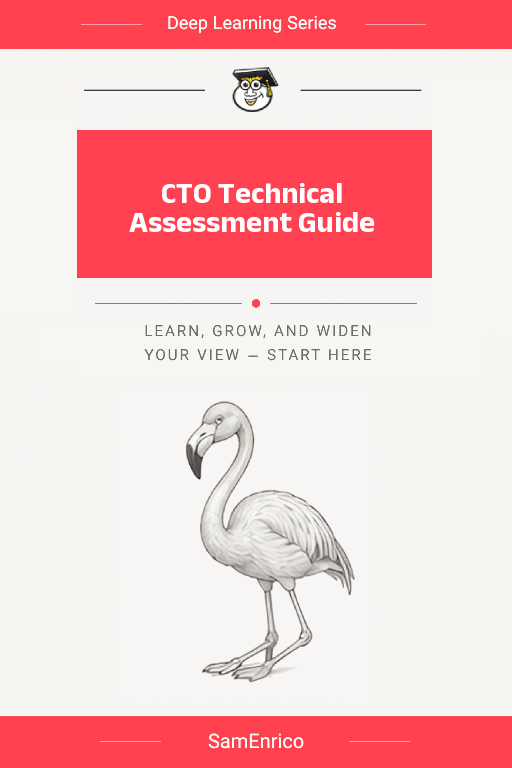
Non-FictionStartup GuideExecutive Search
CTO Technical Assessment Guide eBook
Run technical assessments for CTO candidates witho
Run technical assessments for CTO candidates without coding. Practical tests and project reviews.
Formats
Free sample
Chapter 1: The Leet Code Funeral--–- In 2024, a well-funded Series B startup lost their lead CTO candidate not because he failed the technical interview, but because he passed it. The candidate had spent two weeks grinding algorithmic puzzles. He could invert a binary tree blindfolded. He optimized a sorting algorithm under seven minutes. The engineering team gave him a standing ovation.
Three months later, he had alienated every product manager, refused to use any cloud vendor (“we can build it cheaper”), and deployed a Kafka cluster that cost $47,000 in its first month—for an app with twelve daily users. The CEO fired him on a Tuesday. On Wednesday, she told her board: “I hired the best coder I ever interviewed. I should have hired a CTO.”This book exists because that story happens thousands of times every year. The standard technical interview—whiteboards, Leet Code-style algorithmic puzzles, data structure trivia—is not merely unhelpful for evaluating a CTO candidate.
It is actively destructive. It filters for the wrong traits and against the traits that actually predict executive success.This chapter establishes the foundational problem and introduces the solution: the Three Pillars of Assessment that replace coding tests with decision intelligence.The Great Misunderstanding: Why We Keep Doing This to Ourselves The technology industry suffers from a specific form of credentialing trauma. Most technical founders and early engineers rose through the ranks because they were exceptional individual contributors. They wrote beautiful code. They could spot a race condition from across the room.
When they interview a CTO candidate, they unconsciously ask: “Is this person as good at coding as I was?”That question is catastrophic.Consider the difference between a Programmer and a Technologist. A Programmer optimizes loops, data structures, and compilation times. These are valuable skills—for an engineer. A Technologist optimizes trade-offs between time, talent, and treasury. A Programmer asks: “What is the most elegant solution?” A Technologist asks: “What is the solution that this team, at this company, with this budget, can actually ship before we run out of money?”The mistake most interviewers make is assuming that the Programmer skills are a prerequisite for the Technologist role.
They are not. In fact, deep expertise in low-level coding often creates a liability at the executive level. The best individual contributor is frequently the worst CTO because they cannot stop optimizing for technical purity at the expense of business outcomes.I have interviewed over two hundred CTO candidates across seventy companies. The single worst hire I ever witnessed was a former Google Distinguished Engineer who could recite the Linux kernel scheduler from memory. He lasted four months.
The best hire I ever witnessed was a former English major who taught herself Rails on nights and weekends, built a fifteen-person engineering team, and sold her company for nine figures. She could not invert a binary tree. She could, however, explain exactly why that fact was irrelevant.The industry is finally waking up. Between 2023 and 2025, a measurable shift occurred. Stripe eliminated algorithmic whiteboarding for senior roles.
Dropbox published a post-mortem on their “coding interview disaster.” Basecamp famously replaced technical interviews with paid one-week projects. And for CTO roles specifically, a growing number of firms have abandoned coding tests entirely. They realized what this chapter will prove: coding tests measure test-taking stamina, not system judgment. They measure obedience to synthetic problems, not ability to handle ambiguity. They measure memorization, not taste.The Three Pillars: A Replacement Framework If we are not testing coding, what are we testing?
This book proposes three unified pillars that predict CTO success better than any whiteboarding session. These pillars will appear in every subsequent chapter, and every assessment tool in the appendices is designed to measure them.Pillar One: Taste Taste is the ability to distinguish elegant simplicity from clever complexity. It is the instinct that tells you when a solution is “just right” versus when it is over-engineered or under-engineered. Taste is what separates a CTO who builds a spreadsheet for Uber’s first version from a CTO who builds a real-time GPS tracking system that never ships.How do you recognize taste without understanding code? You listen for how a candidate describes their decisions.
Do they talk about what they removed as proudly as what they added? Do they celebrate deletion? Do they say “we used Postgres because it was boring and it worked” or do they say “we used a custom time-series database because I wanted to learn something new”?Taste is not about intelligence. It is about judgment. And judgment is visible in the decisions a candidate chooses to share.Pillar Two: Trajectory Trajectory is the ability to describe how a system—and a team—evolves over time.
A CTO who can only manage a five-person startup will fail at a five-hundred-person enterprise. A CTO who has only worked in regulated banking will fail at a chaotic growth-stage company. Trajectory is the pillar that measures learning, adaptation, and the capacity to evolve.How do you assess trajectory without seeing code? You ask about failure. Not hypothetical failure—real failure.
“Tell me about the last production outage you caused. Now tell me what you changed so it would never happen again.” The second part is trajectory. A candidate with strong trajectory does not just fix the bug; they change the system that allowed the bug to exist. They improve the deployment pipeline, the testing culture, the monitoring alerts. They learn at the process level, not the patch level.Trajectory also appears in how candidates speak about their own careers.
“I used to believe that microservices were always better. Then I ran a migration that took eighteen months and nearly bankrupted a feature team. Now I default to monoliths until proven otherwise.” That is trajectory. That is someone who learns.Pillar Three: Trade-offs Trade-offs are the heart of technical leadership. Every decision has a cost.
The question is whether the candidate acknowledges that cost or pretends it does not exist. A junior engineer says “we should use Kubernetes.” A CTO says “Kubernetes would solve our deployment inconsistency, but it would add three months of learning time for our junior team and require a dedicated ops hire we cannot afford. Let’s fix our CI pipeline first and revisit Kubernetes when we have ten microservices.”Trade-offs are visible in every answer. When you ask about a technology choice, do they immediately list the downsides? Do they say “X is great, but here is where it fails”?
Do they know what they sacrificed? The best trade-off question is simple: “Tell me about a feature you chose NOT to build.” A candidate who cannot answer that has never made a real trade-off.These three pillars—Taste, Trajectory, Trade-offs—replace every coding test in this book. You will learn to assess them through project forensics, scenario stress tests, and behavioral signals. You will never again need to ask a CTO candidate to write a sorting algorithm. You will ask them to discard algorithms.Why Coding Tests Are Worse Than Useless Let me be precise about the damage that coding tests cause when applied to CTO candidates.
There are four specific failure modes.Failure Mode One: The Leet Code Arms Race Leet Code-style interviews have created a massive…
This is the end of the free sample. Get the eBook to keep going. Buy now
About this book
Details
- Author
- Goebel Rosenda
- Publisher
- SamEnrico
- Language
- English
- Genre
- Non-Fiction, Startup Guide, Executive Search
- Released
- 2026-05-30
- Pages (approx.)
- 155
- Available as
- eBook, Audiobook

Read better in the ZLOADR app
Your eBooks on your phone or tablet. Sign in with your SamEnrico account and start reading.
More by Goebel Rosenda
 Aging Out With NothingGoebel Rosenda$11.99
 Herbal ED SupplementsGoebel Rosenda$11.99
 Depression Nutrition GuideGoebel Rosenda$11.99
 The Hope for Angry ParentsGoebel Rosenda$11.99
 The Boomer Health App GuideGoebel Rosenda$11.99
 The Silk Road Kick: How Persian Warriors Invented the Forerunner to Australian Rules FootballGoebel Rosenda$11.99
 ParamotoringGoebel Rosenda$11.99
 The Breeder's Guide to Rhode Island Red Non-industrial ChickensGoebel Rosenda$11.99
 Minority Firm Proposal WritingGoebel Rosenda$12.99
 How to Start a Design Studio Business (Beginners Guide)Goebel Rosenda$11.99
You may also like
 Hong Kong Handover 1997Dunn Johnnie$11.99
 Zumba For Postnatal Recovery CourseNeal Christian$11.99
 Zumba for BeginnersLadner Nikia$11.99
 YouTube Comment Mining GuideHumes Pandora$12.99
 Worry Box MeditationCarlin Rudy$11.99
 Workplace Stress MeditationNguyen Lynn$11.99
 Workplace Stress and Sleep RepairHawley Ivory$11.99
 Workplace Perfectionism CureDelaney Jeffry$11.99
 Workplace Injustice Anger GuideWallen Isabelle$11.99
 Work Addiction and Burnout LinkGreenwood Ester$11.99
 Women in Yoga and WellnessBeattie Galina$11.99
 Women in Stand Up ComedyChun Evangeline$11.99