
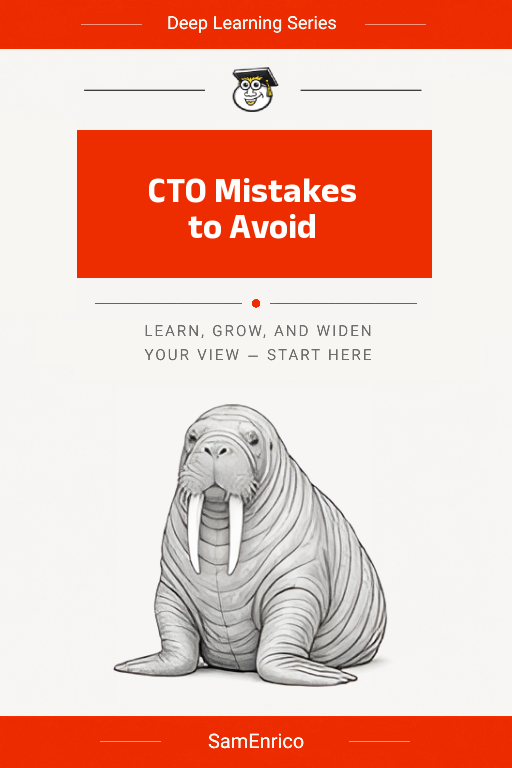
Non-FictionStartup GuideExecutive Search
CTO Mistakes to Avoid eBook
Avoid common mistakes when hiring your first CTO.
by Elder Hyun
Avoid common mistakes when hiring your first CTO. Lessons from founders who got it wrong.
Formats
Free sample
Chapter 1: The Resume Mirage...--Every founder remembers the exact moment they realized they might have hired the wrong person. For Lisa, it came during a board meeting in month seven. Her CTO, a former Google engineering director she had fought to recruit, was explaining why the MVP was delayed again. He used words like "idempotency" and "asynchronous reconciliation" and "control plane instability." The investors nodded along, pretending to understand. Lisa smiled and nodded too.
But inside, she was drowning.She had raised $3 million. She had hired the best. And yet, her product was no closer to launch than the day she started. Her competitor, founded three months after hers, had just announced a Series A. They built their entire platform using Ruby on Rails and a single Postgre SQL database.
No microservices. No Kubernetes. No "control plane." Just code that worked.Lisa had hired a resume. Her competitor had hired a builder.This chapter is about the most seductive and dangerous mistake a founder can make when hiring their first CTO: mistaking big-company credentials for startup competence. It is the mistake of hiring the "Google Vet" – the senior engineering leader from a prestigious tech giant who looks perfect on paper and implodes in practice.The Promise That Seduces You When you are a non-technical founder with no product and no credibility, the idea of hiring someone from Google, Facebook, Apple, or Amazon feels like winning the lottery.
You imagine that their experience building systems for millions of users will translate directly to your startup. You assume that if they could handle the complexity of You Tube or Instagram, your little MVP will be trivial. You believe their title—Director, Senior Staff, Principal—is proof of competence.The logic is seductive because it is simple: big company success equals big talent equals big results.You tell yourself that hiring a "proven" executive de-risks the most uncertain part of your business. You imagine them bringing best practices, disciplined processes, and a network of other elite engineers. You picture them writing elegant code that scales effortlessly.
You convince yourself that the only reason your startup might fail is if you hire someone "lesser" – and surely, a Google vet is the opposite of lesser.The venture capitalists you pitch will raise their eyebrows approvingly when you mention the name. Your friends will be impressed. Your own anxiety will quiet, because you have hired someone who has already climbed the mountain you are trying to scale.This is the promise. It is also a trap.The Trap: Optimization for Maintenance, Not Creation The uncomfortable truth is that big technology companies do not build software the way startups do. They build software the way governments build highways: slowly, carefully, with layers of approval, legacy constraints, and an almost infinite tolerance for process.A senior engineering leader at Google does not wake up in the morning and write code.
They wake up and attend meetings about which features to prioritize, which teams to align, which compliance requirements to satisfy. They have internal tools for everything: deployment, monitoring, testing, rollbacks. They have Site Reliability Engineers who handle outages. They have product managers who write requirements. They have legal teams who review data handling.
They have recruiting teams who find candidates.None of these things exist in a startup.When you hire a Google Vet as your first CTO, you are hiring someone who has been optimized for a world of abundance. Abundance of time. Abundance of people. Abundance of tooling. Abundance of process.
They have never built anything from scratch with no budget, no team, and no permission. They have never had to choose between shipping a buggy feature today or a perfect feature next month – because at Google, you wait for next month. The infrastructure can handle it.But at a startup, the infrastructure cannot handle anything. There is no infrastructure. There is just a laptop and a cloud account and a deadline that is already overdue.The Google Vet will not understand this instinctively.
They will attempt to build the same kind of systems they are used to. They will insist on microservices because "that's how we did it at Google." They will demand a Kubernetes cluster because "that's the industry standard." They will spend weeks designing a "scalable" database schema for zero users. They will write exhaustive documentation for code that does not yet exist. They will wait for perfect requirements that never arrive.Meanwhile, your competitor – the one who hired a scruffy founder who built stuff in her garage – will have launched, gotten feedback, pivoted, launched again, and captured the market.The War Story: The $500,000 MVP That Never Launched Let me tell you about a fintech founder named Marcus. Marcus had raised $2 million for a payment processing platform.
He was non-technical but brilliant at sales. He knew he needed a CTO who could build something that banks would trust. So he did what any reasonable founder would do: he hired the most impressive technical resume he could find.The candidate was a former engineering director at Facebook. He had managed teams of 50 people. He had worked on the news feed infrastructure.
He had a Stanford degree and a portfolio of patents. He spoke confidently about "architectural trade-offs" and "eventual consistency" and "idempotent APIs." Marcus was sold.The CTO started work on day one with enthusiasm. He declared that they would not make the "mistake" of building a monolithic application that would need to be rewritten later. Instead, they would build a "cloud-native, microservices-based, event-driven architecture" that would scale to millions of transactions. He chose Kubernetes for orchestration.
He chose a service mesh for inter-service communication. He chose a multi-region database for redundancy.Marcus had no idea what any of this meant, but it sounded serious. He trusted his CTO.Month one passed. The CTO was "setting up the foundation." Month two passed. The CTO was "establishing the CI/CD pipeline." Month three passed.
The CTO was "designing the domain models." Month four, five, six. No code that customers could use. No MVP. No feedback from the market. Just infrastructure.
Just architecture. Just promises that "next month, we will start building features."At month eight, Marcus had spent 500,000ofhis500,000 of his 500,000ofhis2 million. The MVP was still not live. He had no users. He had no feedback.
He had no product.Meanwhile, a competitor had launched a payment processing platform built by two founders who had previously built a failed e-commerce site. They used Ruby on Rails and a single Postgre SQL database. Their code was ugly. Their infrastructure was simple. But they launched in six weeks, signed their first ten customers, and raised a Series A before Marcus could even show a demo.Marcus fired the Google Vet.
He hired a lead engineer who had built three failed startups. They rewrote the entire platform in four months and launched. But the market had moved on. Marcus eventually sold the company for less than the amount he had raised. He later told me: "I didn't fail because I hired a bad engineer.
I failed because I hired someone who was optimized for a different game."Why This Mistake Is So Common The Google Vet fallacy persists…
This is the end of the free sample. Get the eBook to keep going. Buy now
About this book
Details
- Author
- Elder Hyun
- Publisher
- SamEnrico
- Language
- English
- Genre
- Non-Fiction, Startup Guide, Executive Search
- Released
- 2026-05-29
- Pages (approx.)
- 119
- Available as
- eBook, Audiobook

Read better in the ZLOADR app
Your eBooks on your phone or tablet. Sign in with your SamEnrico account and start reading.
More by Elder Hyun
 Why Not Me StoriesElder Hyun$11.99
 Depression In Older AdultsElder Hyun$11.99
 Teen Sports Confidence GuideElder Hyun$11.99
 Foster Care To Military EnlistmentElder Hyun$11.99
 The Global North South App GapElder Hyun$11.99
 Nephthys' Lament: The Forgotten Goddess of the DeadElder Hyun$11.99
 The Breeder's Guide to Russian Orloff ChickensElder Hyun$11.99
 Minority Firm Opportunity TrackingElder Hyun$12.99
 How to Become a Log WasherElder Hyun$11.99
 Parts RepresentativeElder Hyun$11.99
You may also like
 Hong Kong Handover 1997Dunn Johnnie$11.99
 Zumba For Postnatal Recovery CourseNeal Christian$11.99
 Zumba for BeginnersLadner Nikia$11.99
 YouTube Comment Mining GuideHumes Pandora$12.99
 Worry Box MeditationCarlin Rudy$11.99
 Workplace Stress MeditationNguyen Lynn$11.99
 Workplace Stress and Sleep RepairHawley Ivory$11.99
 Workplace Perfectionism CureDelaney Jeffry$11.99
 Workplace Injustice Anger GuideWallen Isabelle$11.99
 Work Addiction and Burnout LinkGreenwood Ester$11.99
 Women in Yoga and WellnessBeattie Galina$11.99
 Women in Stand Up ComedyChun Evangeline$11.99