
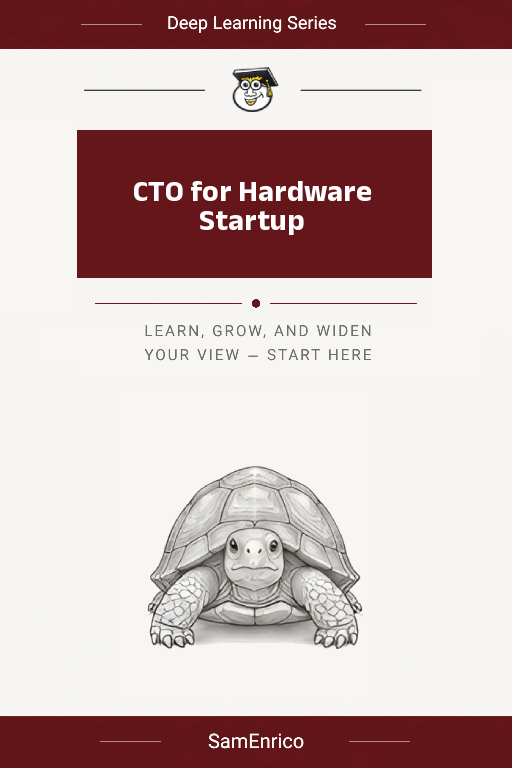
Non-FictionStartup GuideHardware
CTO for Hardware Startup eBook
Find CTO with electronics, firmware, and manufactu
by Canty Waylon
Find CTO with electronics, firmware, and manufacturing experience for physical products.
Formats
Free sample
Chapter 1: The Unicorn Mirage...–- Every founder starts with the same mistake. They write a job description that begins with “10+ years of experience” and ends with “must be willing to wear many hats.” They post it on Linked In, cross their fingers, and wait for the perfect technical leader to materialize. What arrives instead is a stack of resumes from software engineers who once soldered a Raspberry Pi, firmware developers who have never seen a pick-and-place machine, and hardware designers who cannot write a line of embedded C. The founder stares at these candidates and feels the first cold wave of panic: Does this person even exist?The short answer is yes. The long answer is that you have been looking for the wrong thing in the wrong way.
This chapter dismantles the most dangerous myth in hardware startups: that the Chief Technology Officer for a physical product is simply a senior engineer with a fancier title. In reality, the hardware CTO is a hybrid creature that the standard startup playbook does not acknowledge. Software CTOs manage code, servers, and deployment pipelines. Hardware CTOs manage atoms, electrons, supply chains, compliance certifications, factory line yields, and the terrifying moment when 10,000 units arrive at a warehouse and exactly zero of them work.The gap between what founders think they need and what they actually need is wide enough to bankrupt a company. This chapter bridges that gap by defining the true anatomy of a hardware CTO, explaining why the software startup model fails for physical products, and giving you a diagnostic tool to assess whether your current or prospective technical leader can survive the journey from whiteboard to shipping container.The Software CTO Delusion Every hardware founder has read the same startup blogs.
They have internalized the gospel of the software CTO: a brilliant coder who can architect systems, hire a team, and move fast. The problem is that hardware does not move fast. It moves at the speed of solder reflow, component lead times, and regulatory testing schedules. A software CTO can roll back a bad deploy in fifteen minutes. A hardware CTO who makes a mistake watches a forty-foot container full of bricked devices get rejected at customs.The delusion begins with a fundamental misunderstanding of technical debt.
In software, technical debt is an abstraction—poorly written code that will cost time to refactor later. In hardware, technical debt is physical. A poorly placed via on a printed circuit board cannot be refactored; it requires a full board respin, which costs fifty thousand dollars and three months. A firmware bug that only appears at high temperature cannot be patched without a field recall if the over-the-air update system was never implemented. A component chosen because it was cheap and available becomes a crisis when its lead time jumps from eight weeks to fifty-two weeks, and there is no second source because the design was never validated with an alternate part.Founders who apply software hiring criteria to hardware roles end up with a CTO who looks great on paper but fails in the factory.
They hire someone who has shipped millions of lines of code but has never designed a test jig. They hire someone who can architect a cloud backend but cannot read a compliance test report. They hire someone who thrives in agile sprints but freezes when a contract manufacturer says, “Your panelization is wrong, and we cannot run your board.”This chapter is not an attack on software CTOs. It is a warning that the skills do not transfer. The rest of this book assumes that you are building a physical product—something with a printed circuit board, firmware, and a manufacturing process.
If you are building pure software, put this book down and read something else. If you are building hardware, read every word that follows, because the stakes are not theoretical. They are measured in inventory, recalls, and the difference between a startup that scales and one that liquidates.The Three Pillars: Electronics, Firmware, Manufacturing A hardware CTO must be competent in three distinct domains. Not excellent in all three—that would be a unicorn that does not exist—but competent enough to make strategic decisions, ask the right questions, and know when to delegate. The three pillars are not equal in weight, and the required depth in each shifts depending on the startup stage.
But a candidate who is completely missing any one pillar is not a CTO. They are a specialist wearing a borrowed title.The first pillar is electronics. This is the ability to read a schematic, not just admire it. A hardware CTO does not need to lay out every trace on a twelve-layer board, but they must look at a schematic and spot the places where things will go wrong. They need to understand parasitic capacitance, signal integrity, and thermal management.
They need to know why a power supply that works on the bench might fail in the field when the ambient temperature hits forty degrees Celsius. They need to have opinions about component sourcing—not just which parts are best, but which parts will still be available in eighteen months when you order ten thousand of them.The electronics pillar includes the dreaded concept of the PCB spin. A spin is a revised version of a circuit board. Each spin costs money and, more critically, time. A startup that needs three or four spins to get a board right can burn six months and a quarter of a million dollars.
A hardware CTO who cannot estimate the number of spins required, or who does not know how to structure a prototype build to minimize spins, is a liability. The best CTOs assume the first spin will have at least one showstopper bug and plan the test strategy accordingly. The worst CTOs assume the board will work on the first try and then spend six months debugging in a panic.The second pillar is firmware. This is the software that runs on the hardware. It is not the same as application software.
Firmware lives close to the metal. It manages interrupts, timers, memory-mapped registers, and real-time constraints. A hardware CTO does not need to be the best firmware developer on the team, but they must understand the difference between a bare-metal implementation and a real-time operating system. They must know when to use an RTOS and when to avoid the overhead. They must understand over-the-air update strategies—not just the code, but the rollback mechanisms, the security implications, and the user experience of a device that updates itself while sitting on a shelf.The firmware pillar is where software-first founders often go wrong.
They hire a brilliant application developer and assume that person can pick up embedded C. They cannot. Embedded development requires a different mindset. You are not running on a server with unlimited memory and a garbage collector. You are running on a microcontroller with two hundred kilobytes of RAM, and if you leak memory, the device resets in the middle of the night, and the customer throws it in the trash.
A hardware CTO who has never debugged a race condition with an oscilloscope—watching the code execution and the voltage rails…
This is the end of the free sample. Get the eBook to keep going. Buy now
About this book
Details
- Author
- Canty Waylon
- Publisher
- SamEnrico
- Language
- English
- Genre
- Non-Fiction, Startup Guide, Hardware
- Released
- 2026-06-01
- Pages (approx.)
- 153
- Available as
- eBook, Audiobook

Read better in the ZLOADR app
Your eBooks on your phone or tablet. Sign in with your SamEnrico account and start reading.
More by Canty Waylon
 Napping for Cancer RecoveryCanty Waylon$11.99
 Returning To Work GriefCanty Waylon$11.99
 CrossFit Mobility WorkCanty Waylon$11.99
 Pain Meditation QuizCanty Waylon$11.99
 Conversation Starters for Game NightsCanty Waylon$11.99
 The Surgery Morning WaitCanty Waylon$11.99
 Amazon Coupons and DealsCanty Waylon$11.99
 Tobacco Cessation For COPDCanty Waylon$11.99
 Boundary Setting For First RespondersCanty Waylon$11.99
 The Jet Age Heist: How a Rogue Pilot Stole a 747 and Changed Aviation Security ForeverCanty Waylon$11.99
 The Ghosts of Talavera: Wellington's Bloodied BaptismCanty Waylon$11.99
 Ironclad Duel: The CSS Virginia vs. USS Monitor - The First Clash of TitansCanty Waylon$11.99
You may also like
 Hong Kong Handover 1997Dunn Johnnie$11.99
 Zumba For Postnatal Recovery CourseNeal Christian$11.99
 Zumba for BeginnersLadner Nikia$11.99
 YouTube Comment Mining GuideHumes Pandora$12.99
 Worry Box MeditationCarlin Rudy$11.99
 Workplace Stress MeditationNguyen Lynn$11.99
 Workplace Stress and Sleep RepairHawley Ivory$11.99
 Workplace Perfectionism CureDelaney Jeffry$11.99
 Workplace Injustice Anger GuideWallen Isabelle$11.99
 Work Addiction and Burnout LinkGreenwood Ester$11.99
 Women in Yoga and WellnessBeattie Galina$11.99
 Women in Stand Up ComedyChun Evangeline$11.99