
Non-FictionStartup GuideExecutive Search
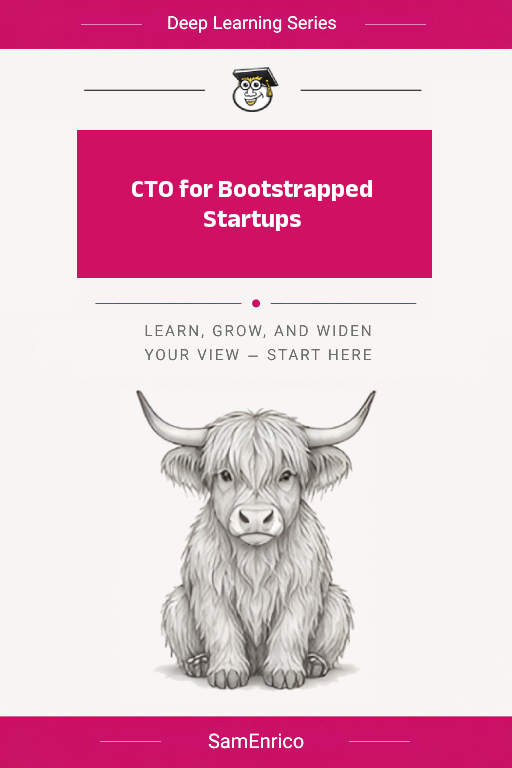
CTO for Bootstrapped Startups eBook
Hire a CTO when you have no funding. Equity-heavy
Hire a CTO when you have no funding. Equity-heavy compensation and creative incentives.
Formats
Free sample
Chapter 1: The Three Hats--The first thing you need to understand is that the CTO you think you need doesn’t exist.Not in a bootstrapped startup, anyway. Not yet.You’ve probably spent hours reading about the CTO role at Google, or Stripe, or some well-funded Series B darling. You’ve seen the org charts, the job descriptions, the carefully crafted Linked In profiles of executives who “set technical vision” and “lead cross-functional alignment” and “drive innovation at scale.” And you’ve thought: I need that. I need someone who thinks strategically, who builds systems that won’t collapse at the first sign of traction, who can manage a team when I finally have one.Here’s the brutal truth: that person doesn’t exist in your world. Not because they aren’t smart or capable, but because the role you’re imagining is a luxury of abundance.
It requires a budget for senior architects, dedicated engineering managers, and a staff of developers to execute. It requires the kind of organizational depth that only comes from millions in funding or years of profitable growth.You have neither.What you have is a problem, a spreadsheet full of customer feedback, a bank account that makes you wince, and a burning need to ship something that works before your runway runs out. And somehow, you need technical leadership.So let’s redefine what the CTO means when there’s no venture capital, no fat salary line, and no room for theory.In a bootstrapped startup, the CTO wears three hats simultaneously. Not sequentially. Not “as needed.” Simultaneously.
And if you hire someone who refuses to wear all three, or you structure a deal that only covers one, you’re setting yourself up for a disaster that will cost you equity, time, and probably the relationship.This chapter is about those three hats. It’s about understanding them, communicating them, and building a compensation and role structure that makes it possible for one person to wear them without burning out or burning you.Let’s start with the biggest mistake I see founders make.The Strategic CTO Fantasy I once watched a founder—let’s call him Marcus—raise a small friends-and-family round for his bootstrapped edtech startup. He had $80k in the bank, a working prototype built by a freelance developer who had just quit, and a list of features his early customers were demanding.Marcus did what he thought was the smart thing. He went out and found a CTO.The guy had an impressive resume. Former director of engineering at a mid-sized Saa S company.
Deep expertise in the tech stack Marcus was using. Great references. And when Marcus explained his situation—limited cash, big ambitions—the CTO nodded knowingly. He said he understood bootstrapping. He said he was ready to “focus on strategy and architecture” while Marcus handled the business side.They agreed on 8% equity, no cash for the first six months, with a springing salary after $50k MRR.
Marcus felt like he’d made a brilliant hire.Four months later, Marcus had no working product, no new features, and a CTO who spent his days drawing diagrams, writing documentation, and attending “alignment meetings” with Marcus’s two part-time contractors. The CTO hadn’t written a line of production code in weeks. When Marcus asked why features were delayed, the CTO said he was “architecting for scale” and that the contractors were “executing the vision.”The contractors, meanwhile, had no clear direction, no code reviews, and no actual leadership. They were billing hours and spinning in circles.Marcus ended up firing the CTO, losing the 8% equity (which had a one-year cliff, so thankfully none had vested), and starting over with a lead developer who charged $80/hour and shipped code every single day.The mistake wasn’t hiring a strategic thinker. The mistake was hiring a strategic thinker to do a builder’s job.At Marcus’s stage—pre-revenue, pre-traction, with a prototype that needed to become an MVP—the only hat that mattered was the builder’s hat.
He didn’t need architecture. He needed working software.This is the fantasy I want you to kill right now: that you can hire a “real CTO” who will think big thoughts while other people write the code. That person exists at a later stage. But at your stage, the CTO writes code. Period.Let me show you what I mean.Hat One: The Builder The builder hat is the most important hat in a bootstrapped startup.
It’s also the one most non-technical founders are afraid to ask for.Here’s what the builder does: they write production code. Not proofs of concept, not prototypes, not architecture diagrams that will gather digital dust. They ship features that paying customers actually use. They fix bugs. They refactor messy code when technical debt starts to slow them down.
They deploy on Friday evenings when something breaks. They are, for all practical purposes, the most senior engineer on a team that might consist of exactly one person: themselves.If you are pre-revenue or early revenue (say, under $50k MRR), your CTO should be spending at least 60-80% of their time in the builder hat. I’ve seen this number range from 50% at the high end of early revenue to 90%+ at the very earliest stages. There is no shame in this. In fact, it’s the only honest way to operate.Let me give you a concrete example.A bootstrapped Saa S I advised—let’s call it Workflow IQ—had a non-technical founder named Priya.
She had validated her idea, signed three beta customers at $500/month each, and needed someone to turn her wireframes into a real product. She found a developer through her network, a woman named Jenna who had spent five years as a senior engineer at a mid-sized tech company.Jenna had never been a CTO. She didn’t want a fancy title. She wanted to build something useful and get paid fairly for her time. Priya offered her 10% equity and a deferred cash agreement that would start paying 60k/yearafter60k/year after 60k/yearafter30k MRR.
Jenna said yes.For the next nine months, Jenna coded. She built the MVP. She added features based on customer feedback. She fixed the inevitable bugs. She worked 25-30 hours per week, mostly nights and weekends on top of her day job.
She didn’t draw architecture diagrams. She didn’t write long design documents. She just shipped.When Workflow IQ hit 30k MRR,Jenna’sdeferredcashkickedin.Shequitherdayjobandwentfull−time.Bythen,theproducthad200payingcustomers,acodebasethatwasstableifnotbeautiful,andaclearpathtothenext30k MRR, Jenna’s deferred cash kicked in. She quit her day job and went full-time. By then, the product had 200 paying customers, a codebase that was stable if not beautiful, and a clear path to the next 30k MRR,Jenna’sdeferredcashkickedin.Shequitherdayjobandwentfull−time.Bythen,theproducthad200payingcustomers,acodebasethatwasstableifnotbeautiful,andaclearpathtothenext50k MRR.Jenna still coded 50% of her time.
The rest went to managing two junior developers Priya had hired and making architectural decisions about the next major version. She had earned the right to take off the builder hat sometimes because she had built the foundation first.The lesson here is…
This is the end of the free sample. Get the eBook to keep going. Buy now
About this book
Details
- Author
- Frierson Deane
- Publisher
- SamEnrico
- Language
- English
- Genre
- Non-Fiction, Startup Guide, Executive Search
- Released
- 2026-05-28
- Pages (approx.)
- 140
- Available as
- eBook, Audiobook

Read better in the ZLOADR app
Your eBooks on your phone or tablet. Sign in with your SamEnrico account and start reading.
More by Frierson Deane
 Depression Journaling GuideFrierson Deane$11.99
 Guts MemoirFrierson Deane$11.99
 Teen Impulse Control GuideFrierson Deane$11.99
 Foster Care And The LGBTQ ClosetFrierson Deane$11.99
 The Bipolar Genetics GuideFrierson Deane$11.99
 The Last Trial of the Roman RepublicFrierson Deane$11.99
 The Breeder's Guide to Shropshire SheepFrierson Deane$11.99
 Minority Firm Contract PerformanceFrierson Deane$12.99
 Processing TechnicianFrierson Deane$11.99
 How to Become a Gem CutterFrierson Deane$11.99
You may also like
 Hong Kong Handover 1997Dunn Johnnie$11.99
 Zumba For Postnatal Recovery CourseNeal Christian$11.99
 Zumba for BeginnersLadner Nikia$11.99
 YouTube Comment Mining GuideHumes Pandora$12.99
 Worry Box MeditationCarlin Rudy$11.99
 Workplace Stress MeditationNguyen Lynn$11.99
 Workplace Stress and Sleep RepairHawley Ivory$11.99
 Workplace Perfectionism CureDelaney Jeffry$11.99
 Workplace Injustice Anger GuideWallen Isabelle$11.99
 Work Addiction and Burnout LinkGreenwood Ester$11.99
 Women in Yoga and WellnessBeattie Galina$11.99
 Women in Stand Up ComedyChun Evangeline$11.99