
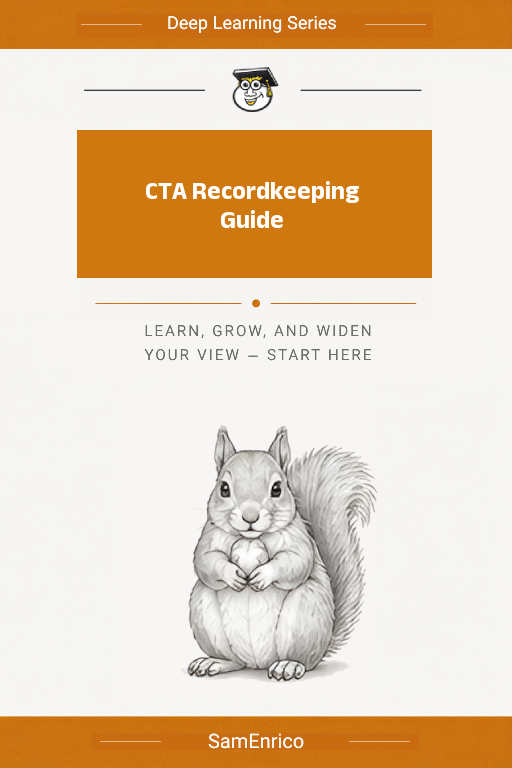
Non-FictionAnnual CheckupRecordkeepingDocumentation
CTA Recordkeeping Guide eBook
Maintain CTA compliance records including supporti
Maintain CTA compliance records including supporting documentation for BOI reporting and updates.
Formats
Free sample
Chapter 1: The Waiting Trap...--–- On a Tuesday morning in late March 2025, a mid-sized manufacturing company outside Chicago received an email that its general counsel had been dreading for months. Fin CEN had opened an inquiry. Not a full audit—not yet—but a request for documentation: "Please provide all records maintained pursuant to the Corporate Transparency Act, including any change logs, ownership updates, and communications with beneficial owners regarding their reporting obligations."The general counsel panicked, then scrambled, then realized the truth. They had filed their initial BOI report back in 2024, when the rules first took effect. They had checked the box.
They had moved on. But they had never built a system to track changes. They had never documented who made which decisions. They had never asked their beneficial owners to confirm that their addresses, their ownership percentages, their control statuses had remained the same.And now, eighteen months later, Fin CEN was asking to see the receipts.The company had thirty days to respond. Their outside counsel estimated that reconstructing three years of ownership changes from scattered emails, expired driver's licenses, and the fading memories of retired executives would cost roughly 85,000inbillablehours.Thecivilpenalties,if Fin CENfoundwillfulneglect,couldaddanother85,000 in billable hours.
The civil penalties, if Fin CEN found willful neglect, could add another 85,000inbillablehours.Thecivilpenalties,if Fin CENfoundwillfulneglect,couldaddanother500 per day for every day the information had been wrong—potentially hundreds of thousands more.The general counsel sat at her desk and asked the only question that mattered now: "Why didn't we build this sooner?"This book exists to ensure that you never ask that question.The Great Misunderstanding of the Corporate Transparency Act The Corporate Transparency Act of 2021, which became effective on January 1, 2024, represents the most significant expansion of federal business transparency regulation in a generation. Its stated purpose is straightforward: to combat money laundering, tax fraud, and terrorist financing by requiring entities to disclose their true beneficial owners to the Financial Crimes Enforcement Network (Fin CEN). The logic is simple. For decades, bad actors have hidden behind anonymous shell companies, using state-level incorporation practices that did not require disclosure of ownership. The CTA closes that loophole.But here is the great misunderstanding that has infected boardrooms, law firms, and compliance departments across the country: the CTA is not a filing law.
It is a recordkeeping law dressed in filing law's clothing.Most business owners and compliance officers have treated the CTA as a one-time paperwork exercise. They identify their beneficial owners. They collect the required data points. They submit the initial BOI report to Fin CEN. Then they close the folder, metaphorically dust off their hands, and return to their actual work.
This approach treats the CTA like an annual report or a business license renewal—something you do once per year or once per entity and then forget.That approach is not merely incomplete. It is dangerous.The CTA imposes two distinct obligations on reporting companies. The first is the initial filing obligation, which has received nearly all the attention from lawyers, accountants, and compliance software vendors. The second is the ongoing update obligation, which has received almost none. And it is the second obligation—the requirement to update BOI within thirty days of any change—that transforms the CTA from a filing law into a recordkeeping law.Consider what the thirty-day update rule actually requires.
You must know, within thirty days, when any beneficial owner changes their residential address. You must know when any beneficial owner acquires or disposes of ownership interests, even if that acquisition moves them across the 25 percent threshold. You must know when any individual gains or loses substantial control over the entity—a new CEO, a board member with veto power, an outside investor who now directs major financial decisions. You must know when the entity itself changes status, such as falling below the twenty-employee threshold that previously qualified it for the Large Operating Company exemption.You cannot know any of these things without a recordkeeping system that continuously tracks ownership, control, and status. And you cannot know that you know them without documentation that would survive an audit.This is why the title of this chapter is "The Waiting Trap." The trap is the seductive belief that because no one is asking for your records today, you do not need to maintain them today.
The trap is the assumption that the March 2025 Interim Final Rule, which paused domestic filing requirements for many entities, means you can stop tracking altogether. The trap is the false comfort of the present moment, when Fin CEN has not yet knocked on your door.But Fin CEN will knock. Not today, perhaps. Not this year. But the statute of limitations for criminal violations is five years.
Fin CEN has explicitly stated that enforcement will focus on willful violations, but willful violations are proved through records—or through the absence of records. The absence of records is itself evidence of willful neglect.The waiting trap has three jaws. The first jaw is legal uncertainty, which encourages delay. The second jaw is operational complexity, which discourages action. The third jaw is human nature, which prefers the comfort of inaction to the discomfort of preparation.
This chapter—and this entire book—is designed to help you escape all three.What the March 2025 Interim Final Rule Actually Changed To understand the current legal landscape, we must first dispense with the confusion that has surrounded the March 2025 Interim Final Rule (IFR). When Fin CEN issued the IFR, many news outlets and compliance newsletters reported that the CTA was "paused" or "suspended" or "on hold." Those reports were incorrect in ways that have already caused real harm to businesses that stopped tracking BOI.Here is what the March 2025 IFR actually did. It provided that domestic reporting companies—entities created by filing with a secretary of state in any of the fifty states—are not currently required to file BOI reports or updates with Fin CEN. This was a significant shift from the original rule, which required all reporting companies to file. The IFR cited ongoing litigation and the need for further administrative review.However, the IFR explicitly did not apply to foreign reporting companies—entities that were formed under the laws of a foreign country but have registered to do business in any U.S.
jurisdiction. Those entities remain fully subject to all CTA requirements, including the initial filing obligation and the thirty-day update rule. Fin CEN has stated publicly that its enforcement priorities for the duration of the IFR will focus on foreign-owned entities, particularly those with opaque ownership structures that may conceal foreign malign actors.The IFR did not repeal the CTA. It did not eliminate the underlying statute. It did not erase the five-year statute of limitations.
It did not excuse any entity from the obligation to maintain records. And crucially, the IFR is temporary. It is subject to change based on court rulings, congressional action, or a new administration's priorities. The current legal limbo is exactly that—limbo, not freedom.For domestic entities, the correct interpretation of the IFR is as follows: you have no current filing obligation, but you have an ongoing preparation obligation. You should…
This is the end of the free sample. Get the eBook to keep going. Buy now
About this book
Details
- Author
- Cunningham Jackie
- Publisher
- SamEnrico
- Language
- English
- Genre
- Non-Fiction, Annual Checkup, Recordkeeping, Documentation
- Released
- 2026-05-30
- Pages (approx.)
- 149
- Available as
- eBook, Audiobook

Read better in the ZLOADR app
Your eBooks on your phone or tablet. Sign in with your SamEnrico account and start reading.
More by Cunningham Jackie
 School Insurance Agency DirectoryCunningham Jackie$11.99
 Beginner Fitness with KidsCunningham Jackie$11.99
 Zumba For Beginners Over 50 HandbookCunningham Jackie$11.99
 Accounting Fraud ViolationsCunningham Jackie$11.99
 Meditation for Trigeminal NeuralgiaCunningham Jackie$11.99
 The Algorithm of Us: How TikTok Reshaped a GenerationCunningham Jackie$11.99
 The Code That Changed the World: How a 1990s Algorithm Reshaped DemocracyCunningham Jackie$11.99
 Understanding Diabetes Mellitus Type 1Cunningham Jackie$17.99
 UK Persons of Control RegisterCunningham Jackie$12.99
 Ultimate Handbook Guide to Rome : (Italy) Travel GuideCunningham Jackie$11.99
 Activity AideCunningham Jackie$11.99
You may also like
 Hong Kong Handover 1997Dunn Johnnie$11.99
 Zumba For Postnatal Recovery CourseNeal Christian$11.99
 Zumba for BeginnersLadner Nikia$11.99
 YouTube Comment Mining GuideHumes Pandora$12.99
 Worry Box MeditationCarlin Rudy$11.99
 Workplace Stress MeditationNguyen Lynn$11.99
 Workplace Stress and Sleep RepairHawley Ivory$11.99
 Workplace Perfectionism CureDelaney Jeffry$11.99
 Workplace Injustice Anger GuideWallen Isabelle$11.99
 Work Addiction and Burnout LinkGreenwood Ester$11.99
 Women in Yoga and WellnessBeattie Galina$11.99
 Women in Stand Up ComedyChun Evangeline$11.99