
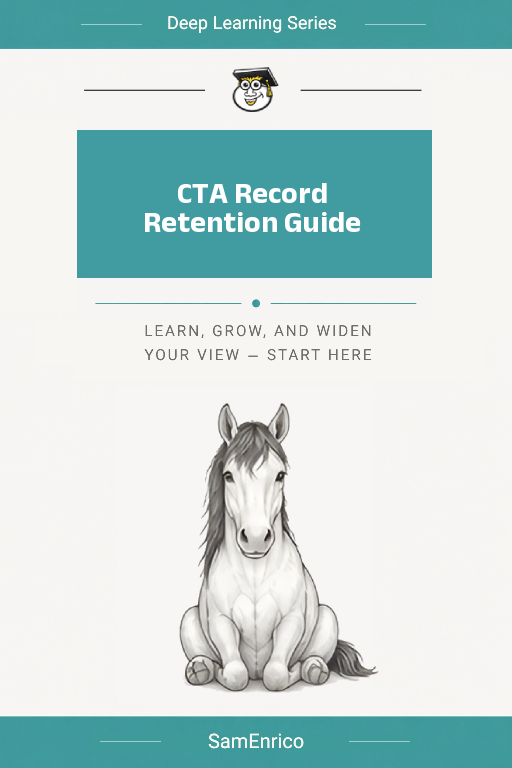
Non-FictionAnnual CheckupRecord Keeping
CTA Record Retention Guide eBook
Maintains required records for BOI reporting inclu
Maintains required records for BOI reporting including supporting documents for beneficial ownership identification and updates.
Formats
Free sample
Chapter 1: The $500 Lie...--–- The email arrived on a Thursday afternoon, and David thought it was spam. He had formed his consulting LLC three years earlier through an online legal service, paid the 499fee,andpromptlyforgottenaboutit.Theemailmentionedsomethingcalledthe Corporate Transparency Act,somethingabout"beneficialownership,"andadeadlinethathadapparentlypassed.Hedeletedit.Twomonthslater,hisbankfrozehisbusinessaccount.Sixmonthsafterthat,hereceivedanoticefrom Fin CENproposing499 fee, and promptly forgotten about it. The email mentioned something called the Corporate Transparency Act, something about "beneficial ownership," and a deadline that had apparently passed. He deleted it. Two months later, his bank froze his business account.
Six months after that, he received a notice from Fin CEN proposing 499fee,andpromptlyforgottenaboutit.Theemailmentionedsomethingcalledthe Corporate Transparency Act,somethingabout"beneficialownership,"andadeadlinethathadapparentlypassed.Hedeletedit.Twomonthslater,hisbankfrozehisbusinessaccount.Sixmonthsafterthat,hereceivedanoticefrom Fin CENproposing10,000 in civil penalties. Twelve months later, David's attorney explained that because he had shredded his formation documents during the "Great Pause" of 2025—thinking he was finally free of the whole mess—he now had no way to prove when his company had been formed, who had filed the paperwork, or whether he had ever been required to report in the first place. The penalty stood. The bank account remained frozen. And David learned what thousands of business owners are about to learn: the government didn't pause enforcement.
It paused filing. There is a difference. This book exists because that difference will bankrupt the unprepared.The Most Dangerous Sentence in Compliance Let me say something that contradicts nearly every news headline you have read since March 26, 2025. The Corporate Transparency Act is not dead. It is not paused.
It is not on hold. What happened on March 26, 2025, was an interim final rule that exempted domestic US companies from the active reporting requirement. That means you do not have to file a Beneficial Ownership Information report with Fin CEN right now. But the underlying law—the Anti-Money Laundering Act of 2020, which created the CTA—remains fully intact. The penalty provisions remain fully intact.
Fin CEN's authority to investigate remains fully intact. And most critically for the purpose of this book, the records that would have supported a BOI report remain just as discoverable, just as subpoenable, and just as dangerous as they were the day before the exemption was announced.Here is the distinction that will save you or sink you. Filing is an action. Record retention is a state of being. When the government said "domestic companies do not need to file," it did not say "domestic companies may destroy all records related to ownership and control." In fact, Fin CEN explicitly stated in the same rulemaking that the underlying statutory authority for recordkeeping remains in effect.
The five-year retention period for terminated entities is still law. The requirement to maintain accurate ownership information is still enforceable through other means—state investigations, civil litigation, bank due diligence requests, and federal criminal inquiries that do not rely on the CTA's reporting provisions.This chapter is called The 500Liebecausethatisthefalsepromisethathaslulledmillionsofbusinessownersintoafalsesenseofsecurity.Theliehasmanyversions.Somepeopleheard"the CTAwasstruckdown."Othersheard"domesticcompaniesdon′thavetoworryanymore."Stillothersheard"justwaituntil2026whentheyrewritetherules."Buttheversionthatwillcausethemostdamageisthequietassumptionthatbecausefilingstopped,recordkeepingcanstoptoo.Thatassumptioniswrong.Andthecostofthatmistake—measuredinfines,legalfees,frozenassets,andinextremecasesprisontime—willvastlyexceedthe500 Lie because that is the false promise that has lulled millions of business owners into a false sense of security. The lie has many versions. Some people heard "the CTA was struck down." Others heard "domestic companies don't have to worry anymore." Still others heard "just wait until 2026 when they rewrite the rules." But the version that will cause the most damage is the quiet assumption that because filing stopped, recordkeeping can stop too. That assumption is wrong.
And the cost of that mistake—measured in fines, legal fees, frozen assets, and in extreme cases prison time—will vastly exceed the 500Liebecausethatisthefalsepromisethathaslulledmillionsofbusinessownersintoafalsesenseofsecurity.Theliehasmanyversions.Somepeopleheard"the CTAwasstruckdown."Othersheard"domesticcompaniesdon′thavetoworryanymore."Stillothersheard"justwaituntil2026whentheyrewritetherules."Buttheversionthatwillcausethemostdamageisthequietassumptionthatbecausefilingstopped,recordkeepingcanstoptoo.Thatassumptioniswrong.Andthecostofthatmistake—measuredinfines,legalfees,frozenassets,andinextremecasesprisontime—willvastlyexceedthe500 LLC formation fee that started this whole chain of events.Why This Book Exists Now You are holding a book about record retention at a moment when most compliance professionals are telling you to do nothing. That is precisely why this book is necessary. The market is flooded with panic compliance guides written in 2023 and 2024—books that assumed the CTA would require universal filing forever. Those books are now obsolete. But no one has yet written the counterintuitive guide: the book that explains why the pause makes recordkeeping more important, not less.Think of it this way.
When the law required everyone to file, records were a means to an end. You gathered ownership information, you completed a form, you submitted it to Fin CEN, and you moved on. The record was simply fuel for the filing engine. But now that filing is paused for most companies, the record has become the end itself. There is no filing to distract you.
There is only the naked question: if a regulator, a bank, or a plaintiff's attorney asked you today to produce a complete, accurate, and timely history of your company's beneficial ownership, could you do it?The top ten books on the CTA—the ones that dominated Amazon's business law category in 2024—all made the same fundamental error. They focused on the how of filing rather than the why of retention. They gave you checklists for completing Form BOI-01 but no system for preserving the underlying evidence. They told you about the 30-day update rule but did not explain how to log changes so that an auditor could verify your timeliness. And they completely missed the March 2025 exemption because it had not happened yet.
This book is not a revision of those works. It is a replacement. It starts from a different premise: because the law is volatile, the record is more important than the report.The Penalty Table You Must Memorize Before we go any further, I need to put numbers in front of you. These numbers will appear throughout the book, but they belong here at the beginning because they explain the stakes. The Corporate Transparency Act incorporates penalty provisions from the Anti-Money Laundering Act of 2020, and those provisions have not been paused, exempted, or reduced.For willful violations of the CTA's reporting or recordkeeping requirements—and remember, recordkeeping is a separate obligation from filing—civil penalties start at 500perday.Thatisnotatypo.∗Perday.∗Ifyoufailtomaintainrequiredrecordsandthatfailurecontinuesfor60days,youarelookingat500 per day.
That is not a typo. *Per day.* If you fail to maintain required records and that failure continues for 60 days, you are looking at 500perday.Thatisnotatypo.∗Perday.∗Ifyoufailtomaintainrequiredrecordsandthatfailurecontinuesfor60days,youarelookingat30,000 in civil penalties before any criminal charges are considered. The statute does not cap these penalties at a maximum; they accumulate until compliance is achieved or until Fin CEN brings an enforcement action.The criminal penalties are more severe. Willful violations can result in imprisonment for up to ten years. This is not theoretical.
The Department of Justice has already brought charges under the CTA's predecessor statutes for willful failures to maintain accurate ownership records, and those cases resulted in felony convictions. The unauthorized disclosure of beneficial ownership information—sharing BOI data with someone who is not authorized to receive it—carries the same felony penalty.Here is what these penalties mean for you practically. If you are a business owner, a compliance officer, a corporate secretary, or an accountant, you are now in the business of recordkeeping whether you like it or…
This is the end of the free sample. Get the eBook to keep going. Buy now
About this book
Details
- Author
- Cerda Drucilla
- Publisher
- SamEnrico
- Language
- English
- Genre
- Non-Fiction, Annual Checkup, Record Keeping
- Released
- 2026-05-29
- Pages (approx.)
- 140
- Available as
- eBook, Audiobook

Read better in the ZLOADR app
Your eBooks on your phone or tablet. Sign in with your SamEnrico account and start reading.
More by Cerda Drucilla
 Fear Of Failure In TeachingCerda Drucilla$11.99
 The Self Hypnosis for Aging FearCerda Drucilla$11.99
 Sports Nutrition for SoccerCerda Drucilla$11.99
 CBT for Dual DiagnosisCerda Drucilla$11.99
 Anger Management for Real EstateCerda Drucilla$11.99
 Frostbite and Fire: The Troll’s Daughter and the Sunlit WarriorCerda Drucilla$11.99
 Novation Head of BusinessCerda Drucilla$11.99
 Factoring for Staffing AgenciesCerda Drucilla$12.99
 How to Become a Stamp AnalystCerda Drucilla$11.99
 Understanding Rutledge–Friedman Harrod SyndromeCerda Drucilla$17.99
You may also like
 Hong Kong Handover 1997Dunn Johnnie$11.99
 Zumba For Postnatal Recovery CourseNeal Christian$11.99
 Zumba for BeginnersLadner Nikia$11.99
 YouTube Comment Mining GuideHumes Pandora$12.99
 Worry Box MeditationCarlin Rudy$11.99
 Workplace Stress MeditationNguyen Lynn$11.99
 Workplace Stress and Sleep RepairHawley Ivory$11.99
 Workplace Perfectionism CureDelaney Jeffry$11.99
 Workplace Injustice Anger GuideWallen Isabelle$11.99
 Work Addiction and Burnout LinkGreenwood Ester$11.99
 Women in Yoga and WellnessBeattie Galina$11.99
 Women in Stand Up ComedyChun Evangeline$11.99