
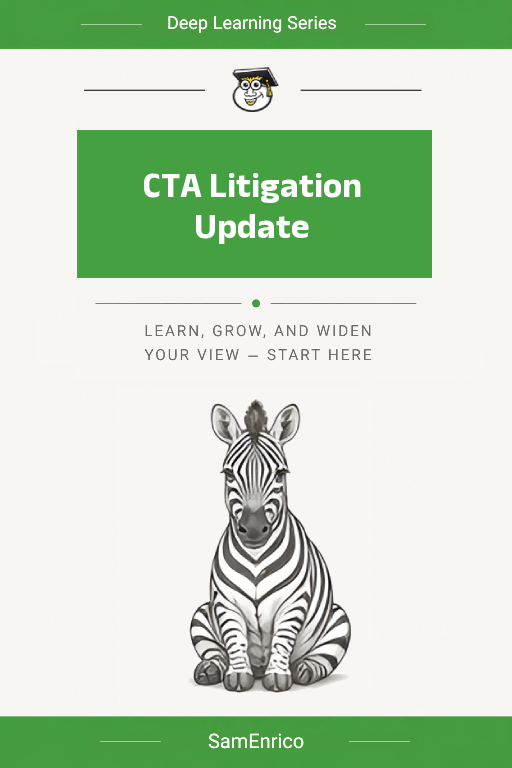
CTA Litigation Update Audiobook
Follow CTA legal challenges including court ruling
Follow CTA legal challenges including court rulings on constitutionality and enforcement injunctions.
Formats
Free sample
Chapter 1: The Transparency Mandate...--In the decade preceding the Corporate Transparency Act, a silent epidemic swept through the American financial system. An estimated two million new limited liability companies and corporations were formed each year across the fifty states, yet in most jurisdictions, the individuals who actually owned and controlled these entities could remain completely anonymous. A shell company could open a bank account, purchase real estate, and move millions of dollars across borders without ever disclosing a single human being's name to law enforcement. This was not a bug in the system—it was a feature, carefully cultivated by state legislators competing for incorporation fees and by corporate service providers marketing secrecy as a commodity.The consequences of this anonymity were not theoretical. Between 2010 and 2020, federal prosecutors repeatedly documented how drug cartels, money launderers, and even terrorist financiers exploited anonymous American shell companies to hide their tracks.
In one emblematic case, a Mexican drug lord used a series of Delaware LLCs to purchase a fleet of aircraft, each company traced only to a nominee director who had no knowledge of the underlying ownership. In another, Russian oligarchs moved billions through anonymous Wyoming corporations in the years following the annexation of Crimea, evading sanctions that were supposed to freeze their assets. The pattern was consistent and damning: wherever there was illicit finance, there was almost always an anonymous American shell company nearby.The Corporate Transparency Act of 2021 was Congress's answer to this epidemic. Tucked into the National Defense Authorization Act—a must-pass defense spending bill that no legislator wanted to vote against—the CTA represented the most dramatic expansion of federal corporate disclosure requirements since the Bank Secrecy Act of 1970. For the first time in American history, millions of small businesses would be required to report their beneficial owners to a federal database, creating a centralized registry of who actually owns the corporate entities that power the American economy.But the CTA was not merely a regulatory expansion.
It was a fundamental rethinking of the relationship between state corporate law and federal anti-financial crime authority. For two centuries, the formation and governance of corporations had been the almost exclusive province of the states, particularly Delaware, which had built a lucrative franchise on its flexible and secretive corporate laws. The CTA represented a federal intrusion into that domain, and from the moment it was signed into law, constitutional scholars predicted that…
This is the end of the free sample. Get the Audiobook to keep going. Buy now
About this book
Details
- Author
- Morrison Irma
- Publisher
- SamEnrico
- Language
- English
- Genre
- Non-Fiction, Annual Checkup, Litigation, Court
- Released
- 2026-05-29
- Pages (approx.)
- 154
- Available as
- eBook, Audiobook

Listen in the VoxFlicks app
Audiobooks and audio dramas wherever you go. Sign in with your SamEnrico account and press play.
More by Morrison Irma
 Spin Class Visualization Techniques CourseMorrison Irma$11.99
 Memory Care Housing BriefMorrison Irma$11.99
 Anger Trigger Identification GuideMorrison Irma$11.99
 Broker Dealer EnforcementMorrison Irma$11.99
 Peak Performance Self HypnosisMorrison Irma$11.99
 The Unstoppable Rise: How Nintendo Conquered the Gaming WorldMorrison Irma$11.99
 The Bloodhound and the Blitz: How a Dog Outsmarted WWII SpiesMorrison Irma$11.99
 How to Start a Hobby in Jigsaw PuzzlesMorrison Irma$11.99
 Inactive Entity ExemptionMorrison Irma$12.99
 Understanding Diabetic AngiopathyMorrison Irma$17.99
 Advanced Cyber Threat DetectionMorrison Irma$11.99