
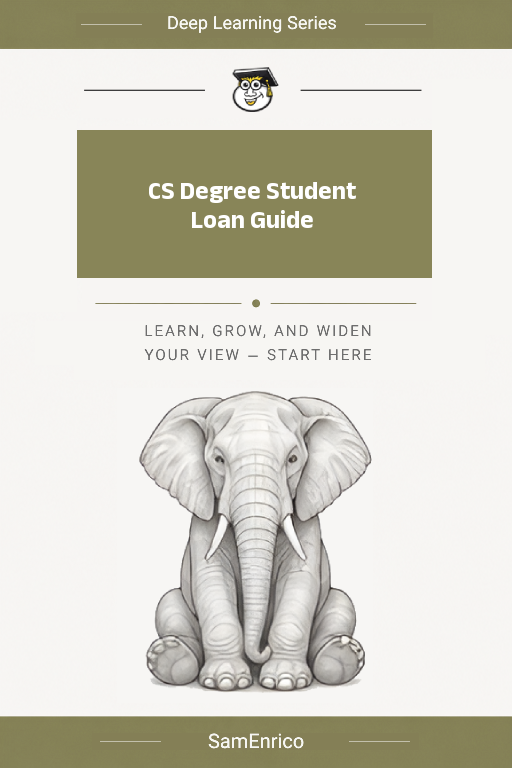
Non-FictionStudent's ShortcutStudent Debt
CS Degree Student Loan Guide
Compare debt loads, repayment periods, and default
by Edward Joel
Compare debt loads, repayment periods, and default rates for CS degrees across different countries.
Formats
About this book
Free sample
Chapter 1: The Two-Tier Reality--Every dollar you borrow for a Computer Science degree is a bet. Not on the economy. Not on interest rates. Not even on the tech industry. A bet on a single question: which salary distribution will you land in?Most student loan advice pretends this question doesn't exist.
It assumes averages. It quotes the Bureau of Labor Statistics. It tells you that the mean starting salary for a CS graduate is 63,017,andthereforeyour63,017, and therefore your 63,017,andthereforeyour40,000 debt is "manageable." This is not wrong. It is worse than wrong. It is dangerously incomplete.Here is what the averages hide: Computer Science is not a single career path with a normal distribution of outcomes.
It is two completely separate career paths masquerading as one degree. The first path leads to salaries between 55,000and55,000 and 55,000and75,000. The second leads to salaries between 150,000and150,000 and 150,000and250,000. There is very little in between. The middle is a desert.This is called a bimodal distribution, and it is the single most important financial fact about a CS degree that no one explains to you before you sign the promissory note.If you borrow 40,000expectingthemeansalaryof40,000 expecting the mean salary of 40,000expectingthemeansalaryof63,000, you will be fine if you land in the upper mode.
You will be dangerously over-leveraged if you land in the lower mode. And here is the cruel irony: the students who most need to understand this distinction are the least likely to hear about it. Career centers want to report high averages. Universities want to advertise impressive outcomes. Loan officers want to approve applications.
No one has an incentive to tell you that your outcomes depend almost entirely on factors that your student loan application never asks about.This chapter will change that. By the time you finish reading, you will know exactly which tier you belong in, how much debt is safe for that tier, and why the advice that works for a Stanford graduate heading to Google will financially cripple a state school graduate heading to IT support.The Income Shield That Isn't Let us start with what the best-selling personal finance…
This is the end of the free sample. Get the eBook to keep going. Buy now
Contents
- Chapter 1
- Chapter 2
- Chapter 3
- Chapter 4
- Chapter 5
- Chapter 6
- Chapter 7
- Chapter 8
- Chapter 9
- Chapter 10
- Chapter 11
- Chapter 12
Details
- Author
- Edward Joel
- Publisher
- SamEnrico
- Language
- English
- Genre
- Non-Fiction, Student's Shortcut, Student Debt
- Released
- 2026-05-29
- Pages (approx.)
- 133
- Available as
- eBook, Audiobook

Read better in the ZLOADR app
Your eBooks on your phone or tablet. Sign in with your SamEnrico account and start reading.
More by Edward Joel
 Interfaith Couple AngerEdward Joel$11.99
 Distraction Proof Morning RoutineEdward Joel$11.99
 Self Doubt In Friendship GuideEdward Joel$11.99
 Al Green Let's Stay TogetherEdward Joel$11.99
 Emergency Reserve PlanningEdward Joel$11.99
 Sleep Memory For Truck DriversEdward Joel$11.99
 Paleo Skin Health GuideEdward Joel$11.99
 The Shadow Pact: Spies of the LamassuEdward Joel$11.99
 The Diamond Laundromat: How Soviet Spies and African War Lords Built a $1 Billion Insider Trading EmpireEdward Joel$11.99
 How to Produce Ski and Snowboard Storage RacksEdward Joel$11.99
 A Collector's Handbook to the Cadillac 85Edward Joel$11.99
 10 Ways to Use Steel-cut Oats (Recipe Book)Edward Joel$11.99
You may also like
 Hong Kong Handover 1997Dunn Johnnie$11.99
 Zumba For Postnatal Recovery CourseNeal Christian$11.99
 Zumba for BeginnersLadner Nikia$11.99
 YouTube Comment Mining GuideHumes Pandora$12.99
 Worry Box MeditationCarlin Rudy$11.99
 Workplace Stress MeditationNguyen Lynn$11.99
 Workplace Stress and Sleep RepairHawley Ivory$11.99
 Workplace Perfectionism CureDelaney Jeffry$11.99
 Workplace Injustice Anger GuideWallen Isabelle$11.99
 Work Addiction and Burnout LinkGreenwood Ester$11.99
 Women in Yoga and WellnessBeattie Galina$11.99
 Women in Stand Up ComedyChun Evangeline$11.99