
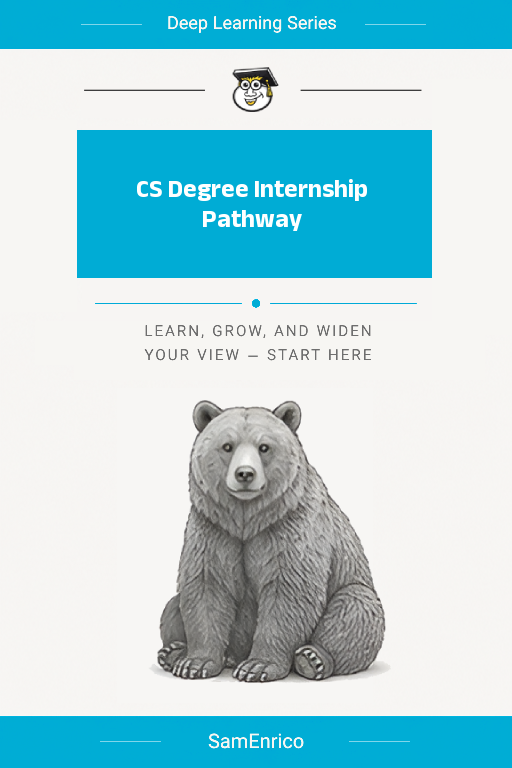
Non-FictionStudent's ShortcutInternship GuideBig Tech Paths
CS Degree Internship Pathway eBook
Leverage university internship programs at Google
by Ly Morgan
Leverage university internship programs at Google Microsoft and Amazon that are rarely available to bootcamp students.
Formats
Free sample
Chapter 1: The Two Job Markets--–- Most students discover the truth too late. They spend four years grinding Leet Code, building full-stack portfolios, and obsessing over their Git Hub contribution graph. Then they graduate, apply to 500 jobs, and hear nothing back. Meanwhile, their classmate—the one with lower grades and fewer projects—walks into a six-figure offer at Google before senior year even begins. The difference isn't talent.
It isn't hard work. It's knowing which job market exists and which one you've been playing in.The Myth of the Meritocratic Tech Interview For the past decade, bootcamps, You Tube influencers, and even well-meaning professors have sold students on a simple promise: if you learn to code well enough, the job offers will come. Build a portfolio. Solve Leet Code Hards. Contribute to open source.
The market, they claim, is a meritocracy where the best engineer wins.This is a lie.Not a small exaggeration. Not a half-truth. An outright, provable lie that has cost thousands of students years of wasted effort and hundreds of thousands of dollars in tuition and bootcamp fees.The truth is far less glamorous but far more actionable: the tech internship market is not one market but two parallel universes. In the first universe—the public job boards visible to everyone—one hundred thousand applicants fight for every hundred internship slots. In the second universe—the private, enrollment-gated portals accessible only to currently enrolled university students—the same hundred slots receive perhaps two hundred applicants.That is the difference between a 0.1% acceptance rate and a 50% acceptance rate.And here is the kicker: the students in the second universe are not better coders.
They are not more qualified. They simply have something that bootcamp graduates and self-taught developers cannot acquire: an active university enrollment status.The Public Job Board Graveyard Let's start with the reality most students live in without realizing there is an alternative.Linked In, Indeed, Glassdoor, Angel List—these platforms are where internships go to die. When Google posts a Software Engineering Internship opening on Linked In, within seventy-two hours the application count will exceed ten thousand. By the time the posting closes two weeks later, it may reach fifty thousand. The recruiters do not read fifty thousand resumes.
They do not even read five thousand. An automated system filters out anyone without a .edu email address, anyone whose graduation year is outside the target range, anyone whose university is not in their pre-approved list, and then—and only then—a human looks at perhaps two hundred candidates.The remaining 49,800 applicants never know what hit them.This is not malice. It is simple math. A single recruiter can reasonably screen two hundred resumes per week. If a posting receives fifty thousand applications, the recruiter would need two hundred fifty weeks—nearly five years—to read every single one.
So they don't. They set filters. They cull. And the first filter, always, is enrollment status.Public job boards are designed for one thing: volume. They are not designed for fairness.
They are not designed to find hidden talent. They are designed to reduce a mountain of applications to a manageable pile as quickly as possible.The students who succeed on public job boards are not the best coders. They are the ones who applied within the first hour, who happened to attend a target university, whose resumes contained exactly the right keywords to bypass the automated filter. In other words, they got lucky.You do not want to rely on luck when your career is on the line.The Private University Portal: Your Invisible Advantage Now let me show you the job market that bootcamps cannot see.Every major university maintains a career services portal—Handshake, Ripple Match, Symplicity, or an in-house system. These portals are contractually connected to corporate recruiting teams at Google, Microsoft, Amazon, Meta, Apple, and hundreds of other tech companies.
When a company wants to hire interns, they do not always post publicly. Sometimes—often, for the most competitive programs—they post exclusively to these university portals.Here is what that means for you.When Google posts its STEP internship exclusively through Handshake to a specific set of partner universities, that posting might reach ten thousand students across twenty schools. But not all ten thousand will apply. Many will think they are not ready. Many will miss the deadline.
Many will be intimidated by the Google name and talk themselves out of it. The actual number of applicants might be two hundred. For fifty internship slots.That is a 25% acceptance rate.Compare that to the 0.1% acceptance rate on Linked In. The difference is not your coding ability. The difference is simply knowing which door to knock on.These private portals are not secret.
They are not hidden. Every enrolled student has access to them. But most students never check them until their junior year, and by then, the freshman and sophomore programs have already closed.The Bootcamp Disadvantage: What They Cannot Legally Offer To understand why bootcamp graduates cannot access your pipeline, you need to understand three legal and logistical barriers that no amount of coding skill can overcome.Barrier One: Curricular Practical Training (CPT)In the United States, international students on F-1 visas require CPT authorization to work off-campus. CPT is only available to students enrolled in a degree-granting program at an accredited university. Bootcamps are not accredited universities.
They cannot issue I-20 forms. They cannot sponsor CPT. This means a bootcamp graduate—even an exceptional one—cannot legally work as a paid intern at any company that requires CPT verification. Most Big Tech companies require this verification for all interns, regardless of citizenship, as a matter of standard compliance.(To be precise: less than 1% of bootcamps are accredited. Those few exist, but they are the exception, not the rule.
This book assumes you are competing against the 99%.)Barrier Two: Enrollment Verification Letters Every Big Tech internship offer is contingent on enrollment verification. You must prove that you are currently enrolled in a degree program and that you will return to that program after the internship ends. Bootcamps do not have "returning students" because bootcamps are short-term programs with no degree track. A bootcamp graduate cannot provide an enrollment verification letter for the fall semester because they will not be enrolled anywhere.Barrier Three: The Return-to-Degree Timeline Big Tech does not invest 20,000–20,000–20,000–40,000 in an intern expecting immediate productivity. They invest in a long-term pipeline.
They want to train a sophomore, bring them back as a junior, and convert them to full-time upon graduation. This two-to-three-year relationship requires a degree timeline that bootcamps do not provide. A bootcamp student completes their program in three to six months and then expects a full-time job. They do not fit the pipeline model.None of this is the bootcamp graduate's fault. They were sold a dream that the industry quietly made impossible.
But their misfortune is your advantage. Every time a bootcamp graduate applies to a role they cannot legally fill, they are wasting an application slot that a university student could have taken. Do not let that be you.Case Study: The Sophomore Who Skipped Leet Code Let me introduce you to Maya. She…
This is the end of the free sample. Get the eBook to keep going. Buy now
About this book
Details
- Author
- Ly Morgan
- Publisher
- SamEnrico
- Language
- English
- Genre
- Non-Fiction, Student's Shortcut, Internship Guide, Big Tech Paths
- Released
- 2026-06-01
- Pages (approx.)
- 130
- Available as
- eBook, Audiobook

Read better in the ZLOADR app
Your eBooks on your phone or tablet. Sign in with your SamEnrico account and start reading.
More by Ly Morgan
 Creativity Trance MethodLy Morgan$11.99
 The Tosfot Yom TovLy Morgan$11.99
 Agoraphobia Hair Salon Anxiety GuideLy Morgan$11.99
 Menopause Growth Hormone ShiftLy Morgan$11.99
 AI Camera Tracking for VFXLy Morgan$11.99
 The Secret Codebreakers: How a Teen Girl Cracked the NazisLy Morgan$11.99
 Frozen Echoes: Unlocking the Secrets of the Arctic’s Oldest ArtifactsLy Morgan$11.99
 Understanding BrachyolmiaLy Morgan$17.99
 Ecommerce Fraud Prevention OutlookLy Morgan$12.99
 Hedge Fund AnalystLy Morgan$11.99
 10 Ways to Use Cola (Recipe Book)Ly Morgan$11.99
You may also like
 Hong Kong Handover 1997Dunn Johnnie$11.99
 Zumba For Postnatal Recovery CourseNeal Christian$11.99
 Zumba for BeginnersLadner Nikia$11.99
 YouTube Comment Mining GuideHumes Pandora$12.99
 Worry Box MeditationCarlin Rudy$11.99
 Workplace Stress MeditationNguyen Lynn$11.99
 Workplace Stress and Sleep RepairHawley Ivory$11.99
 Workplace Perfectionism CureDelaney Jeffry$11.99
 Workplace Injustice Anger GuideWallen Isabelle$11.99
 Work Addiction and Burnout LinkGreenwood Ester$11.99
 Women in Yoga and WellnessBeattie Galina$11.99
 Women in Stand Up ComedyChun Evangeline$11.99