
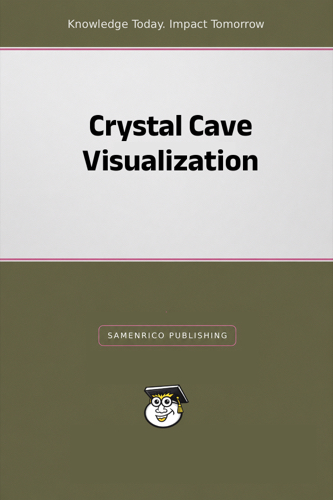
Crystal Cave Visualization eBook
Sits in geode chamber, feeling quartz energy.
Sits in geode chamber, feeling quartz energy.
Formats
Free sample
Chapter 1: Frozen Light...--The first time you hold a quartz crystal, something shifts. It is not merely the weight of stone in your palm, nor the coolness against your skin. It is a recognition—a subtle, wordless knowing that this object, formed over millions of years beneath mountains you will never climb, carries a memory you cannot name. Your ancestors felt this. The Egyptians placed crystal amulets over the hearts of their dead to guide them through the underworld.
The Sumerians inscribed crystal cylinders with prayers to gods whose names have crumbled into dust. Aboriginal dreamers of Australia spoke of crystals as "frozen light"—light that entered the earth at the beginning of time and chose to stay, solidifying into geometries of astonishing precision while waiting for human hands to wake it again.This book is about entering that memory. Not through the intellect alone—though we will honor the intellect—but through the oldest door you possess: your imagination, guided by your breath, anchored in your body, and amplified by the crystalline architecture of a cave that exists simultaneously beneath the earth and within your own psyche.You are about to learn a practice called Crystal Cave Visualization. It is a form of active meditation, energy healing, and manifesting technology that has no single cultural origin because it draws from a universal human capacity: the ability to enter an inner sanctuary and reshape reality from within. Over the next twelve chapters, you will learn to construct, enter, work within, and return from a geode chamber of your own making—a chamber lined with quartz crystals that respond to your thoughts, amplify your intentions, and reflect back to you the truth of who you are beneath the rough exterior of daily life.But first, you must understand what you are building.
And to understand that, you must understand the stone itself.The Geology of Remembrance Quartz is not rare. It is the second most abundant mineral in Earth's continental crust, after feldspar. You have walked on it, driven over it, and probably thrown it as a child without knowing its name. But abundance does not diminish power. Water is abundant, yet it shapes continents.
Air is everywhere, yet you cannot live without it for more than a few minutes. Quartz is abundant because the universe, in its strange economy, decided that something capable of such precise and consistent behavior should be widely available.What makes quartz extraordinary is its molecular structure. Silicon dioxide—Si O₂—arranges itself into a repeating lattice of tetrahedra, each silicon atom bonded to four oxygen atoms in a pyramid shape that stacks with mathematical perfection. This is not random. When quartz forms under the right conditions of temperature, pressure, and chemical availability, it grows in six-sided prisms capped by pyramidal terminations.
These are not decorative. They are the physical expression of an underlying order that repeats at every scale, from the microscopic to the mountain-sized.But here is where geology becomes magic, or perhaps where magic reveals itself as unrecognized geology. Quartz is piezoelectric. The word comes from the Greek piezein (to press) and ēlektron (amber, which produces static electricity when rubbed). When you apply mechanical pressure to a quartz crystal—when you squeeze it, strike it, or even hold it firmly—the crystal generates an electrical voltage across its faces.
Conversely, when you apply an electrical voltage to quartz, it vibrates at a precise frequency. This is why quartz watches work. This is why your smartphone keeps time. This is why radios tune to stations. A tiny sliver of quartz, cut to exact specifications and excited by electricity, oscillates millions of times per second without deviation.Now consider what this means for your practice.When you hold a quartz crystal during meditation, your hand applies pressure.
Your body heat creates thermal stress. Your heartbeat, pulse, and even the electromagnetic field generated by your nervous system produce minuscule charges that interact with the crystal's lattice. The crystal responds. It vibrates. It generates a tiny electrical field of its own.
And because quartz is also pyroelectric (it produces charge when heated or cooled), your breath alone—warm on the inhale, cooler on the exhale—creates a conversation between you and the stone.You are not imagining this. You are not engaging in wishful thinking. You are participating in a physical exchange that can be measured, though the subtlety of its effects on human consciousness is only beginning to be studied by mainstream science.The ancient peoples who called crystals "frozen light" had no electron microscopes or piezoelectric theory. But they had something perhaps more valuable: direct perception unmediated by analytical filtering. They held a crystal and felt it hum.
They placed it on wounds and watched inflammation subside. They slept with it under their pillows and dreamed with impossible clarity. They called it frozen light because that is what it felt like—light that had condensed into matter, carrying with it the properties of light: speed, vibration, information, and the ability to travel without diminishing.They were right in ways they could not have articulated. Light is electromagnetic radiation. Quartz generates electromagnetic charge under pressure.
The resonance between the two is not metaphorical. It is physical.The Geode as Mirror of the Self Now let us move from the crystal to the cave. Specifically, to the geode.A geode begins as a hollow cavity inside volcanic or sedimentary rock. Perhaps a gas bubble froze in cooling lava, leaving an empty space. Perhaps a root decayed underground, leaving a tunnel.
Perhaps an animal burrowed and died, and its body dissolved over eons. Whatever the origin, the cavity sits empty for a time—sometimes millions of years—until water carrying dissolved silica seeps in. Drop by drop, century by century, the silica precipitates out of solution, forming microscopic crystals on the cavity's inner walls. Layer by layer, the crystals grow inward, pointing toward the center, creating a hidden galaxy of facets and points that no one will see unless the outer shell is cracked open.Think about this. The geode is the only stone that conceals its beauty entirely.
An amethyst cluster can be seen from the outside. A quartz point announces itself. But a geode offers nothing to the casual observer except a lumpy, unremarkable exterior. You could walk past a thousand geodes and never know what they contained. Only a person willing to break the shell—or, in the case of the visualizations in this book, to find the natural crack or seam—can enter the crystalline cathedral within.This is not a coincidence of geology.
This is the first teaching.You are a geode.Your exterior—the face you show to the world, the personality you have constructed, the defenses you have built against hurt and disappointment—is rough, weathered, and deliberately unremarkable in places where you have learned to hide. This is not a flaw. It is a survival mechanism. The shell protects the interior while it grows. But at a certain point, the shell becomes a prison.
You forget that the beauty exists. You begin to believe that you are only the rough exterior, that there is nothing inside worth revealing or exploring.Crystal…
This is the end of the free sample. Get the eBook to keep going. Buy now
About this book
Details
- Author
- Bergstrom Abigail
- Publisher
- SamEnrico
- Language
- English
- Genre
- Non-Fiction, Self-Help, Crystals
- Released
- 2026-06-06
- Pages (approx.)
- 158
- Available as
- eBook, Audiobook

Read better in the ZLOADR app
Your eBooks on your phone or tablet. Sign in with your SamEnrico account and start reading.
More by Bergstrom Abigail
 Stress Migraine Triggers GuideBergstrom Abigail$11.99
 Flow State Meditation ScriptsBergstrom Abigail$11.99
 The Focus and Sleep LinkBergstrom Abigail$11.99
 Whale Song Ocean DepthsBergstrom Abigail$11.99
 Self Talk for LonelinessBergstrom Abigail$11.99
 Eisenhower Matrix for ManagersBergstrom Abigail$11.99
 Cheerleader's HypnosisBergstrom Abigail$11.99
 The Phantom of the Andes: The Hunt for Peru’s First Serial KillerBergstrom Abigail$11.99
 How to Produce PlantsBergstrom Abigail$11.99
 Cooperatives Export Certification GuideBergstrom Abigail$12.99
 Chinese Supplier Payment Dispute WorkbookBergstrom Abigail$12.99
 How to Produce a Digital Media PlayerBergstrom Abigail$11.99