
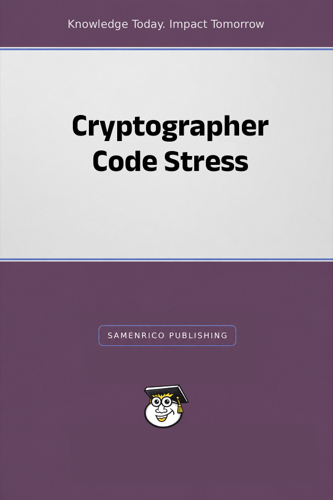
Non-FictionSelf-HelpCryptography
Cryptographer Code Stress eBook
Break or protect codes without developing obsessiv
Break or protect codes without developing obsessive patterns.
Formats
Free sample
Chapter 1: The Paranoia Baseline...--–- The first time you realize you have a problem will not come during a crisis. It will come during a quiet moment, probably a Tuesday, when you catch yourself checking the same file for the seventh time in fifteen minutes. You will know, at some level, that nothing has changed. The bytes are the same. The entropy hasn't shifted.
The cipher has not magically decrypted itself since the last six checks. But you will check again anyway, because the alternative—the suspended state of not-knowing—feels physically intolerable.This is not a story about weak will or poor discipline. This is a story about what happens when a mind trained to see patterns everywhere starts seeing threats everywhere, and when the very machinery that makes you exceptional at breaking codes begins to break you instead.Let me tell you about Daniel.Daniel was thirty-four when he stopped sleeping. He was a senior cryptanalyst at a government signals agency, the kind of person whose job title required three security clearances and whose annual performance reviews used words like "prodigious" and "indispensable." He could look at a block cipher and see, in the distribution of its S-box outputs, the faint fingerprint of a backdoor. He could listen to a recorded voice and hear, beneath the speech, the subtle timing variations of a compromised random number generator.
He was, by any objective measure, extraordinarily good at his job.He was also, by the time he came to see me, extraordinarily unwell."I don't understand what's happening to me," he said, sitting in the gray light of my office, his leg bouncing at a frequency that suggested either profound anxiety or a deliberate side-channel attack on my floorboards. "I've always been like this. Detail-oriented. Thorough. I catch things other people miss.
That's why they hired me. That's why I got promoted.""And now?" I asked."Now I can't stop." He looked at his hands, which were trembling slightly. "I check my work fifteen times. I check my coworkers' work. I check the air gaps between networks even though I know—intellectually—that they're physically impossible to bridge.
I lie awake at night trying to factor prime numbers in my head, not because I need to, but because I can't turn off the part of my brain that's looking for the factorization."He paused. Then: "I found a vulnerability in our authentication system last month. A real one. Something that three other senior analysts had missed for two years. I was a hero for about six hours.
And then I started wondering what else I'd missed. What else everyone had missed. And I haven't slept through the night since."Daniel was not suffering from a psychiatric disorder in the clinical sense. He met no formal criteria for obsessive-compulsive disorder, generalized anxiety, or any of the other diagnostic labels that might come to mind. He was, instead, suffering from something more subtle and, in some ways, more dangerous: the complete, total, and unsupervised optimization of a cryptographer's natural cognitive style.His pattern-seeking had become pattern-forcing.
His thoroughness had become paralysis. His distrust of incomplete information had become an inability to trust any information at all.And the most troubling part, the part that kept me awake after he left my office, was this: Daniel's agency had trained him to think this way. They had rewarded him for it. They had given him bonuses and promotions and the quiet respect of his peers. And then, when his mind finally began to collapse under the weight of its own vigilance, they had offered him an employee assistance hotline and a suggestion that he "maybe take a few days off."This book exists because of Daniel, and because of the dozens of cryptographers, security engineers, and code-breakers I have spoken with since that first conversation.
Their stories vary in the details—different agencies, different companies, different ciphers and algorithms and threat models—but they share a common architecture. They all describe the same slow, invisible transition from healthy skepticism to pathological hypervigilance. They all describe the moment when they realized they could no longer distinguish between a legitimate security concern and an obsessive spiral. And they all describe the absence of any framework, any vocabulary, any protocol for recognizing and stopping that transition before it reached crisis levels.This chapter is the first step in building that framework. It will ask you to look honestly at your own cognitive patterns, to measure what has probably never been measured before, and to accept a difficult truth: the traits that make you a great cryptographer are also the traits that can destroy you, if you do not learn to manage them.The Cryptographer's Quad: Accuracy, Secrecy, Sanity, Sustainability Every cryptographer operates within a set of competing demands.
We call these demands the Cryptographer's Quad—four essential priorities that constantly pull against one another:Accuracy. Your work must be correct. A single off-by-one error in a padding oracle, a single biased byte in a random number generator, a single reused nonce in a stream cipher—these are not academic failures. They are exploitable vulnerabilities. The cryptographer's commitment to accuracy is absolute, or it should be.
But absolute accuracy has a cost.Secrecy. You protect information. This is not merely a job requirement; for many cryptographers, it becomes an identity. You keep secrets from adversaries, from competitors, sometimes from friends and family. The boundary between "need to know" and "want to know" becomes second nature.
But secrecy, unchecked, becomes isolation.Sanity. Your mind must function. You need to sleep, eat, maintain relationships, experience joy, and distinguish between a real threat and a paranoid fantasy. Sanity is not the absence of mental illness; it is the presence of cognitive flexibility—the ability to engage and disengage, to zoom in and zoom out, to hold a suspicion without being consumed by it.Sustainability. Your practices must be maintainable over years and decades, not hours and days.
A cryptographer who burns out in three years has a shorter effective career than one who produces slightly less but lasts thirty. Sustainability is the long game. It is the quiet recognition that you are not a machine, and that treating yourself like one is the fastest route to obsolescence.Here is the hard truth that Daniel learned too late, and that this book will repeat until it becomes instinct: you can only optimize for three of these four at any given time.Want perfect accuracy and absolute secrecy and total sanity? Then your sustainability will suffer—you will burn out within months.Want perfect accuracy and absolute secrecy and long-term sustainability? Then your sanity will suffer—you will become anxious, obsessive, and eventually dysfunctional.Want perfect accuracy and sanity and sustainability?
Then your secrecy will suffer—you will need to share, to collaborate, to offload cognitive burden onto trusted others.This is not a flaw in your character. It is a constraint of human cognition, as unchangeable as the laws of thermodynamics. And the first step toward managing cryptographer code stress is accepting that you cannot have everything at once. You must choose. You must rotate.
You must, in the language of cryptography itself, rotate your keys—changing which three pillars you prioritize based on context, deadline…
This is the end of the free sample. Get the eBook to keep going. Buy now
About this book
Details
- Author
- Haywood Cyndi
- Publisher
- SamEnrico
- Language
- English
- Genre
- Non-Fiction, Self-Help, Cryptography
- Released
- 2026-06-06
- Pages (approx.)
- 144
- Available as
- eBook, Audiobook

Read better in the ZLOADR app
Your eBooks on your phone or tablet. Sign in with your SamEnrico account and start reading.
More by Haywood Cyndi
 The Overland Marine BiologistHaywood Cyndi$11.99
 Menopause Supplements GuideHaywood Cyndi$11.99
 Carson Cancer Battle Final Years GuideHaywood Cyndi$11.99
 The Caregiver Home Modification GuideHaywood Cyndi$11.99
 Nefertiti's Vanished Crown: The Curse of the Sun DiskHaywood Cyndi$11.99
 The Last Waltz: The Untold Story of Vienna's Forgotten MaestroHaywood Cyndi$11.99
 Performance Review IntegrationHaywood Cyndi$12.99
 Cape Town Tech Hub ManualHaywood Cyndi$12.99
 Test ProctorHaywood Cyndi$11.99
 Understanding FloatersHaywood Cyndi$17.99
 How to Become a Cigarette-package ExaminerHaywood Cyndi$11.99
You may also like
 Hong Kong Handover 1997Dunn Johnnie$11.99
 Zumba For Postnatal Recovery CourseNeal Christian$11.99
 Zumba for BeginnersLadner Nikia$11.99
 YouTube Comment Mining GuideHumes Pandora$12.99
 Worry Box MeditationCarlin Rudy$11.99
 Workplace Stress MeditationNguyen Lynn$11.99
 Workplace Stress and Sleep RepairHawley Ivory$11.99
 Workplace Perfectionism CureDelaney Jeffry$11.99
 Workplace Injustice Anger GuideWallen Isabelle$11.99
 Work Addiction and Burnout LinkGreenwood Ester$11.99
 Women in Yoga and WellnessBeattie Galina$11.99
 Women in Stand Up ComedyChun Evangeline$11.99