
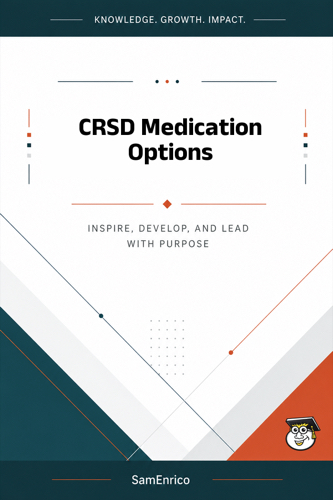
Non-FictionHealth & WellnessPharmacotherapy
CRSD Medication Options eBook
Hetlioz for Non24, modafinil for shift work sleepi
by Lenz Corazon
Hetlioz for Non24, modafinil for shift work sleepiness.
Formats
Free sample
Chapter 1: The Broken Orchestra...–- Every night, millions of people lie awake in the dark, staring at their ceilings, convinced that their inability to sleep—or to stay awake when it matters—is a personal failure. They have tried the advice: put away your phone an hour before bed, drink warm milk, keep a consistent schedule, avoid caffeine after noon. They have downloaded the meditation apps, bought the weighted blankets, installed the blackout curtains. And still, their bodies refuse to cooperate. Their sleep drifts later each night until they are going to bed at sunrise.
Or they fall asleep at their desk during a night shift despite having drunk three cups of coffee. Or they wake up at 2:00 AM feeling wide awake, then crash at 7:00 AM just as the alarm rings for work.If any of this sounds familiar, here is the most important thing you will read in this entire book: You are not lazy. You are not weak. You do not lack willpower.What you may have is a physical disorder of the brain's internal clock—a condition as real as diabetes or hypertension, and one that requires medical treatment, not moral judgment. This chapter will explain how that clock works, why it breaks, and why the language of "bad habits" has no place in the discussion of circadian rhythm sleep disorders.The Suprachiasmatic Nucleus: A Masterpiece of Biological Engineering Deep inside your brain, just above the point where your optic nerves cross, lies a tiny structure about the size of a grain of rice.
It is called the suprachiasmatic nucleus—the SCN for short—and it is the most important part of your nervous system that you have probably never heard of.The SCN is the body's master pacemaker. It generates an internal rhythm that cycles approximately every 24 hours and 10 minutes to 24 hours and 30 minutes in most humans. This is slightly longer than the Earth's 24-hour day, which is why we need external cues—called zeitgebers (German for "time-givers")—to reset the clock daily. Without these cues, your internal rhythm would drift later and later, just like a wristwatch that runs a few minutes slow each day.The most powerful zeitgeber is light. When light enters your eyes—specifically, when it strikes a special population of retinal ganglion cells that contain a photopigment called melanopsin—a signal travels along the retinohypothalamic tract directly to the SCN.
This signal tells the clock: "The sun is up. Reset yourself."The SCN then orchestrates a cascade of events throughout the body. It signals the pineal gland (another tiny brain structure) to suppress melatonin production during the day and ramp it up at night. Melatonin is the hormone of darkness; it tells every cell in your body that it is time to prepare for sleep. The SCN also regulates cortisol, the "stress hormone" that peaks in the early morning to help you wake up, and body temperature, which drops at night to conserve energy for sleep.Think of the SCN as the conductor of an orchestra.
The musicians—your liver, heart, lungs, kidneys, and every other organ—all have their own internal clocks. But they can only play in harmony if the conductor sets the tempo. When the conductor is off, the entire orchestra sounds terrible. You do not have a "liver problem" or a "lung problem." You have a problem with the person holding the baton.Why Your Mother's Sleep Advice Won't Work Let us be blunt. Most of the sleep hygiene advice you have received throughout your life—the stuff about warm baths, lavender oil, and avoiding screens—is perfectly reasonable for someone with a healthy circadian system who occasionally has a bad night.
It is completely useless, and sometimes actively harmful, for someone with a true circadian rhythm sleep disorder.Here is why.Sleep hygiene assumes that your internal clock is basically functional but that you have accumulated bad habits that interfere with it. Go to bed at the same time every night. Wake up at the same time every morning. Do not eat late. Exercise regularly.
These are good general health practices. But they cannot fix a broken clock.Consider the case of a patient with Non-24-Hour Sleep-Wake Disorder. Every day, their internal clock drifts later by one to two hours. One week they are falling asleep at 10:00 PM. The next week, midnight.
The week after, 2:00 AM. Then 4:00 AM. Eventually, they cycle all the way around to 10:00 PM again, only to start the drift anew. No amount of "consistent bedtime" can override a clock that is physically incapable of resetting to a 24-hour day without pharmacological help.Or consider the shift worker who has developed Shift Work Disorder. Their employer requires them to work from 10:00 PM to 6:00 AM, but their SCN is still trying to run on a daytime schedule.
They are asked to be maximally alert during the circadian trough (the period of lowest alertness, typically between 3:00 AM and 5:00 AM) and to sleep during the circadian peak (when the body naturally wants to be awake). Telling this person to "get better sleep hygiene" is like telling someone with a broken leg to "walk it off."The language of sleep hygiene blames the victim. It implies that if you are suffering from a CRSD, it is because you are not trying hard enough. This is not only cruel; it is medically inaccurate. You cannot will your SCN to produce more melanopsin.
You cannot meditate your way into a functional retinohypothalamic tract. You need chronobiotic agents—medications that reset the clock itself, not just sedate you or keep you awake.The Hormonal Symphony: Melatonin, Cortisol, and the Architecture of Sleep To understand why CRSD medications work the way they do, you need to understand the two key hormones that the SCN controls: melatonin and cortisol. These are not merely sleep-related chemicals; they are the primary messengers through which the brain tells the body what time it is.Melatonin is often misunderstood as a sleep aid. It is not. Melatonin is a darkness signal.
When the SCN detects darkness (via the retinohypothalamic tract), it instructs the pineal gland to release melatonin into the bloodstream. Melatonin binds to receptors throughout the body—most importantly, the MT1 and MT2 receptors in the SCN itself—and communicates: "It is nighttime. Prepare for sleep."The key word is "prepare." Melatonin does not force you to sleep the way a sedative does. Instead, it lowers your core body temperature, reduces alertness, and opens the "sleep gate" in the SCN. If you are in a dark, quiet environment when melatonin peaks, you will fall asleep easily.
If you are in a bright, noisy environment, you may feel sleepy but still be unable to sleep because the competing alerting signals are too strong.Cortisol is the yin to melatonin's yang. Cortisol peaks in the early morning, typically between 6:00 AM and 8:00 AM, and signals the body to wake up. It raises blood sugar (providing energy), increases heart rate and blood pressure, and sharpens cognitive function. Cortisol is often called the "stress hormone" because it also rises during stressful situations, but its circadian role is entirely healthy and necessary.In a healthy circadian system, melatonin and cortisol…
This is the end of the free sample. Get the eBook to keep going. Buy now
About this book
Details
- Author
- Lenz Corazon
- Publisher
- SamEnrico
- Language
- English
- Genre
- Non-Fiction, Health & Wellness, Pharmacotherapy
- Released
- 2026-06-07
- Pages (approx.)
- 157
- Available as
- eBook, Audiobook

Read better in the ZLOADR app
Your eBooks on your phone or tablet. Sign in with your SamEnrico account and start reading.
More by Lenz Corazon
 Trigger Reframing CBTLenz Corazon$11.99
 Self Esteem Blended FamilyLenz Corazon$11.99
 Alcohol Detox Agitation GuideLenz Corazon$11.99
 Personal Brand for TechLenz Corazon$11.99
 Nonverbal EQ SkillsLenz Corazon$11.99
 Inulin PrebioticLenz Corazon$11.99
 Certificate of Insurance GuideLenz Corazon$11.99
 The Great Pyramid of Glass: A Renaissance Vision UnfulfilledLenz Corazon$11.99
 The Knight of the Round Ball: The Legend of Ricardo Teixeira and the Rise of Brazilian FootballLenz Corazon$11.99
 Afghan Hound: Independent & ElegantLenz Corazon$11.99
 A Collector's Handbook to the Aston Martin V8 SaloonLenz Corazon$11.99
 JEE Multiple Correct Question GuideLenz Corazon$12.99
You may also like
 Hong Kong Handover 1997Dunn Johnnie$11.99
 Zumba For Postnatal Recovery CourseNeal Christian$11.99
 Zumba for BeginnersLadner Nikia$11.99
 YouTube Comment Mining GuideHumes Pandora$12.99
 Worry Box MeditationCarlin Rudy$11.99
 Workplace Stress MeditationNguyen Lynn$11.99
 Workplace Stress and Sleep RepairHawley Ivory$11.99
 Workplace Perfectionism CureDelaney Jeffry$11.99
 Workplace Injustice Anger GuideWallen Isabelle$11.99
 Work Addiction and Burnout LinkGreenwood Ester$11.99
 Women in Yoga and WellnessBeattie Galina$11.99
 Women in Stand Up ComedyChun Evangeline$11.99