
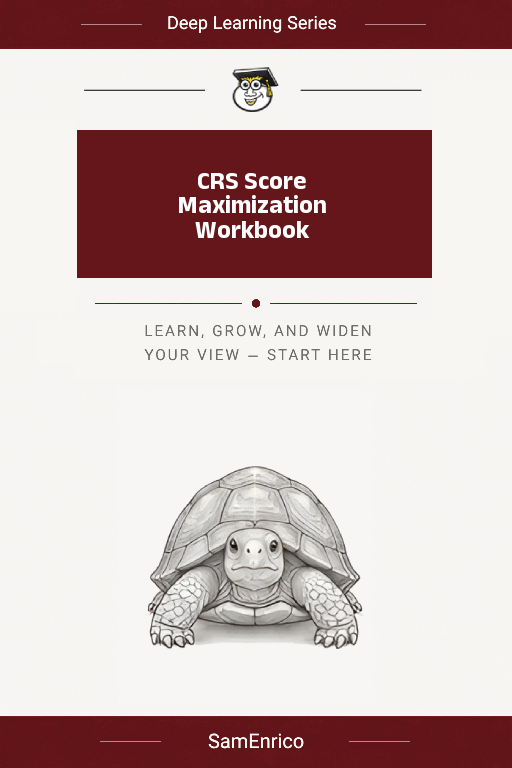
Non-FictionStudent's ShortcutCRS CalculatorPoints Strategy
CRS Score Maximization Workbook eBook
Calculate and boost your Comprehensive Ranking Sys
Calculate and boost your Comprehensive Ranking System points with language tests Canadian education and skilled work experience.
Formats
Free sample
Chapter 1: The 1,200-Point Illusion--–- Most applicants get their CRS score wrong before they even submit their profile. Not by a few points—but by fifty, eighty, sometimes over a hundred points. They misread the grid, double-count bonuses they don't qualify for, or assume that a job offer means automatic points. Then they wait six months in the pool, watch draw after draw pass them by, and wonder why they never receive an Invitation to Apply. This workbook exists to ensure you are not one of those applicants.The Problem with Self-Calculation The Comprehensive Ranking System is not complicated because the math is hard.
It is complicated because the rules change based on who you are applying with, where you studied, how many years of foreign experience you have, and whether that experience overlaps with Canadian education. Most online calculators ask for your age, language scores, and education—then spit out a number. That number is often wrong because the calculator does not know whether your spouse's education counts, whether your foreign work experience overlaps with a period when you were a full-time student, or whether your language test will expire before you receive an Invitation to Apply.Consider this scenario: A software engineer in India with a Bachelor's degree, three years of foreign work experience, and an IELTS score of 7.0 in each band uses a free online calculator. The calculator tells them their CRS score is 421. They feel hopeful.
They create their Express Entry profile. The actual score calculated by IRCC? 387. The difference is thirty-four points—the gap between receiving an Invitation to Apply within six months versus waiting indefinitely. What went wrong?
The online calculator assumed the engineer's foreign work experience was in a TEER 0 or 1 occupation when it was actually TEER 2. The calculator also assumed the engineer had no sibling in Canada (correct) but failed to deduct points for the spouse's lack of language test. The engineer's spouse had never taken IELTS, so IRCC assigned zero points for spousal language. The online calculator had assumed CLB 4 by default.This workbook solves that problem by walking you through the exact calculation that IRCC uses, line by line, with checkboxes for every nuance that automated calculators miss.The Three-Bucket Framework Before you calculate anything, you need to understand how the 1,200 maximum points are structured. Most resources break the CRS into two buckets: core points and bonus points.
That oversimplification causes confusion when you reach the skill transferability section. Instead, this workbook uses a three-bucket framework that mirrors how IRCC actually processes your profile:Bucket 1: Core Human Capital Points (Maximum 500)These are the fundamental attributes that you bring to the Canadian economy: your age, your education, your first official language ability, and your Canadian work experience. If you are applying with an accompanying spouse, your maximum core points drop from 500 to 460. However, your spouse can earn back up to 40 of those points through their own language ability, education, and Canadian work experience. This is not a penalty so much as a recalibration: a single applicant's profile stands alone, while a married couple's profile is evaluated as a unit.Bucket 2: Skill Transferability Points (Maximum 100)These points reward combinations of attributes that make you more likely to succeed economically.
For example, having both a university degree and strong official language ability suggests you can integrate quickly. Having both foreign work experience and Canadian work experience suggests you already understand the Canadian workplace. You cannot earn these points without first having the underlying core attributes. And crucially, you cannot double-count: the same combination of education and language cannot be used to claim transferability points in two different categories.Bucket 3: Bonus Points (Maximum 600)These are the game-changers. A provincial nomination adds 600 points, effectively guaranteeing an Invitation to Apply on the very next draw.
A qualifying job offer adds 50 or 200 points depending on the NOC level. Strong French language ability adds 50 points. A sibling who is a Canadian citizen or permanent resident adds 15 points. These bonuses stack, but only within specific rules. For example, you cannot claim both a qualifying job offer and a provincial nomination for the same job offer in most provinces.
You can claim French bonus points and sibling points simultaneously.The workbook element that accompanies this chapter—the Master Score Tracker—has three separate rows for these three buckets. As you complete each chapter, you will update your tracker. By Chapter 12, you will see not only your final score but exactly which bucket contributed the most points and where you have room for improvement.The Core + Spouse Math Explained in Full If you are single, your core human capital calculation is straightforward: IRCC awards points for your age, your education, your first official language ability, and your Canadian work experience. There is no spouse to consider, no reduction to account for. Your maximum possible core points are 500.If you are married or in a common-law relationship and you include your spouse as an accompanying dependent, your maximum core points drop to 460.
This is not because IRCC penalizes marriage. It is because the system assumes that a couple has shared expenses and that the principal applicant's income must support both people. A single applicant earning 50,000peryearhasalowerriskofneedingsocialassistancethanamarriedapplicantearningthesame50,000 per year has a lower risk of needing social assistance than a married applicant earning the same 50,000peryearhasalowerriskofneedingsocialassistancethanamarriedapplicantearningthesame50,000 to support two people. The 40-point reduction reflects that economic reality.However—and this is where most online calculators get it wrong—your spouse can earn back up to 40 of those points through their own contributions. The breakdown is specific and unforgiving:Spousal Language Ability (Maximum 20 points): Your spouse must take an approved language test (IELTS General, CELPIP, or PTE Core) and achieve at least CLB 4 in all four skills to earn any points.
At CLB 4, they earn 6 points. At CLB 5, they earn 12 points. At CLB 6, they earn 16 points. At CLB 7 or higher, they earn the full 20 points. If your spouse does not take a language test or scores below CLB 4 in any skill, IRCC awards zero points for spousal language.Spousal Education (Maximum 10 points): Your spouse's education is evaluated using the same Educational Credential Assessment process that applies to the principal applicant.
A one-year post-secondary program earns 4 points. A two-year program earns 6 points. A Bachelor's degree or three-year program earns 8 points. A Master's degree or professional degree (e.g., MD, DDS, JD) earns the full 10 points. If your spouse's education was completed outside Canada, you must obtain an ECA from a designated organization (WES, ICES, IQAS, or others listed on the IRCC website).
If your spouse's education is a trade credential, a different set of equivalencies applies.Spousal Canadian Work Experience (Maximum 10 points): Your spouse must have at least one year of full-time (or equivalent part-time) skilled work experience in Canada. The occupation must be TEER 0, 1, 2, or 3. One to two years earns 5 points. Three or more years earns the full 10 points. Unlike the principal applicant's work experience, the spouse's Canadian work experience does not need to be continuous.
However, it must be documented with the same level of proof: pay stubs, offer letters, and reference letters on company letterhead.Here is the critical insight that changes strategies for thousands of couples: If your spouse has no language test…
This is the end of the free sample. Get the eBook to keep going. Buy now
About this book
Details
- Author
- Witherspoon Bernetta
- Publisher
- SamEnrico
- Language
- English
- Genre
- Non-Fiction, Student's Shortcut, CRS Calculator, Points Strategy
- Released
- 2026-06-01
- Pages (approx.)
- 151
- Available as
- eBook, Audiobook

Read better in the ZLOADR app
Your eBooks on your phone or tablet. Sign in with your SamEnrico account and start reading.
More by Witherspoon Bernetta
 HGH Legal and Regulatory GuideWitherspoon Bernetta$11.99
 Baghdad Market Economic Golden AgeWitherspoon Bernetta$11.99
 The Parent Medical Self CareWitherspoon Bernetta$11.99
 The Urge Log WorkbookWitherspoon Bernetta$11.99
 AI Video Transcription and ChapteringWitherspoon Bernetta$11.99
 Echoes of the Iron Curtain: Reagan's Brandenburg Gate ChallengeWitherspoon Bernetta$11.99
 Stuart's Ghost: The Forgotten Men Who Conquered Central AsiaWitherspoon Bernetta$11.99
 Plaque MakerWitherspoon Bernetta$11.99
 How to Start a Rubber (wholesale) Business (Beginners Guide)Witherspoon Bernetta$11.99
 Small Business Inventory Accounting AIWitherspoon Bernetta$12.99
 Understanding Brown SyndromeWitherspoon Bernetta$17.99
You may also like
 Hong Kong Handover 1997Dunn Johnnie$11.99
 Zumba For Postnatal Recovery CourseNeal Christian$11.99
 Zumba for BeginnersLadner Nikia$11.99
 YouTube Comment Mining GuideHumes Pandora$12.99
 Worry Box MeditationCarlin Rudy$11.99
 Workplace Stress MeditationNguyen Lynn$11.99
 Workplace Stress and Sleep RepairHawley Ivory$11.99
 Workplace Perfectionism CureDelaney Jeffry$11.99
 Workplace Injustice Anger GuideWallen Isabelle$11.99
 Work Addiction and Burnout LinkGreenwood Ester$11.99
 Women in Yoga and WellnessBeattie Galina$11.99
 Women in Stand Up ComedyChun Evangeline$11.99