
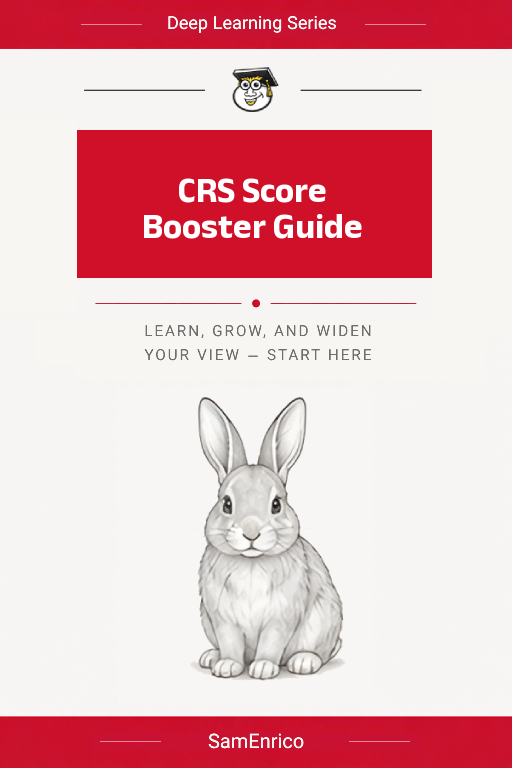
Non-FictionStudent's ShortcutPoints Strategy
CRS Score Booster Guide eBook
Maximize Comprehensive Ranking System points throu
Maximize Comprehensive Ranking System points through language retakes, education, and work experience.
Formats
Free sample
Chapter 1: The Score Autopsy--Every year, tens of thousands of skilled professionals around the world submit their Express Entry profiles with quiet confidence, believing they have done everything right. They have taken their language tests, gathered their educational credentials, and documented their work history with meticulous care. Yet when the draw results are published, they watch in disbelief as candidates with seemingly identical qualifications receive Invitations to Apply while their own profiles remain untouched in the pool. The difference between celebration and frustration is rarely a matter of dramatic life changes—a new degree, a different career, or a move to Canada. More often, it is a single miscalculated assumption about where their points are actually coming from and where they are leaking.This chapter introduces the single most important exercise you will perform in your entire immigration journey: the Score Autopsy.
Think of it as a forensic investigation into your Comprehensive Ranking System (CRS) score. Instead of guessing which areas to improve, you will systematically dissect your current score, identify the exact source of every point, and pinpoint the one or two deficits that are keeping you below the cutoff. By the end of this chapter, you will know with certainty whether you are a Language Deficit candidate, an Education Deficit candidate, an Experience Deficit candidate, or some combination thereof. More importantly, you will know exactly which action to take first—and which actions to ignore entirely.The problem with generic immigration advice is that it treats all candidates as if they have the same starting point. A blogger tells you to "improve your language score" without asking whether you are at CLB 7 or CLB 8.
A forum user insists that "a second diploma is the best investment" without knowing that you already have a Master's degree. A well-meaning friend recommends "gaining more work experience" without understanding that your second year of foreign experience adds precisely zero points. These generic recommendations are not merely unhelpful; they are actively harmful because they consume your most valuable resource—time—on activities that cannot possibly close your points gap.The Score Autopsy solves this problem by forcing you to look at your CRS score not as a single number but as a collection of discrete components. Each component has a maximum value, a current value, and a gap. Your job is to identify the components with the largest gaps that are also feasibly addressable within your timeframe.
A candidate who needs 40 points and has a CLB 8 language score should focus on reaching CLB 9 (which yields 82 points) rather than completing a two-year diploma (which yields 50 points but takes four times as long). A candidate who needs 15 points and has a sibling in Canada should claim those points immediately rather than studying for a language retake. A candidate who needs 50 points and has two years of foreign experience should wait for the third year rather than spending money on a new credential.The Score Autopsy is not a one-time exercise. You will perform it when you first build your profile, after every major life event (a birthday, a job change, a language test result), and before every major investment of time or money in your immigration strategy. It is your compass, your diagnostic tool, and your shield against the endless noise of conflicting advice.The Two Pillars of Your CRS Score Before you can conduct an autopsy, you must understand the anatomy of the CRS.
The system divides your points into two major categories: Core Human Capital and Skill Transferability. These two pillars interact in ways that many candidates misunderstand, leading to wasted effort.Core Human Capital: The Foundation Core Human Capital points are awarded for your personal attributes, regardless of how they combine with each other. These include:Age: Up to 110 points (without spouse) or 100 points (with spouse). Points peak at age 20–29 and decline steadily thereafter. At age 30, you lose 5–10 points.
At age 40, you lose another 10–15 points. At age 45, you become ineligible for most programs.Level of Education: Up to 150 points (without spouse) or 140 points (with spouse). A high school diploma earns 30 points. A one-year post-secondary certificate earns 90 points. A Bachelor's degree earns 120 points.
A Master's degree earns 135 points. A Ph D earns 150 points.Official Language Proficiency (First Language): Up to 136 points (without spouse) or 128 points (with spouse). CLB 4 earns 6 points. CLB 5 earns 10 points. CLB 6 earns 14 points.
CLB 7 earns 18 points. CLB 8 earns 22 points. CLB 9 earns 32 points. CLB 10 earns 34 points.Official Language Proficiency (Second Language): Up to 24 points (without spouse) or 22 points (with spouse). CLB 4 earns 2 points.
CLB 5 earns 4 points. CLB 6 earns 6 points. CLB 7 earns 8 points. CLB 8 earns 10 points. CLB 9 earns 12 points.
CLB 10 earns 14 points.Canadian Work Experience: Up to 80 points (without spouse) or 70 points (with spouse). One year earns 40 points. Two years earn 53 points. Three years earn 64 points. Four years earn 72 points.
Five or more years earn 80 points.Notice that Canadian work experience is part of Core Human Capital, while foreign work experience appears only in Skill Transferability. This distinction is crucial. A candidate with five years of foreign work experience but zero Canadian experience has a much lower Core Human Capital score than a candidate with just one year of Canadian experience. The CRS system heavily favors Canadian experience because it is a proven predictor of economic success in Canada.Skill Transferability: The Multiplier Skill Transferability points are awarded for combinations of attributes. You cannot earn these points without first having the underlying Core Human Capital.
The maximum transferability points available are 100 (without spouse) or 100 (with spouse), divided into two categories:Education + Language: Up to 50 points Post-secondary credential of 1+ years + CLB 7 (all four skills): 25 points Post-secondary credential of 1+ years + CLB 9 (all four skills): 50 points Two or more post-secondary credentials (one of 3+ years) + CLB 7: 25 points Two or more post-secondary credentials (one of 3+ years) + CLB 9: 50 points Foreign Work Experience + Language: Up to 50 points1–2 years foreign experience + CLB 7: 13 points1–2 years foreign experience + CLB 9: 25 points3+ years foreign experience + CLB 7: 25 points3+ years foreign experience + CLB 9: 50 points The critical insight: Transferability points are not awarded for education or foreign work experience alone. They are awarded only when you have both the credential/experience and a sufficiently high language score. A candidate with a Ph D but CLB 7 earns only 25 transferability points from Education + Language. A candidate with a Bachelor's degree and a one-year certificate but CLB 9 earns 50 transferability points—twice as many. This is why the CLB 9 cliff (Chapter 4) is the single most important target for most candidates.The Three Deficit Archetypes Once you understand the two pillars, you can classify yourself into one of three deficit archetypes.
Each archetype has a distinct cause of point leakage and a distinct solution. The Score Autopsy will reveal your archetype.Archetype 1: Language Deficit You are a Language Deficit candidate if your language score is CLB 8 or below in any skill, and your Core Human Capital score for education and experience is otherwise strong. The defining characteristic of this archetype is that you are leaving 50 or more transferability points on the table because your language score has not crossed the CLB 9 threshold.Symptoms of Language Deficit:Your foreign work experience is 3+ years, but your transferability points are only 25 instead of 50.Your education includes two or more credentials, but your transferability…
This is the end of the free sample. Get the eBook to keep going. Buy now
About this book
Details
- Author
- Olivas Stephnie
- Publisher
- SamEnrico
- Language
- English
- Genre
- Non-Fiction, Student's Shortcut, Points Strategy
- Released
- 2026-05-30
- Pages (approx.)
- 160
- Available as
- eBook, Audiobook

Read better in the ZLOADR app
Your eBooks on your phone or tablet. Sign in with your SamEnrico account and start reading.
More by Olivas Stephnie
 Strength Training For SeniorsOlivas Stephnie$11.99
 Forest Walk Sleep MeditationOlivas Stephnie$11.99
 Sugar Addiction in ChildrenOlivas Stephnie$11.99
 The Canoe on Lake GuideOlivas Stephnie$11.99
 Parent Death and DisinheritanceOlivas Stephnie$11.99
 The Phantom Fish: Australia's Deep-Sea DeceptionOlivas Stephnie$11.99
 The Hollow Crown: Merlin’s Shadow NetworkOlivas Stephnie$11.99
 Employee Training Record TrapOlivas Stephnie$12.99
 Understanding Glutamate-aspartate Transport DefectOlivas Stephnie$17.99
 How to Start a Buckwheat Growing Business (Beginners Guide)Olivas Stephnie$11.99
 Market Access DirectorOlivas Stephnie$11.99Market Access DirectorOlivas Stephnie$11.99
You may also like
 Hong Kong Handover 1997Dunn Johnnie$11.99
 Zumba For Postnatal Recovery CourseNeal Christian$11.99
 Zumba for BeginnersLadner Nikia$11.99
 YouTube Comment Mining GuideHumes Pandora$12.99
 Worry Box MeditationCarlin Rudy$11.99
 Workplace Stress MeditationNguyen Lynn$11.99
 Workplace Stress and Sleep RepairHawley Ivory$11.99
 Workplace Perfectionism CureDelaney Jeffry$11.99
 Workplace Injustice Anger GuideWallen Isabelle$11.99
 Work Addiction and Burnout LinkGreenwood Ester$11.99
 Women in Yoga and WellnessBeattie Galina$11.99
 Women in Stand Up ComedyChun Evangeline$11.99