
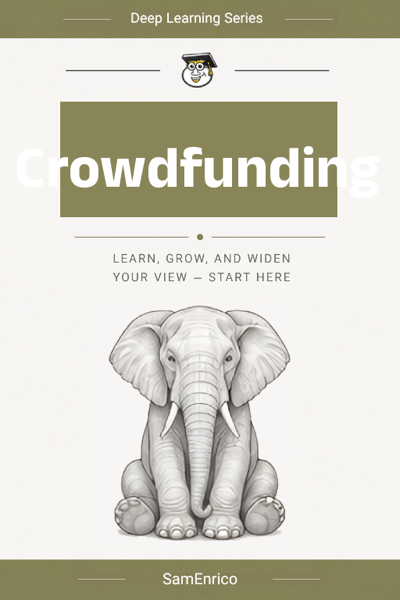
Non-FictionInformativeEducational
Crowdfunding eBook
A Coursebook on Crowdfunding
A Coursebook on Crowdfunding
Formats
Free sample
Chapter 1: The Mozart Precedent...--–- In 1785, Wolfgang Amadeus Mozart sat in a Viennese coffeehouse, surrounded by the smog of burning tallow candles and the murmur of aristocrats who had more money than taste. He had just completed three piano concertos—his Nos. 14, 15, and 16—and he faced a problem that would feel painfully familiar to any entrepreneur reading this book today. He needed cash to pay the copyists, rent the venue, and hire the orchestra. But the banks would not lend to a freelancer.
The nobility, his traditional patrons, were tightening their purse strings after the Austro-Turkish War. So Mozart did something radical. He published a subscription proposal. For a fee paid in advance, subscribers would receive a dedication in the printed score and priority seating at the premiere. Two hundred and thirty-nine years before Kickstarter launched, Mozart ran the first documented rewards-based crowdfunding campaign.The subscription list survives in the archives of the Gesellschaft der Musikfreunde in Vienna.
It contains 176 names. Subscribers paid between one and three ducats—roughly $150 to $450 in today's money—for the privilege of seeing their names printed next to "Allegro" and "Rondo." Mozart raised the equivalent of approximately $30,000. He delivered the concertos on time. And he never had to bow to a single patron who demanded changes to his music.This is the origin story that the technology press almost always gets wrong. They will tell you that crowdfunding began in 2000 with Artist Share, or in 2009 with Kickstarter, or that it is a product of the smartphone era.
They are mistaken. Crowdfunding is older than the United States Constitution. It is older than the concept of the limited liability corporation. It is, at its core, a very simple human technology: many people giving small amounts of money to a creator they trust, in exchange for something they value, without a bank standing in the middle.What has changed is not the psychology of the crowd. What has changed is the distribution channel.
Mozart had to stand in a coffeehouse and shake hands. You have the internet. But the underlying mechanics—the four distinct models of exchange, the mathematical threshold of 30 percent funding, the critical distinction between family money and stranger validation—these have remained remarkably stable for two and a half centuries. This chapter will teach you those mechanics. By the time you finish reading, you will understand why most campaigns fail, why the ones that succeed almost always follow the same trajectory, and why your grandmother's $100 donation is both essential and dangerous to your long-term success.The Four Pillars of Modern Crowdfunding Before you can choose a strategy, you must understand the landscape.
Every crowdfunding campaign in the world—from a neighborhood kid raising money for a new soccer uniform to a biotech startup raising $50 million for a clinical trial—falls into exactly one of four categories. These are not marketing distinctions. They are legal and financial distinctions. Confusing them is the fastest way to fail.Pillar One: Donation-Based Crowdfunding This is the simplest model. A creator asks for money.
A backer gives money. The backer receives nothing material in return except the warm feeling of having helped. There are no rewards, no equity, no loans, no interest payments. The transaction is a gift.Platforms like Go Fund Me and Give India dominate this space. The typical use cases are medical emergencies, funeral expenses, disaster relief, and charitable projects.
A family whose house burns down raises $50,000 from neighbors and strangers. A teacher raises $2,000 for classroom supplies. A community group raises $10,000 to plant trees in a park.The legal framework for donation-based crowdfunding is surprisingly light. In most jurisdictions, these funds are treated as tax-free gifts to individuals, but donations to registered nonprofits may be tax-deductible. However, there is a catch that destroys many campaigns: you must deliver what you promised.
If you promised to plant trees and you do not, you have committed fraud, even if no money changed hands in exchange for a physical product. The backer's expectation is the contract.Pillar Two: Rewards-Based Crowdfunding This is the model Mozart used. A backer gives money. In exchange, the creator promises to deliver a specific product, service, or experience at a future date. The reward might be a copy of the finished book, a signed poster, a dinner with the founder, or the right to name a character in the story.
The key word is "promise." The backer is not investing. The backer is pre-purchasing.Kickstarter, Indiegogo, and Crowdfunder are the dominant platforms. The typical use cases are physical products (smartwatches, board games, coolers), creative works (films, albums, books), and technology hardware. The global market for rewards-based crowdfunding exceeded $6 billion in 2023, with the average successful campaign raising approximately $25,000. However, the median successful campaign is much lower—around $10,000—because a small number of massive campaigns (like the Pebble Watch at $20 million or Brandon Sanderson's book campaign at $41 million) skew the average dramatically.The legal framework for rewards-based crowdfunding is consumer protection law.
You are selling a product before it exists. If you fail to deliver, backers can sue you for breach of contract. If you knowingly misrepresent the product, you have committed fraud. This is not theoretical. The Federal Trade Commission has brought enforcement actions against Kickstarter creators who spent campaign funds on personal expenses instead of manufacturing.Pillar Three: Lending-Based Crowdfunding (Peer-to-Peer Lending)In this model, a backer loans money to a creator.
The creator repays the principal plus interest over a fixed term. The backer is a creditor, not an owner. The creator retains full equity in their business.Platforms like Lending Club, Prosper, and Funding Circle dominate this space. The typical use cases are small business expansion, debt consolidation, real estate development, and personal loans. A restaurant owner borrows $50,000 to renovate her kitchen.
A farmer borrows $100,000 to buy a new tractor. A real estate developer borrows $500,000 to flip a house.The interest rates vary wildly based on risk. A borrower with excellent credit might pay 6 percent. A borrower with poor credit might pay 30 percent. The platforms assess risk using proprietary algorithms that consider credit scores, income, debt-to-income ratios, and business history.
The legal framework is standard lending law, including usury limits (maximum interest rates), truth-in-lending disclosures, and collection practices.Pillar Four: Equity-Based Crowdfunding This is the most complex and most regulated model. A backer gives money. In exchange, the creator issues shares of stock in the company. The backer becomes an owner. If the company succeeds, the backer's shares increase in value.
If the company fails, the backer loses everything.Platforms like Wefunder, Start Engine, and Republic dominate this space, but only in jurisdictions that have legalized equity crowdfunding. The United States did so through the JOBS Act of 2012, which created Regulation Crowdfunding (Reg CF). The European Union followed with the European Crowdfunding Service Provider Regulation (ECSP) in 2021. The typical use cases are high-growth startups (software, biotech, clean energy) and local businesses (breweries, bakeries, real estate).The legal framework is securities law. Issuers must file disclosure documents with regulators, including audited financial statements (for larger raises), risk factors, and use-of-proceeds statements.
Investors have caps on how much they can invest based on their income and net worth. The issuer must file annual…
This is the end of the free sample. Get the eBook to keep going. Buy now
About this book
Details
- Author
- Rosenbaum Kathline
- Publisher
- SamEnrico
- Language
- English
- Genre
- Non-Fiction, Informative, Educational
- Released
- 2026-06-03
- Pages (approx.)
- 159
- Available as
- eBook, Audiobook

Read better in the ZLOADR app
Your eBooks on your phone or tablet. Sign in with your SamEnrico account and start reading.
More by Rosenbaum Kathline
 Talent Migration Patterns for ExecutivesRosenbaum Kathline$11.99
 Gambling Addiction and DenialRosenbaum Kathline$11.99
 Blue Zones Moai FriendshipRosenbaum Kathline$11.99
 Asking for Help RecoveryRosenbaum Kathline$11.99
 The Foxy Knoxy Stereotype DeconstructionRosenbaum Kathline$11.99
 The Great Coffee Heist: How Starbucks Stole the World's BrewRosenbaum Kathline$11.99
 Real Estate Leasing Tech GuideRosenbaum Kathline$12.99
 One Page Seasonal Marketing GuideRosenbaum Kathline$12.99
 Understanding Leukemia, MyeloidRosenbaum Kathline$17.99
 A Beginners Guide to Egyptian stick fencing (Volume 1)Rosenbaum Kathline$11.99
You may also like
 Hong Kong Handover 1997Dunn Johnnie$11.99
 Zumba For Postnatal Recovery CourseNeal Christian$11.99
 Zumba for BeginnersLadner Nikia$11.99
 YouTube Comment Mining GuideHumes Pandora$12.99
 Worry Box MeditationCarlin Rudy$11.99
 Workplace Stress MeditationNguyen Lynn$11.99
 Workplace Stress and Sleep RepairHawley Ivory$11.99
 Workplace Perfectionism CureDelaney Jeffry$11.99
 Workplace Injustice Anger GuideWallen Isabelle$11.99
 Work Addiction and Burnout LinkGreenwood Ester$11.99
 Women in Yoga and WellnessBeattie Galina$11.99
 Women in Stand Up ComedyChun Evangeline$11.99