
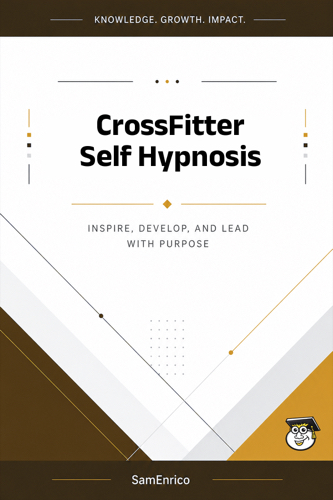
Non-FictionSelf-HelpCrossFit Psychology
CrossFitter Self Hypnosis eBook
Use trance to push through WOD pain and maintain t
Use trance to push through WOD pain and maintain technique under fatigue.
Formats
Free sample
Chapter 1: Why Grit Lies--–- The first time I watched a Cross Fitter quit mid-WOD, it wasn’t because her muscles failed. It was the moment her conscious mind betrayed her.She was fifteen seconds into a thirty-second sprint on the assault bike. Her face had shifted from focused to frantic. Her breathing went from controlled to chaotic. And then, with eight seconds still on the clock, she stopped pedaling entirely.
She didn’t collapse. She didn’t injure herself. She simply looked at the monitor, shook her head, and stepped off the bike.Afterward, she told me the same thing I’ve heard from hundreds of athletes since: “I just couldn’t take the burn anymore. My lungs were on fire. My legs were screaming.
I had nothing left.”But here’s the truth she didn’t know. And the truth that most Cross Fitters never learn.Her legs had plenty left. Her lungs were nowhere near their physiological limit. What actually stopped her wasn’t muscle failure or oxygen debt. It was something far more subtle, far more invisible, and far more powerful than any physical limitation.It was the voice inside her head that said, “This is too much.”And she believed it.The Mantra That’s Holding You Back Walk into any Cross Fit box on any given morning, and you’ll hear the same mantra repeated like a sacred prayer.
“Just grind harder.” “Push through the pain.” “Embrace the suck.” “Your mind quits before your body does.”These phrases have become the unofficial scripture of functional fitness. They’re printed on t-shirts. They’re shouted by coaches during the last minute of an AMRAP. They’re tattooed on the forearms of athletes who wear their suffering like a badge of honor.And they are, for the most part, wrong.Not because grit doesn’t matter. It does.
Not because mental toughness isn’t valuable. It absolutely is. But because the cultural obsession with “grinding harder” misunderstands the fundamental relationship between the conscious mind and the fatigued body. It assumes that more effort equals more output. It assumes that the voice telling you to stop is a weakness to be crushed.But what if that voice isn’t weakness?
What if it’s a misunderstood survival mechanism? And what if the solution isn’t more grit, but less conscious interference?This chapter will show you why the “grind harder” mentality is scientifically backward, how your conscious mind actually becomes a liability during high-intensity effort, and why the most elite Cross Fitters aren’t the ones who try the hardest—they’re the ones who try the least.The Neural Static Phenomenon To understand why grit fails, you first need to understand what happens inside your brain during a high-intensity Workout of the Day (WOD).Let’s use a classic example: the 21-15-9 couplet of thrusters and pull-ups. This is a workout that has ended more Cross Fit careers than any injury. Twenty-one thrusters. Twenty-one pull-ups.
Fifteen thrusters. Fifteen pull-ups. Nine and nine. The entire thing, if you’re fast, takes between six and ten minutes.Now, imagine you’re on rep twelve of the first set of thrusters. Your heart rate is hovering around 175 beats per minute.
Your breathing has shifted from nasal to mouth-breathing to full respiratory desperation. Your quads are sending urgent signals to your brain: “We are burning. This is not sustainable. Please stop.”What you’re experiencing is what I call neural static.Neural static is the overwhelming flood of interoceptive signals—internal body sensations—that bombards your conscious mind during intense exercise. These signals include:Heart rate acceleration – the pounding in your chest that feels like it might burst Respiratory distress – the “burning lungs” sensation that makes you feel like you’re suffocating Muscle acidosis – the deep, aching burn in your working muscles Thermal regulation signals – the sensation of overheating, of being cooked from the inside Proprioceptive degradation – the loss of coordination, the feeling that your body no longer obeys your commands In a resting state, your brain filters out most of these signals.
You don’t consciously feel your heartbeat. You don’t notice your diaphragm moving. But during a WOD, the volume on these signals gets turned up to maximum. And your conscious mind—the analytical, decision-making part of your brain located primarily in the prefrontal cortex—gets overwhelmed.Think of it like a radio station playing static at full volume. You can’t hear the music anymore.
You can’t think clearly. You can only hear noise.When neural static reaches a critical threshold, your brain makes a survival calculation. It asks a single question: “Is the body under threat?”And because the signals it’s receiving—burning, breathlessness, heat—are identical to the signals of actual physical danger (fire, drowning, overheating), your brain often answers “yes” even when no real threat exists. This triggers a cascade of stress responses: cortisol release, adrenaline spike, and—most importantly—a powerful subconscious command to stop moving.This is the quit. Not a failure of will.
A successful survival instinct.The tragedy is that your brain is trying to protect you from a threat that doesn’t exist. Your body is not in danger. You are not drowning. You are not on fire. You are simply exercising.
But your primitive survival circuitry doesn’t know the difference. And unless you train it otherwise, it will continue to pull the emergency brake every time the sensations become intense.The Critical Factor: Why Your Conscious Mind Is the Problem In hypnotherapy, there is a concept known as the Critical Factor. The Critical Factor is the part of your conscious mind that evaluates incoming information, compares it to past experiences, and decides whether to accept or reject it.Here’s how it works in everyday life: If someone tells you that you can fly by flapping your arms, your Critical Factor immediately rejects that suggestion. “That’s impossible,” your brain says. “Gravity exists.
I’ve never flown before. Rejected.”The Critical Factor is essential for survival. It keeps you from walking off cliffs or trusting strangers with knives. It is the gatekeeper of your subconscious, deciding which suggestions get through and which get blocked.But during a WOD, the Critical Factor becomes a liability.Here’s why.When neural static floods your conscious mind, your Critical Factor goes into overdrive. It starts evaluating every signal: “Burning lungs?
That means danger. Racing heart? That means danger. Muscle fatigue? That means stop.”But here’s the crucial distinction that most athletes never understand: The Critical Factor cannot distinguish between discomfort and danger.To your conscious mind, a heart rate of 190 beats per minute feels exactly the same whether you’re running a 400-meter sprint or having a heart attack.
The sensation is identical. The interpretation is what differs. And your Critical Factor, in the absence of training, will almost always default to the danger interpretation.This is why “just grind harder” fails. Because grinding harder means engaging your conscious mind more intensely. It means trying to override the Critical Factor with willpower.
And willpower is a finite resource that gets depleted rapidly under stress.Consider what happens when you try to force your…
This is the end of the free sample. Get the eBook to keep going. Buy now
About this book
Details
- Author
- Stephens Dennis
- Publisher
- SamEnrico
- Language
- English
- Genre
- Non-Fiction, Self-Help, CrossFit Psychology
- Released
- 2026-06-11
- Pages (approx.)
- 157
- Available as
- eBook, Audiobook

Read better in the ZLOADR app
Your eBooks on your phone or tablet. Sign in with your SamEnrico account and start reading.
More by Stephens Dennis
 Last Minute Cram GuideStephens Dennis$11.99
 The Uncle's Suicide PactStephens Dennis$11.99
 CPR for WarehousesStephens Dennis$11.99
 Failure Catastrophizing StopperStephens Dennis$11.99
 Shift Work Family CommunicationStephens Dennis$11.99
 Post Diet Metabolic RepairStephens Dennis$11.99
 Healthcare Difficult ConversationsStephens Dennis$11.99
 The Siege of Colchester: Cromwell's Bloody ReckoningStephens Dennis$11.99
 The Vanishing Masterpiece: How a Lost Rembrandt Resurfaced in a Small-Town AtticStephens Dennis$11.99
 Opium: Opium Poppy HarvestingStephens Dennis$11.99
 The Essential Guide to ChantStephens Dennis$11.99
 Alibaba Supplier Verification vs Amazon Transparency GuideStephens Dennis$12.99
You may also like
 Hong Kong Handover 1997Dunn Johnnie$11.99
 Zumba For Postnatal Recovery CourseNeal Christian$11.99
 Zumba for BeginnersLadner Nikia$11.99
 YouTube Comment Mining GuideHumes Pandora$12.99
 Worry Box MeditationCarlin Rudy$11.99
 Workplace Stress MeditationNguyen Lynn$11.99
 Workplace Stress and Sleep RepairHawley Ivory$11.99
 Workplace Perfectionism CureDelaney Jeffry$11.99
 Workplace Injustice Anger GuideWallen Isabelle$11.99
 Work Addiction and Burnout LinkGreenwood Ester$11.99
 Women in Yoga and WellnessBeattie Galina$11.99
 Women in Stand Up ComedyChun Evangeline$11.99