
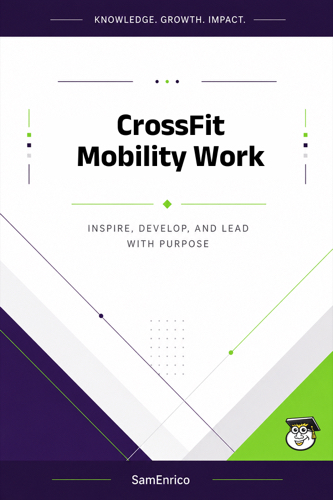
Non-FictionHealth & WellnessMobility
CrossFit Mobility Work eBook
Stretches and exercises to improve range of motion
by Canty Waylon
Stretches and exercises to improve range of motion for better performance.
Formats
Free sample
Chapter 1: The Five-Minute Lie--–- You have been lied to. Not by a malicious conspiracy or a secret society of stretching enthusiasts, but by a well-intentioned chorus of coaches, parents, and gym posters that has been singing the same wrong note for decades. The lie sounds simple, familiar, and almost comforting: You need to stretch before you work out. It arrives in the voice of your high school gym teacher who made everyone hold a toe touch for thirty seconds before dodgeball. It echoes from the pages of old fitness magazines that recommended "loosening up" with five minutes of passive hamstring pulls before lifting.
It whispers from your own memory every time you walk into the gym and automatically reach for your toes before the WOD.Here is the truth that changes everything: Performing prolonged static stretching immediately before high-intensity Cross Fit training does not prepare you. It weakens you.This chapter is not a gentle suggestion. It is a full-throated dismantling of one of the most persistent, damaging, and counterproductive habits in all of fitness. By the time you finish reading, you will understand exactly why your pre-WOD stretching routine has been quietly robbing you of power, stability, and performance. You will learn the critical difference between flexibility and mobility—a distinction that separates perpetually injured athletes from those who train for decades without breaking down.
And you will walk away with a complete, five-minute dynamic reset that will replace your old habits with something infinitely more effective.This is not theory. This is not opinion. This is the foundation upon which every subsequent chapter of this book is built. Get it wrong, and nothing else matters. Get it right, and everything changes.The Science of Self-Sabotage Let us begin with an experiment you can perform on yourself before your next training session.
No special equipment required. Just honesty.Day One: Arrive at the Box cold. Do not stretch. Do not roll. Go directly to an empty barbell and perform five squat cleans at moderate speed.
Pay close attention to how the barbell feels. Notice the pop at the top of your pull. Feel the stability in your shoulders as you receive the bar. Observe how connected your legs feel to the floor.Day Two: Arrive early. Spend five minutes performing your usual static stretching routine.
Hold each stretch for thirty to forty-five seconds. Really lean into those hamstring pulls, quad stretches, and pec openers. Feel the deep, satisfying sensation of your tissues lengthening. Then perform the same five squat cleans with the same empty barbell.If you are honest with yourself, you will notice something unsettling. The barbell feels heavier.
The pull feels slower. Your shoulders feel less stable—almost sloppy. Your legs feel less connected to the ground. You might even feel slightly more wobbly in the catch position.This is not in your head. This is physiology.
And it is costing you performance.Here is what happens inside your muscles during a prolonged static stretch. Your muscles contain tiny sensory receptors called muscle spindles that detect changes in length. When you stretch quickly or aggressively, these spindles fire a reflex that makes the muscle contract to protect itself—this is why bouncing into a stretch feels tight and uncomfortable. But when you hold a stretch for more than fifteen seconds, a different mechanism takes over. The Golgi tendon organ, located at the junction where your muscle meets your tendon, senses the sustained tension and actively inhibits the muscle's ability to contract.
This is called autogenic inhibition.That sounds helpful. It is not—not before heavy lifting or high-intensity interval training.Autogenic inhibition temporarily reduces muscle stiffness. Some stiffness is not your enemy. Some stiffness is essential. Your muscles and tendons function like elastic bands.
During the lowering phase of a squat, the descent of a thruster, or the countermovement before a box jump, your muscle-tendon unit stretches and stores elastic energy. That energy is then released during the upward or explosive phase, contributing to power output. The stiffer your muscle-tendon unit—within reason—the more elastic energy it can store and return.Static stretching before activity flattens that spring. You lose elastic recoil. You become less powerful.The research is consistent and damning.
A meta-analysis published in the Scandinavian Journal of Medicine & Science in Sports reviewed over two hundred studies and concluded that static stretching performed immediately before strength or power activities reduces maximal voluntary contraction by approximately five to eight percent. It impairs balance. It decreases vertical jump height by up to four percent. It slows sprint times over short distances. It reduces the rate of force development—meaning you cannot generate power as quickly.Let that land.
In a sport where a missed lift often comes down to a few pounds or a fraction of a second, voluntarily giving up five to eight percent of your power output is not preparation. It is sabotage.But wait, you might be thinking. Surely all that stretching reduces my risk of injury. I feel looser. Looser must mean safer.The evidence does not support you.
Multiple large-scale systematic reviews have found no meaningful reduction in injury risk from pre-activity static stretching. What reduces injury risk is being strong through a full range of motion—which is not the same as being passively flexible. What reduces injury risk is proper load management, adequate recovery, and movement competency. Holding a hamstring stretch for thirty seconds before a WOD accomplishes none of those things.Flexibility vs. Mobility: The Distinction That Changes Everything If static stretching before a WOD is the wrong tool, what is the right one?
To answer that question, we must first understand a distinction that most athletes never learn but that separates the perpetually injured from the perpetually performing.Flexibility is passive. It is the range of motion available at a joint when an external force moves the limb for you. Touching your toes while sitting on the floor with someone pushing on your back is flexibility. Having a coach lift your leg toward your head while you lie passive on a table is flexibility. Splitting on command is flexibility.
Flexibility requires no active control, no strength, no stability. It is something that happens to you.Mobility is active. It is the range of motion you can achieve and control under your own power, without external assistance. Performing a full-depth overhead squat with a barbell balanced above your head is mobility. Holding the bottom of a pistol squat while maintaining your balance is mobility.
Reaching both arms overhead while keeping your ribs down and your lower back neutral is mobility. Mobility requires strength, coordination, proprioception, and stability.Here is the key insight that unlocks everything else in this book: You can be highly flexible without being mobile. Competitive gymnasts and contortionists are often spectacularly flexible. But ask many of them to perform a heavy snatch through that same range of motion, and they will collapse like a house of cards. They have the range but not the control.
Conversely, you can be highly mobile without being extraordinarily flexible. Many elite Cross Fit athletes cannot do full splits or touch their palms to the floor, but they can…
This is the end of the free sample. Get the eBook to keep going. Buy now
About this book
Details
- Author
- Canty Waylon
- Publisher
- SamEnrico
- Language
- English
- Genre
- Non-Fiction, Health & Wellness, Mobility
- Released
- 2026-06-09
- Pages (approx.)
- 158
- Available as
- eBook, Audiobook

Read better in the ZLOADR app
Your eBooks on your phone or tablet. Sign in with your SamEnrico account and start reading.
More by Canty Waylon
 Napping for Cancer RecoveryCanty Waylon$11.99
 Returning To Work GriefCanty Waylon$11.99
 Pain Meditation QuizCanty Waylon$11.99
 Conversation Starters for Game NightsCanty Waylon$11.99
 The Surgery Morning WaitCanty Waylon$11.99
 Amazon Coupons and DealsCanty Waylon$11.99
 Tobacco Cessation For COPDCanty Waylon$11.99
 Boundary Setting For First RespondersCanty Waylon$11.99
 The Jet Age Heist: How a Rogue Pilot Stole a 747 and Changed Aviation Security ForeverCanty Waylon$11.99
 The Ghosts of Talavera: Wellington's Bloodied BaptismCanty Waylon$11.99
 Ironclad Duel: The CSS Virginia vs. USS Monitor - The First Clash of TitansCanty Waylon$11.99
 How to Become a Break-and-load OperatorCanty Waylon$11.99
You may also like
 Hong Kong Handover 1997Dunn Johnnie$11.99
 Zumba For Postnatal Recovery CourseNeal Christian$11.99
 Zumba for BeginnersLadner Nikia$11.99
 YouTube Comment Mining GuideHumes Pandora$12.99
 Worry Box MeditationCarlin Rudy$11.99
 Workplace Stress MeditationNguyen Lynn$11.99
 Workplace Stress and Sleep RepairHawley Ivory$11.99
 Workplace Perfectionism CureDelaney Jeffry$11.99
 Workplace Injustice Anger GuideWallen Isabelle$11.99
 Work Addiction and Burnout LinkGreenwood Ester$11.99
 Women in Yoga and WellnessBeattie Galina$11.99
 Women in Stand Up ComedyChun Evangeline$11.99