
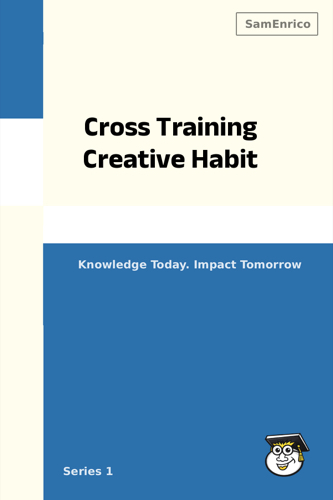
Non-FictionSelf-HelpCross Training
Cross Training Creative Habit eBook
Work in a different artistic medium daily to refre
by Hogue Nydia
Work in a different artistic medium daily to refresh your primary creative practice.
Formats
Free sample
Chapter 1: The Expertise Trap--The most dangerous moment in any creative career is the day you finally know what you are doing.It sounds like a paradox, because we spend years—sometimes decades—chasing competence. We take classes, practice scales, fill sketchbooks, revise manuscripts, and suffer through the humiliating early phase where everything we make is terrible. We dream of the day when skill becomes automatic, when the brush goes where we want it to go, when the sentence arrives already formed, when the fingers find the right chord without conscious thought. We imagine that fluency is freedom.And then we get there. And something strange happens.The work becomes easier, but it also becomes flatter.
The surprises stop coming. You find yourself making the same kinds of marks, writing the same kinds of sentences, solving problems with the same three solutions you have used for years. You are not stuck exactly—you are still producing, still meeting deadlines, still receiving praise—but there is a dullness underneath it all, a sense that you are performing rather than discovering. The electric uncertainty of the beginner has been replaced by the dead reliability of the expert.This is the expertise trap. And the first step toward escaping it is recognizing that your hard-won mastery is not your greatest asset.
It is your most dangerous blind spot.The Myelin Problem To understand why expertise calcifies creativity, we need to look inside the brain. Specifically, we need to understand a substance called myelin.Myelin is the fatty insulation that wraps around nerve fibers, and its job is to speed up neural transmission. Every time you repeat an action—playing a scale, drawing a circle, typing a common word—your brain lays down another layer of myelin along the pathways involved. The more you repeat, the thicker the insulation becomes. And the thicker the insulation, the faster and more efficient the signal.This is why practice works.
Myelination is the biological basis of skill acquisition. A beginner pianist struggles because the neural pathways from the visual cortex (reading the music) to the motor cortex (moving the fingers) are bare wires, slow and unreliable. After hundreds of hours of practice, those same pathways are thickly insulated, and the notes seem to play themselves. The pianist stops thinking about finger placement and starts thinking about expression. That is the gift of myelination.But myelin has a dark side.
The same insulation that makes you fast and reliable also makes you rigid. Once a pathway is heavily myelinated, your brain prefers it. It becomes the path of least resistance. When you encounter a creative problem, your brain automatically reaches for the well-insulated solution—the one you have used a thousand times before—rather than exploring new routes. You are not being lazy; you are being neurological.The f MRI evidence is striking.
Studies of expert musicians show that when they improvise within their familiar genre, their brains show efficient, focused activity in well-myelinated regions. But when they are asked to improvise in an unfamiliar style—a jazz pianist attempting Baroque ornamentation, for example—a completely different network lights up. The brain is literally working harder, forging new connections. And here is the crucial finding: the musicians who reported the most creative breakthroughs in their primary genre were the ones who regularly practiced unfamiliar styles. The discomfort of novelty was, paradoxically, the engine of their mastery.This is the central argument of this book: myelination giveth, and myelination taketh away.
Your expertise is real, and it is valuable. But it is also a cage. And the only way out is to deliberately, systematically, do things you are bad at.The Three Atrophied Muscles If expertise is the disease, what is the cure? The answer is cross-training, which we will explore in depth throughout this book. But before we can prescribe the remedy, we need a diagnosis.
Most creative people suffer from atrophy in one or more of three specific creative muscles. These muscles are not metaphorical; they are observable patterns of behavior that can be measured, strengthened, and restored.Muscle One: Divergent Thinking Divergent thinking is the ability to generate many possible solutions to an open-ended problem. It is the engine of brainstorming, the source of "what if" questions, the cognitive style that produces ten bad ideas in order to find one good one. Children are natural divergent thinkers; ask a five-year-old how many uses a brick has, and she will list twenty (a building block, a doorstop, a weapon, a paperweight, a stepstool, a sculpture, a heat sink, a toy for a giant, a message dropped from a high place). Ask an adult, and you will get three or four practical answers.Expertise kills divergent thinking because myelination favors convergent thinking—the ability to narrow down options and find the single correct solution.
Convergent thinking is essential for execution. You cannot paint a painting if you are still considering seventeen different color palettes. But when convergent thinking dominates, you stop generating possibilities altogether. You go with the first solution that occurs to you, because it is the most myelinated. The result is work that is technically competent but predictably dull.Signs of divergent thinking atrophy: You rarely brainstorm.
When you do, you run out of ideas after three or four. You find yourself dismissing ideas as "bad" before you have fully articulated them. You have not surprised yourself in months.Muscle Two: Risk-Taking Risk-taking is the willingness to attempt something that might fail—publicly, embarrassingly, catastrophically. It is the muscle that allows you to try a strange color combination, submit a weird story to a conservative journal, or show an unfinished work to a trusted friend. Risk-taking is not recklessness; it is calculated vulnerability, the understanding that safety and growth are opposites.Expertise kills risk-taking because experts have more to lose.
A beginner who makes a bad painting has lost nothing; she had no reputation to damage. A celebrated painter who makes a bad painting risks critical dismissal, lost sales, and a dent in her professional identity. The stakes are real. Over time, the expert learns to stay within the boundaries of what has worked before. The palette shrinks.
The subject matter narrows. The experiments become smaller and smaller until they disappear entirely.Signs of risk-taking atrophy: You find yourself thinking "that won't work" before trying it. You have a clear sense of your "style" and you protect it. You cannot remember the last time you made something that made you nervous to show someone. You have not been embarrassed by your own work in years.Muscle Three: Tolerant Editing Tolerant editing is the ability to delete, cut, or abandon something beautiful that does not serve the whole.
It sounds like a small skill, but it is perhaps the most psychologically difficult of the three. Tolerant editing requires you to recognize that your affection for a particular sentence, riff, or brushstroke is irrelevant to its function. It requires you to kill your darlings.Expertise kills tolerant editing because experts fall in love with their own cleverness. The guitarist who learned a difficult arpeggio wants to use it in every song. The writer who crafted a perfect metaphor cannot bear…
This is the end of the free sample. Get the eBook to keep going. Buy now
About this book
Details
- Author
- Hogue Nydia
- Publisher
- SamEnrico
- Language
- English
- Genre
- Non-Fiction, Self-Help, Cross Training
- Released
- 2026-06-08
- Pages (approx.)
- 139
- Available as
- eBook, Audiobook

Read better in the ZLOADR app
Your eBooks on your phone or tablet. Sign in with your SamEnrico account and start reading.
More by Hogue Nydia
 Step Twelve Carry MessageHogue Nydia$11.99
 The EQ for Firefighters GuideHogue Nydia$11.99
 Baal Shem Tov Mystical PathHogue Nydia$11.99
 Relationship Building for LandlordsHogue Nydia$11.99
 Comparison Trap at Work GuideHogue Nydia$11.99
 Choosing a ChiropractorHogue Nydia$11.99
 Stress Temperature RegulationHogue Nydia$11.99
 Self Hypnosis For CodependencyHogue Nydia$11.99
 The Djinn’s Double Game: A Spy Among SpiritsHogue Nydia$11.99
 The Hippocratic Code: Ancient Greece's Medical RevolutionHogue Nydia$11.99
 How to Start a Crispbread Business (Beginners Guide)Hogue Nydia$11.99
 Bootcamp Income Share AgreementsHogue Nydia$12.99
You may also like
 Hong Kong Handover 1997Dunn Johnnie$11.99
 Zumba For Postnatal Recovery CourseNeal Christian$11.99
 Zumba for BeginnersLadner Nikia$11.99
 YouTube Comment Mining GuideHumes Pandora$12.99
 Worry Box MeditationCarlin Rudy$11.99
 Workplace Stress MeditationNguyen Lynn$11.99
 Workplace Stress and Sleep RepairHawley Ivory$11.99
 Workplace Perfectionism CureDelaney Jeffry$11.99
 Workplace Injustice Anger GuideWallen Isabelle$11.99
 Work Addiction and Burnout LinkGreenwood Ester$11.99
 Women in Yoga and WellnessBeattie Galina$11.99
 Women in Stand Up ComedyChun Evangeline$11.99