
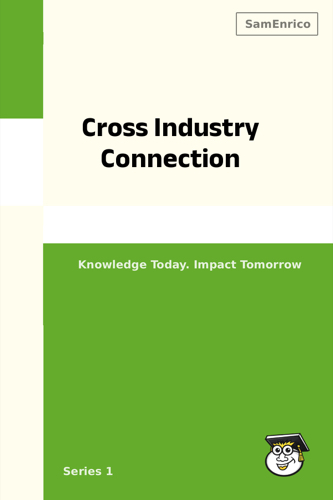
Cross Industry Connection eBook
Build relationships outside your field for fresh p
by Pak Candra
Build relationships outside your field for fresh perspectives and unexpected opportunities.
Formats
Free sample
Chapter 1: The Echo Chamber Trap--–- When did you last change your mind because of a conversation with someone in your exact role? Not because they presented a better argument, not because they had more data, but simply because their perspective was so different from yours that it forced a genuine reconsideration. If you are like most professionals, that moment is difficult to recall. More likely, your most recent mind-changing conversations happened with people who see the world very differently—perhaps a friend in a completely different industry, a family member with a different career path, or even a stranger at a social gathering who had nothing to do with your field. And that apparent contradiction is the first clue that your professional network may be systematically undermining your ability to innovate, adapt, and grow.This book is not about networking in the conventional sense.
It is not about collecting business cards, mastering the elevator pitch, or climbing the corporate ladder through strategic schmoozing. Those tactics have their place, but they are fundamentally about deepening connections within your existing world. Cross Industry Connection is about something far more radical and, as you will discover, far more valuable: building deliberate, strategic relationships with people who work in entirely different fields, face entirely different constraints, and think in entirely different patterns. The premise is simple but profound. The breakthroughs you are looking for—the solution to that persistent problem, the unexpected career opportunity, the innovation that will set you apart—already exist.
They just exist somewhere else. Your job is not to invent them from scratch. Your job is to find them, recognize them, and translate them into your context. And you cannot do that alone inside your bubble.The Most Dangerous Room in the World Imagine a conference room filled with twelve people. They are all smart, experienced, and well-intentioned.
They have worked in the same industry for an average of fifteen years each. They read the same trade journals, attend the same annual conferences, and share the same vocabulary. They finish each other's sentences. They nod in agreement. They make decisions efficiently because they all operate from the same unspoken assumptions.
This room, so comfortable and productive, is actually the most dangerous place in the business world.Psychologists call this phenomenon "Groupthink"—a pattern of thinking where the desire for harmony and conformity within a group overrides realistic appraisal of alternatives. First identified by Irving Janis in the 1970s, groupthink has been blamed for disasters ranging from the Bay of Pigs invasion to the Challenger space shuttle explosion. In each case, the warning signs were present, but the group's collective blindness—reinforced by shared assumptions and social pressure—prevented anyone from speaking up. The room felt safe. That was the problem.In a professional context, groupthink is not a dramatic explosion.
It is a slow erosion. It is the subtle way that your team's "best practices" become unexamined orthodoxies. It is the way that "that won't work here" becomes a full stop rather than an invitation to explore. It is the way that industry jargon, which started as useful shorthand, becomes a substitute for actual thinking. When everyone in the room speaks the same language, you stop translating.
When you stop translating, you stop questioning. When you stop questioning, you stop growing.Consider the story of Kodak. In 1975, a young engineer named Steve Sasson invented the first digital camera. It was a crude device—0.01 megapixels, a black-and-white image saved onto a cassette tape—but it worked. Sasson showed his invention to Kodak's leadership.
Their response, according to company lore, was polite but dismissive. "That's cute," they said, "but don't tell anyone about it." Why would they embrace a technology that threatened their core business of selling photographic film? The logic was impeccable from inside the bubble. From outside the bubble, it was catastrophic. By the time Kodak finally entered the digital market, it was too late.
The company filed for bankruptcy in 2012. The technology that killed it was invented by its own engineers, then buried by groupthink.Or take the taxi industry. For decades, taxi medallions in cities like New York were considered a rock-solid investment. The logic was simple: the number of medallions was capped by law, demand for rides would only increase, and therefore medallion prices would rise forever. This logic made perfect sense inside the taxi industry.
Everyone agreed. Then came Uber, a company founded by people who had never driven a taxi, never owned a medallion, and never operated under the assumption that the rules of the taxi industry were immutable. They saw a problem—expensive, unreliable transportation—and solved it using technology, not tradition. The taxi industry did not lose because it had bad drivers or old cars. It lost because it was thinking inside a bubble that no longer existed.The Adjacent Possible The concept that explains both Kodak's failure and Uber's success is something called the "Adjacent Possible." It was first introduced by biophysicist Stuart Kauffman to describe how new chemical combinations emerge in evolution, then popularized by innovation theorist Steven Johnson.
The adjacent possible is the set of all the things that are one step away from where you are right now. You cannot leap directly from a single-celled organism to a human being. But you can move from a single-celled organism to a simple multicellular cluster. That cluster opens up new possibilities that were not available before. Each step creates the conditions for the next step.In business and creativity, the adjacent possible works the same way.
Breakthroughs rarely come from pure invention. They come from combination—taking an idea that works in one context and applying it to another. Johannes Gutenberg did not invent movable type. He borrowed the screw press technology from wine-making and adapted it for printing. The Wright Brothers did not invent the internal combustion engine.
They borrowed lightweight engine technology from bicycle manufacturing and applied it to flight. Steve Jobs did not invent the graphical user interface. He saw it at Xerox PARC and, famously, "stole" it for the Macintosh.In every case, the innovator stood at the intersection of two or more fields. They saw what was possible because they had one foot in one world and one foot in another. The pure experts inside each field—the wine press makers, the bicycle mechanics, the Xerox engineers—did not see the breakthrough because they were too close to their own assumptions.
They were looking at the center of their field. The breakthrough was at the edge, where their field met another.This is the core insight of Cross Industry Connection: your next breakthrough is not hiding in the center of your industry. It is hiding at the intersection of your industry and someone else's. And the only way to see it is to build relationships with people who live in that other world.Three Warning Signs You Are Trapped in an Echo Chamber How do you know if you are suffering from groupthink? The bubble is notoriously invisible to those inside it.
Here are three warning signs to watch for in yourself and your team.The first warning sign is jargon as a substitute for thinking.…
This is the end of the free sample. Get the eBook to keep going. Buy now
About this book
Details
- Author
- Pak Candra
- Publisher
- SamEnrico
- Language
- English
- Genre
- Non-Fiction, Self-Help
- Released
- 2026-06-06
- Pages (approx.)
- 122
- Available as
- eBook, Audiobook

Read better in the ZLOADR app
Your eBooks on your phone or tablet. Sign in with your SamEnrico account and start reading.
More by Pak Candra
 Shift Work Smartphone ManagementPak Candra$11.99
 Heirs and Housing EquityPak Candra$11.99
 Body Image for Cleft Lip GuidePak Candra$11.99
 Method of Loci for Learning DisabilitiesPak Candra$11.99
 The Crimson Codex: Secrets of the Forbidden PalettePak Candra$11.99
 The Pacific Odyssey: Captain José Luis Diez and the First Spanish Circumnavigation in a CenturyPak Candra$11.99
 Understanding Exercise Induced AnaphylaxisPak Candra$17.99
 Night PhotographyPak Candra$11.99
 ToS Legal PrecedentsPak Candra$12.99
 One-Page Executive Summary BlueprintPak Candra$12.99
 How to Become a Mold PreparerPak Candra$11.99
You may also like
 Hong Kong Handover 1997Dunn Johnnie$11.99
 Zumba For Postnatal Recovery CourseNeal Christian$11.99
 Zumba for BeginnersLadner Nikia$11.99
 YouTube Comment Mining GuideHumes Pandora$12.99
 Worry Box MeditationCarlin Rudy$11.99
 Workplace Stress MeditationNguyen Lynn$11.99
 Workplace Stress and Sleep RepairHawley Ivory$11.99
 Workplace Perfectionism CureDelaney Jeffry$11.99
 Workplace Injustice Anger GuideWallen Isabelle$11.99
 Work Addiction and Burnout LinkGreenwood Ester$11.99
 Women in Yoga and WellnessBeattie Galina$11.99
 Women in Stand Up ComedyChun Evangeline$11.99