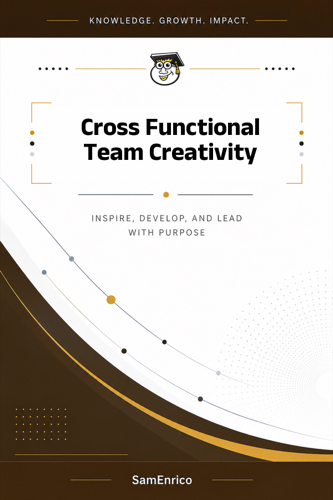
Cross Functional Teams eBook
Mix departments for varied expertise.
by Earl Coy
Mix departments for varied expertise.
Formats
Free sample
Chapter 1: The Department Store Lie--It was 3:47 PM on a Tuesday when the $47 million mistake became irreversible.The conference room at Nex Gen Dynamics held fourteen people—vice presidents of marketing, engineering, sales, legal, finance, and customer support—plus three empty chairs where the regulatory compliance manager had been sitting before she resigned in frustration six weeks earlier. The agenda item was simple: “Launch Decision – Q4 Product.” The debate had been raging for ninety-three minutes.Marketing wanted the launch date moved up by three weeks to beat a competitor to market. Engineering insisted the firmware wasn’t stable. Legal had discovered a potential patent infringement that no one had time to investigate. Sales demanded exclusive features that would require rewriting the user manual.
Finance had frozen all overtime budgets. Customer support, invited at the last minute, kept asking basic questions about how the product actually worked, which no one could answer.No one was listening to anyone.The VP of Marketing, a charismatic former brand manager named Diane, made her final plea: “We either launch on November 1st, or we lose Christmas. You all know what that means.” The VP of Engineering, a methodical software architect named Raj, shook his head. “You’re asking us to ship a product that crashes 40% of the time. I will not put my name on that.” The VP of Legal, who had been silent for most of the meeting, finally spoke: “The patent issue alone gives our competitors grounds for an injunction.
We launch on November 1st, and we could be legally blocked from selling by November 15th.”Diane turned to the CEO, who had been watching like a tennis spectator. “We need a decision,” she said.The CEO made one. “We launch November 1st. Engineering works weekends. Legal files a protective petition.
Sales, you get your features in version 2.0. Meeting adjourned.”The product launched on November 1st. It crashed 40% of the time. A competitor filed an injunction on November 12th. The product was pulled from shelves on November 18th.
Returns cost $12 million. Lost customer goodwill cost an estimated $35 million more. The CEO was fired within six months. Diane was promoted—to a different company. Raj quit.
The regulatory compliance manager’s replacement was hired at double her old salary, but the damage was done.Every single person in that room had the same data. Every single person wanted the company to succeed. Every single person made rational decisions based on the incentives and information available to their department. And together, they destroyed a product, a quarter, and a career.This is the Department Store Lie.The Lie You’ve Been Told About How Work Gets Done The Department Store Lie is the deeply embedded, rarely questioned assumption that organizations work best when they are organized like a department store: distinct floors, separate escalators, different return policies, and a clear boundary between where one department ends and another begins. Marketing stays on the third floor.
Engineering lives in the basement. Sales roams the ground floor. Customer support is in the back, visible only when something goes wrong.This model was invented in the 1920s by Alfred Sloan at General Motors, refined by management consultants throughout the mid-century, and codified into every MBA program on the planet. It is called functional organization—grouping people by what they know rather than by what they need to achieve. And for most of the twentieth century, it worked beautifully.
When markets were stable, product cycles lasted years, and customer expectations were predictable, the department store model delivered efficiency, clarity, and economies of scale.But here is the lie: the department store model assumes that the most important work happens inside departments, with only occasional handoffs between them. In the 1920s, that was true. A car company could spend two years engineering a new model, then hand it to manufacturing, then hand it to sales, then hand it to service, and each department could work independently without much coordination because the timeline was measured in years, not weeks.Today, that assumption is fatal.Consider the following: the average product development cycle in 1990 was thirty-six months. In 2000, it was eighteen months. In 2010, it was twelve months.
In 2023, in industries like software and consumer electronics, it is often three to six months. When cycles compress from years to months, the handoff model breaks. There is no time for sequential work. There is no buffer for miscommunication. There is no room for “that’s not my job.”The Department Store Lie persists because it feels safe.
It gives everyone a clear role. It protects managers from ambiguity. It makes performance reviews easy—you grade people on their individual contribution to their department’s metrics. But safety is not the same as effectiveness. Clarity is not the same as correctness.
And the cost of the Department Store Lie is measured in failed launches, burned-out employees, and $47 million mistakes.What This Book Is—And What It Is Not This book is an operating manual for a fundamentally different way of organizing work. It is called cross-functional teams—groups of people from different departments who share a single goal, make decisions together, and succeed or fail as a unit.Cross-functional teams are not a new idea. They have existed in various forms for decades, most famously in product development at Toyota, aerospace engineering at NASA, and software development in the Agile movement. But what is new is the necessity of cross-functional teams. They are no longer a niche practice for R&D projects or emergency task forces.
They are becoming the default operating model for any organization that needs to move quickly, adapt constantly, and solve problems that no single department can solve alone.Before we go further, let me be clear about what this book is not.This is not a book about “teamwork.” Teamwork is the ability to get along with your colleagues. It is a baseline skill, like being able to use email or show up on time. Cross-functional collaboration is harder than teamwork because it requires you to work effectively with people whose incentives, language, and worldview are actively working against alignment. You can have excellent teamwork skills and still fail at cross-functional work because the problem is not your personality—it is the structure.This is not a book about “breaking down silos” as a metaphor. Silos are not just attitudes.
They are real structures: different budgets, different promotion criteria, different software systems, different physical locations, different bosses. You cannot “break down” a silo with a trust fall or a team lunch. You can only redesign the incentives and accountabilities that hold silos in place.This is not a book about “getting everyone in a room and hoping for the best.” That is called a meeting. Meetings are where cross-functional work goes to die. This book provides specific, repeatable protocols for decision-making, conflict resolution, recruitment, performance evaluation, compensation, and learning.
If you are looking for inspiration, this is the wrong book. If you are looking for tools, you are in the right place.This is not a book that pretends cross-functional teams are easy. They are not. They are slower than functional teams in the short term and faster in the long…
This is the end of the free sample. Get the eBook to keep going. Buy now
About this book
Details
- Author
- Earl Coy
- Publisher
- SamEnrico
- Language
- English
- Genre
- Non-Fiction, Self-Help, Cross Functional
- Released
- 2026-06-07
- Pages (approx.)
- 155
- Available as
- eBook, Audiobook

Read better in the ZLOADR app
Your eBooks on your phone or tablet. Sign in with your SamEnrico account and start reading.
More by Earl Coy
 Senior Home Safety ConfidenceEarl Coy$11.99
 Design Thinking for Account ManagementEarl Coy$11.99
 Adaptive ThermogenesisEarl Coy$11.99
 The Step Ten Daily ReviewEarl Coy$11.99
 Shift Work Weight Gain GuideEarl Coy$11.99
 Mediterranean LongevityEarl Coy$11.99
 Handling Nicotine Withdrawal SymptomsEarl Coy$11.99
 The Battle of Ipsus: The End of Alexander's DreamEarl Coy$11.99
 The Shanghai Opium Vault Heist: A 19th-Century Crime Unraveled by DNAEarl Coy$11.99
 How to Produce TouchpadsEarl Coy$11.99
 How to Become a Powerhouse HelperEarl Coy$11.99
 Portfolio Career Building GuideEarl Coy$12.99