
Non-FictionSelf-HelpOrganizational Behavior
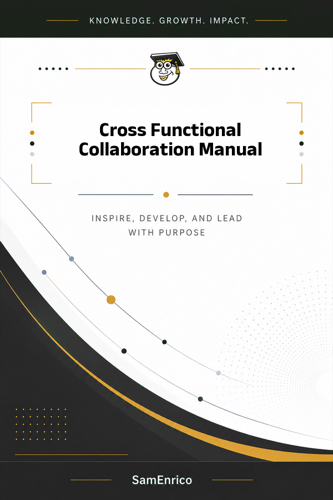
Cross Functional Collaboration Manual eBook
Bridges departmental silos to spark creative solut
Bridges departmental silos to spark creative solutions through diverse expertise.
Formats
Free sample
Chapter 1: The Language Trap...--–- The meeting was scheduled for ninety minutes. It ran for three hours. Seventeen people sat around a polished conference table, each representing a different department. Marketing had brought slide decks. Engineering had brought spreadsheets.
Sales had brought quotas. Legal had brought red pens. And when the meeting finally ended, no one could agree on what had been decided.The problem was not that these people were difficult, stubborn, or incompetent. The problem was that they were all speaking English, and none of them were speaking the same language.This is the opening scene of every failed cross-functional collaboration. It plays out thousands of times every day in offices around the world.
A project kicks off with high hopes. Leaders declare that "silos must be broken." Someone schedules a kickoff meeting. And then the slow, grinding, expensive machinery of misunderstanding begins to turn.By the time the project crashes—late, over budget, or simply abandoned—everyone blames everyone else. Marketing says Engineering didn't understand the customer. Engineering says Marketing made impossible promises.
Sales says Product didn't deliver. Product says Sales overcommitted. Legal says everyone is reckless. Finance says everyone is wasting money.The autopsy reveals nothing useful because the autopsy is conducted using the same broken language that caused the crash in the first place.This book exists because that pattern is not inevitable. It is not a law of nature that different departments cannot work together.
The problem has a name, a structure, and a solution. The name is the Language Trap. The structure is the collision of cognitive and political silos. The solution is a systematic method for translating expertise into shared understanding—not by eliminating differences, but by leveraging them.But before we can build the solution, we have to understand the trap. And to understand the trap, we have to begin with a deceptively simple question: why does collaboration fail?The Most Dangerous Sentence in Business There is a sentence that gets spoken in every organization, usually by a well-intentioned leader, that sounds like progress but is actually the beginning of disaster.
The sentence is: "Let's get everyone in a room and talk it through."On its face, this seems reasonable. Communication solves problems. If people are not aligned, they should talk more. If they disagree, they should talk until they agree. If they misunderstand each other, they should talk until they understand.This is wrong.
Not slightly wrong. Fundamentally, structurally, dangerously wrong.The assumption behind "let's talk it through" is that misunderstanding is a function of insufficient information. If two people disagree, the theory goes, it is because one of them lacks a piece of data that the other possesses. Give them both the same data, and they will reach the same conclusion.But cross-functional disagreement is almost never about missing data. It is about different interpretations of the same data.
It is about different mental models, different incentives, and different vocabularies that attach different meanings to the same words.Consider a simple example. A product manager and a quality assurance lead are looking at the same piece of software. The product manager says, "This is ready to ship." The QA lead says, "This is not ready to ship." They have identical data. They are looking at the same screen. They disagree not because one knows something the other doesn't, but because they are using different definitions of the word "ready."To the product manager, "ready" means "good enough to satisfy enough customers to hit our revenue target." To the QA lead, "ready" means "no known bugs that could cause a failure rate above 0.01 percent." These are not the same thing.
They are not even close to the same thing. And no amount of "talking it through" will resolve the disagreement unless both parties first acknowledge that they are using the same word to mean two different things.This is the Language Trap. It is the fundamental barrier to cross-functional collaboration. And it is invisible to the people who are trapped inside it.The Anatomy of a Silo: Cognitive and Political To escape the Language Trap, we have to understand what a silo actually is. Most people think of silos as organizational boxes on a chart.
Marketing is in one box. Engineering is in another box. Finance is in a third box. The solution, according to this view, is to draw new boxes or remove the lines between the old ones.This is a category error. Silos are not physical structures.
You cannot remove them by redrawing an org chart. Silos are cognitive and political structures. They exist inside people's heads and in the incentive systems that govern their behavior.Cognitive Silos: The Maps in Our Heads Every department develops a distinct mental model—an unspoken framework for how the world works, what problems matter, and what solutions look like. These mental models are not arbitrary. They are the product of training, experience, and the specific demands of the job.A marketer's mental model is built around narrative, emotion, and perception.
The marketer asks: What story will resonate with our audience? How will people feel when they see this? What will they tell their friends? The marketer's world is made of stories, symbols, and social proof.An engineer's mental model is built around constraints, tolerances, and reproducibility. The engineer asks: Can we build this within our existing systems?
What are the failure modes? How do we test whether it works? The engineer's world is made of specifications, trade-offs, and verifiable facts.A finance professional's mental model is built around risk, return, and opportunity cost. The finance person asks: What is the expected value of this investment? What is the probability of downside?
What else could we do with this money? The finance person's world is made of spreadsheets, discount rates, and probabilistic outcomes.A legal professional's mental model is built around liability, compliance, and precedent. The legal person asks: What could go wrong that would result in a lawsuit? Has a similar arrangement been challenged before? How do we document consent?
The legal person's world is made of clauses, jurisdictions, and worst-case scenarios.None of these mental models is wrong. They are all correct within their own domains. The problem is that they are incompatible. When a marketer says "this is a great idea," they mean something different from what an engineer means by "this is a great idea." The marketer means "people will love it." The engineer means "we can build it reliably." Neither statement refutes the other. But they are often treated as if they are in competition.This is the cognitive dimension of the Language Trap.
It operates below the level of conscious awareness. People do not know that they are interpreting words differently. They assume that everyone shares their mental model. And when someone disagrees, they assume the other person is either stupid or malicious.Political Silos: The Incentives That Shape Behavior Cognitive silos would be difficult enough to manage on their own. But they are reinforced and amplified by political silos—the formal and informal incentive systems that reward departments for optimizing their own metrics, even when that optimization harms the organization as a whole.Every department has…
This is the end of the free sample. Get the eBook to keep going. Buy now
About this book
Details
- Author
- Cabrera Maile
- Publisher
- SamEnrico
- Language
- English
- Genre
- Non-Fiction, Self-Help, Organizational Behavior
- Released
- 2026-06-07
- Pages (approx.)
- 154
- Available as
- eBook, Audiobook

Read better in the ZLOADR app
Your eBooks on your phone or tablet. Sign in with your SamEnrico account and start reading.
More by Cabrera Maile
 The Sleep Sack vs Blanket GuideCabrera Maile$11.99
 German Skilled Labor ShortageCabrera Maile$11.99
 Fake Door Testing TechniqueCabrera Maile$12.99
 Workplace Stress Reduction for Night ShiftCabrera Maile$11.99
 Calisthenics Male Physique GuideCabrera Maile$11.99
 The Last Dance: The Untold Story of the 1998 Chicago Bulls' Final Trade DeadlineCabrera Maile$11.99
 Codex Reborn: The AI That Rewrote HistoryCabrera Maile$11.99
 How to Become a Cable MaintainerCabrera Maile$11.99
 Logo Design in One DayCabrera Maile$12.99Fake Door Testing TechniqueCabrera Maile$12.99
 Understanding Chromosome 3Cabrera Maile$17.99
 Installation EngineerCabrera Maile$11.99
You may also like
 Hong Kong Handover 1997Dunn Johnnie$11.99
 Zumba For Postnatal Recovery CourseNeal Christian$11.99
 Zumba for BeginnersLadner Nikia$11.99
 YouTube Comment Mining GuideHumes Pandora$12.99
 Worry Box MeditationCarlin Rudy$11.99
 Workplace Stress MeditationNguyen Lynn$11.99
 Workplace Stress and Sleep RepairHawley Ivory$11.99
 Workplace Perfectionism CureDelaney Jeffry$11.99
 Workplace Injustice Anger GuideWallen Isabelle$11.99
 Work Addiction and Burnout LinkGreenwood Ester$11.99
 Women in Yoga and WellnessBeattie Galina$11.99
 Women in Stand Up ComedyChun Evangeline$11.99